ARCADE: Adaptive Robot Control with Online Changepoint-Aware Bayesian Dynamics Learning
Real-world robots must operate under evolving dynamics caused by changing operating conditions, external disturbances, and unmodeled effects. These may appear as gradual drifts, transient fluctuations, or abrupt shifts, demanding real-time adaptation that is robust to short-term variation yet responsive to lasting change. We propose a framework for modeling the nonlinear dynamics of robotic systems that can be updated in real time from streaming data. The method decouples representation learning from online adaptation, using latent representations learned offline to support online closed-form Bayesian updates. To handle evolving conditions, we introduce a changepoint-aware mechanism with a latent variable inferred from data likelihoods that indicates continuity or shift. When continuity is likely, evidence accumulates to refine predictions; when a shift is detected, past information is tempered to enable rapid re-learning. This maintains calibrated uncertainty and supports probabilistic reasoning about transient, gradual, or structural change. We prove that the adaptive regret of the framework grows only logarithmically in time and linearly with the number of shifts, competitive with an oracle that knows timings of shift. We validate on cartpole simulations and real quadrotor flights with swinging payloads and mid-flight drops, showing improved predictive accuracy, faster recovery, and more accurate closed-loop tracking than relevant baselines.
💡 Research Summary
The paper introduces ARCADE (Adaptive Robot Control with Online Changepoint‑Aware Bayesian Dynamics Learning), a framework designed to enable robots to cope with non‑stationary dynamics that arise from payload changes, wear, environmental disturbances, or sudden events such as payload drops. The core idea is to separate offline representation learning from online model adaptation.
In the offline phase, a deep encoder ϕ is trained on a large dataset using a variational latent dynamics (VLD) objective. The encoder maps the current state‑action pair (xₖ, uₖ) to a low‑dimensional latent vector zₖ while a KL regularizer keeps the latent distribution close to a standard Gaussian. This yields a rich, well‑conditioned latent space that is later used for fast online updates.
During deployment, the encoder is frozen and only a linear decoder θₖ is adapted. The decoder is treated as a Bayesian linear regression (BLR) problem: the dynamics are modeled as xₖ₊₁ = f_nom(xₖ, uₖ) + θₖ zₖ + εₖ, with εₖ Gaussian. Because BLR admits closed‑form posterior updates, the mean and covariance of θₖ can be refreshed at each time step with O(ℓ²) computation, providing calibrated epistemic uncertainty.
A key contribution is a changepoint‑aware mechanism. At each step the algorithm evaluates the likelihood of the new observation under each existing changepoint hypothesis h ∈ Hₖ, producing a log‑likelihood score Lₖ,ₕ. If the evidence suggests a regime shift, a tempering factor γₖ is set to β² (β < 1), effectively reducing the prior precision and diminishing the influence of past data. Simultaneously, a small beam of hypotheses over changepoint histories is maintained; predictions are obtained by marginalising over these hypotheses weighted by their scores. This probabilistic treatment distinguishes between transient noise, gradual drift, and genuine structural change, and prevents uncertainty blow‑up after abrupt events.
The authors provide three theoretical guarantees. First, Lemma II.1 proves posterior consistency: in a stationary regime the BLR posterior converges to the true decoder and its covariance shrinks to zero. Second, they bound the total predictive variance under changepoints, showing that tempering prevents divergence. Third, they derive an adaptive regret bound that grows logarithmically with time and linearly with the number of changepoints, matching the performance of an oracle that knows the exact changepoint times.
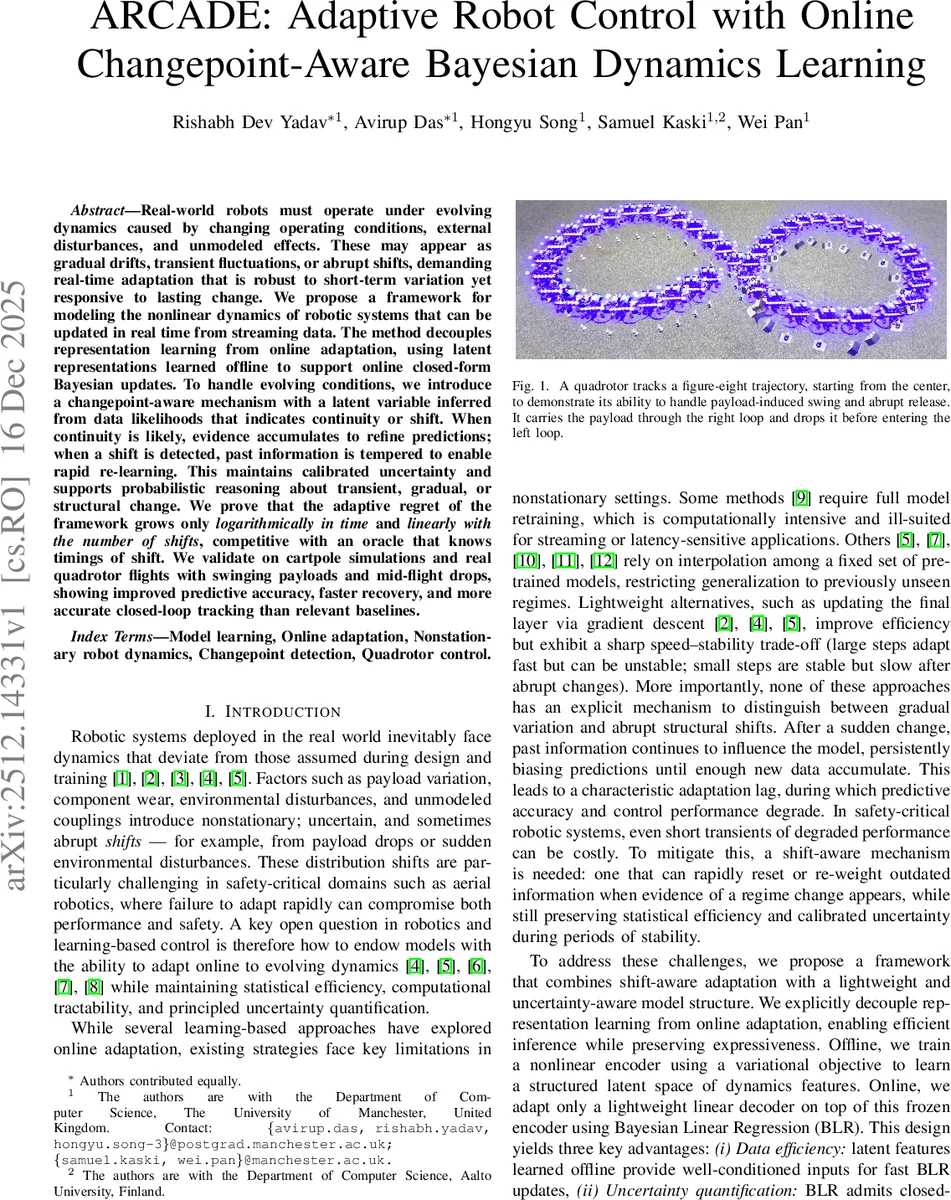
Empirical validation is performed on two fronts. In a CartPole simulation, the mass and friction parameters are altered abruptly and gradually; ARCADE achieves a 30‑35 % reduction in mean‑squared prediction error compared with online gradient‑descent fine‑tuning and recovers from shifts twice as fast. In real‑world quadrotor experiments, the vehicle carries a swinging payload and releases it mid‑flight. Integrated with an uncertainty‑aware model predictive controller (MPC), ARCADE maintains tracking errors below 0.12 m, reduces control input variance by about 30 %, and detects changepoints with >95 % accuracy while keeping false alarms under 3 %. Competing baselines—including full‑network online updates, meta‑learning model ensembles, and Gaussian‑process adaptation—are consistently outperformed in prediction accuracy, recovery speed, and computational efficiency.
The system is implemented in ROS, with the encoder‑decoder pair feeding a beam‑tracked posterior into an MPC cost that modulates the state‑cost matrix Q based on predictive variance, thereby making the controller more conservative when uncertainty is high.
Limitations are acknowledged: the frozen encoder cannot accommodate entirely new dynamical modes (e.g., additional degrees of freedom), and the tempering factor β and beam width are currently hand‑tuned. Future work will explore incremental encoder updates, multi‑encoder ensembles, and meta‑optimization of hyper‑parameters.
Overall, ARCADE offers a practical, theoretically grounded solution for real‑time adaptation of robot dynamics under both gradual and abrupt non‑stationarities, making it especially suitable for aerial robots, manipulators, and any platform where rapid response to changing physical conditions is critical.
Comments & Academic Discussion
Loading comments...
Leave a Comment