Exploring Logistic Functions as Robust Alternatives to Hill Functions in Genetic Network Modeling
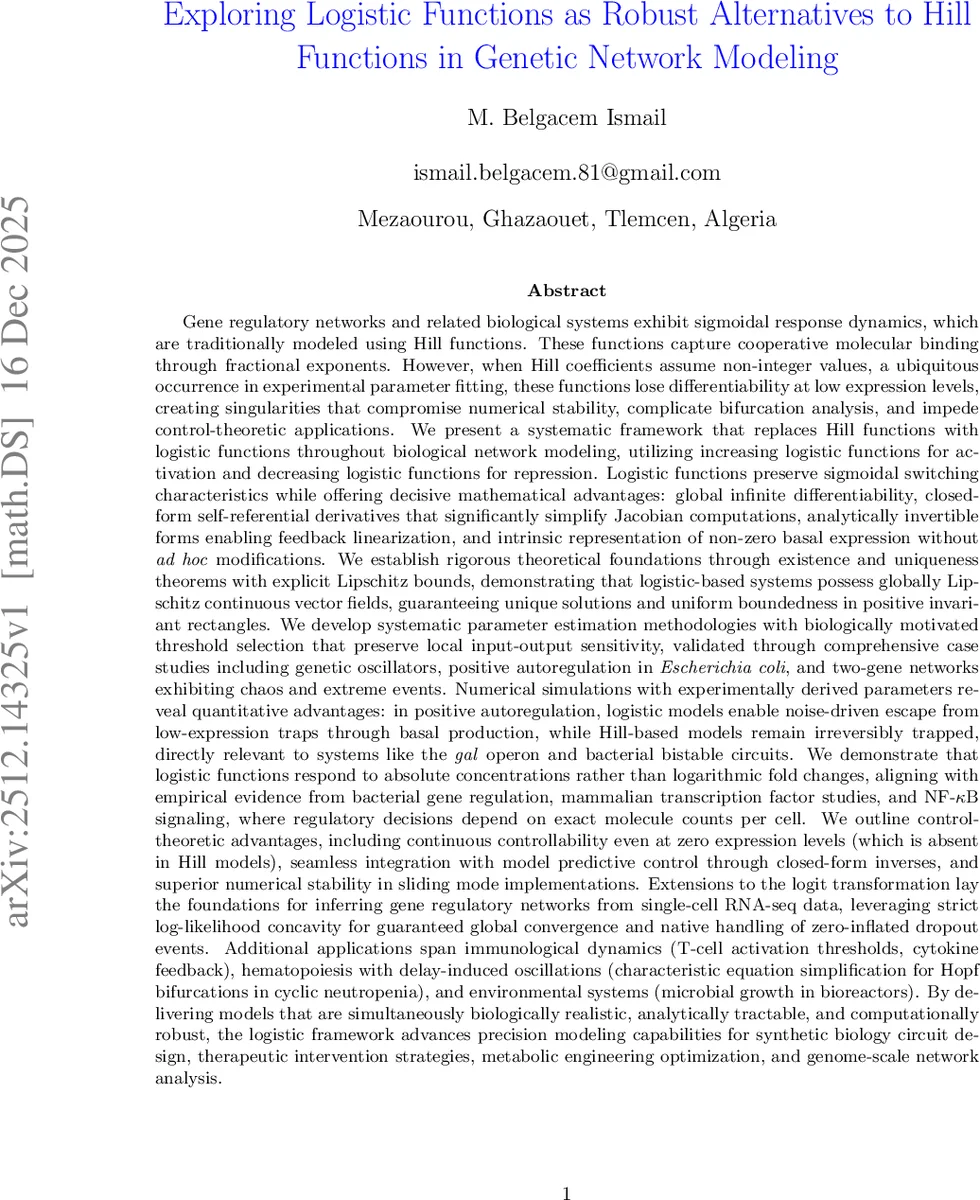
Gene regulatory networks exhibit sigmoidal dynamics traditionally modeled using Hill functions. When Hill coefficients are non-integer values–ubiquitous in experimental fitting–these functions lose differentiability at low expression, creating singularities that compromise numerical stability and impede control applications. We present a systematic framework replacing Hill functions with logistic functions: increasing for activation, decreasing for repression. Logistic functions preserve sigmoidal characteristics while offering key advantages: infinite differentiability, closed-form derivatives simplifying Jacobians, invertible forms enabling feedback linearization, and built-in basal expression. We prove existence and uniqueness with explicit Lipschitz bounds, guaranteeing unique solutions and boundedness. Parameter estimation with biologically motivated thresholds demonstrated in case studies: genetic oscillators, positive autoregulation in E. coli, two-gene chaotic networks. Simulations with experimental parameters show: logistic models allow noise escape from low-expression traps via basal, while Hill models trap irreversibly–relevant to gal operon and bistables. Logistic functions respond to absolute concentrations rather than logarithmic fold changes, aligning with molecule count-based decisions. Control advantages: controllability at zero (missing in Hill), seamless MPC integration, superior stability. Logit extensions enable network inference from scRNA-seq data, using concavity for convergence and handling dropouts. Applications: immunology, hematopoiesis with delays, environmental systems. The framework advances modeling for synthetic biology, therapeutic interventions, metabolic engineering, and genome-scale analysis.
💡 Research Summary
The paper addresses a fundamental limitation of the widely used Hill function in gene regulatory network (GRN) modeling: when the Hill coefficient n is non‑integer—a common outcome of experimental fitting—the term (x^{n}) becomes non‑differentiable at low expression levels, leading to singularities, numerical instability, and difficulties in bifurcation analysis and control design. To overcome these issues, the authors propose a systematic replacement of both activating and repressing Hill functions with logistic functions. For activation they use an increasing logistic form
(f_{\text{act}}(x)=\frac{L}{1+e^{-\lambda (x-\theta)}})
and for repression a decreasing form
(f_{\text{rep}}(x)=\frac{L}{1+e^{\lambda (x-\theta)}}).
Here L is the maximal expression, λ controls steepness, and θ is the threshold concentration. Logistic functions are globally (C^{\infty}); their first and higher‑order derivatives have simple closed‑form expressions, which dramatically simplifies Jacobian and Hessian calculations required for stability analysis and model‑based control (MPC, LQR, sliding‑mode, etc.). Moreover, the inverse logistic (logit) is analytically available, enabling exact feedback linearization and observer design.
Mathematically, the paper proves that systems built from these logistic nonlinearities are globally Lipschitz continuous. By bounding the derivative as (| \nabla f| \le L\lambda/4), explicit Lipschitz constants are derived, guaranteeing existence and uniqueness of solutions via the Picard–Lindelöf theorem and ensuring that trajectories remain bounded within biologically relevant positive orthants.
Parameter estimation is streamlined because the logistic curve can be linearized in log‑odds space, allowing standard linear regression or regularized elastic‑net approaches to estimate θ and λ from dose‑response data. The authors highlight that the log‑likelihood for logistic regression is strictly concave, providing a unique global optimum even for highly sparse single‑cell RNA‑seq data with zero‑inflated dropouts.
Three case studies illustrate the practical benefits: (1) a synthetic genetic oscillator, where the logistic model reproduces the same period and amplitude as the Hill‑based model but with far superior numerical stability; (2) a positive autoregulatory circuit in E. coli, where Hill models trap the system in a low‑expression “dead‑end” under noise, while the logistic model’s built‑in basal expression enables stochastic escape, matching observed behavior of the gal operon; (3) a two‑gene chaotic network, where the smooth Jacobian from logistic functions allows accurate Lyapunov exponent computation and reliable exploration of chaotic regimes.
From a control‑theoretic perspective, the logistic formulation retains controllability at zero expression—a property lost with Hill functions—making it possible to design linear‑quadratic regulators or model‑predictive controllers without artificial regularization. The existence of a closed‑form inverse also simplifies the construction of state observers and sliding‑mode surfaces, reducing chattering and improving robustness.
Finally, the paper extends the framework to network inference. By employing the logit transformation, logistic regression with elastic‑net regularization can be applied to high‑dimensional scRNA‑seq datasets, handling dropout events naturally and guaranteeing convergence to a unique solution. This opens a pathway for genome‑scale GRN reconstruction that is both statistically sound and biologically interpretable.
In summary, logistic functions provide a mathematically rigorous, numerically stable, and biologically realistic alternative to Hill functions. They preserve the sigmoidal response and cooperative behavior while eliminating non‑integer exponent singularities, offering closed‑form derivatives and inverses, facilitating parameter estimation, enabling robust control design, and supporting large‑scale network inference. The framework promises immediate impact across synthetic biology circuit design, metabolic engineering optimization, therapeutic gene‑network modeling, and systems biology research.
Comments & Academic Discussion
Loading comments...
Leave a Comment