Absolute incidence theorems and tilings
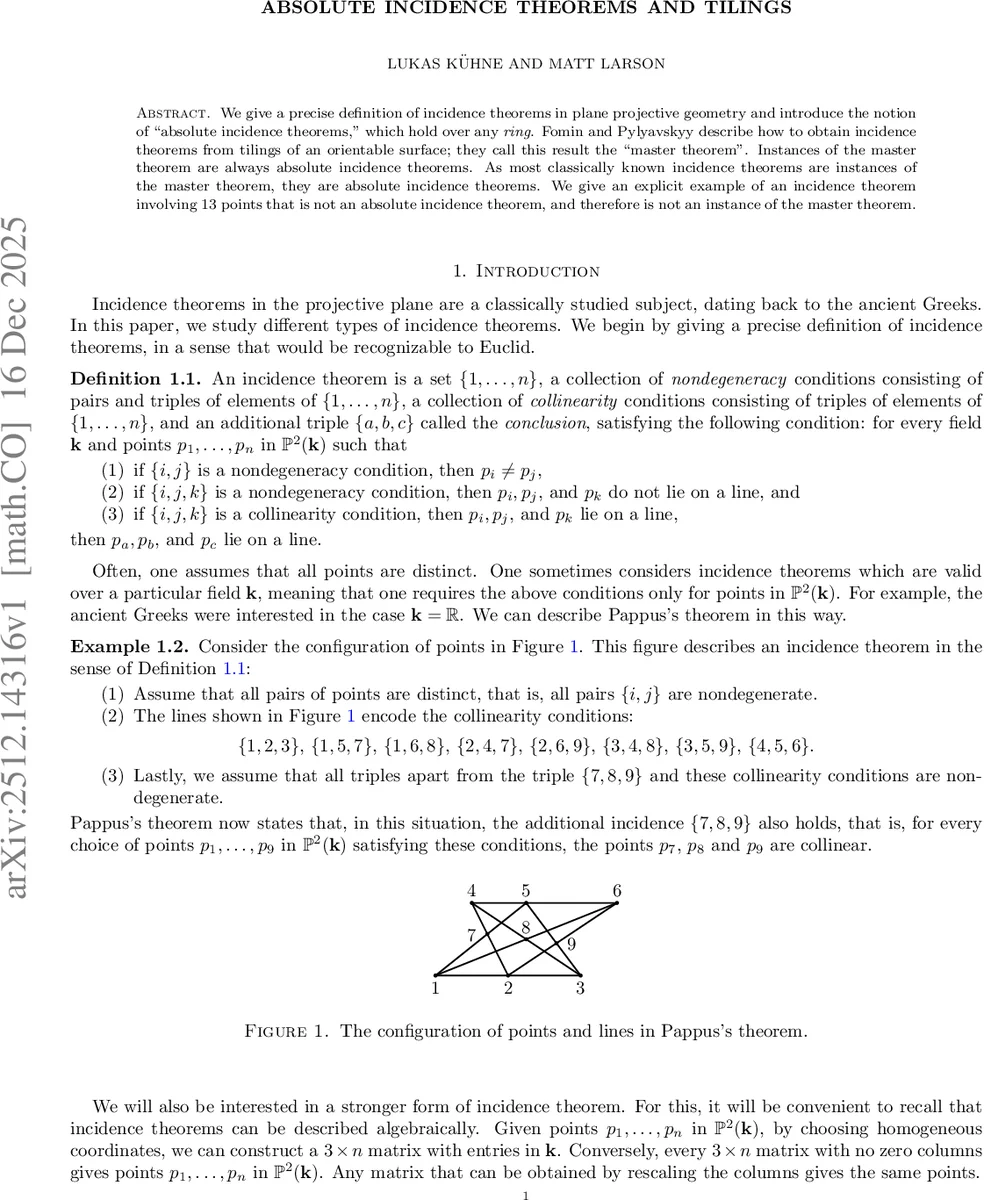
We give a precise definition of incidence theorems in plane projective geometry and introduce the notion of absolute incidence theorems,'' which hold over any ring. Fomin and Pylyavskyy describe how to obtain incidence theorems from tilings of an orientable surface; they call this result the master theorem’’. Instances of the master theorem are always absolute incidence theorems. As most classically known incidence theorems are instances of the master theorem, they are absolute incidence theorems. We give an explicit example of an incidence theorem involving 13 points that is not an absolute incidence theorem, and therefore is not an instance of the master theorem.
💡 Research Summary
This paper establishes a rigorous framework for incidence theorems in the projective plane and introduces the notion of “absolute incidence theorems,” which are statements that remain valid over any commutative ring, not just fields. The authors begin by formalizing an incidence theorem as a finite set of points together with two families of conditions: non‑degeneracy conditions (pairs of distinct points and triples not lying on a line) and collinearity conditions (triples of points forced to be collinear). They translate these geometric constraints into algebraic ones using a 3 × n matrix of homogeneous coordinates: a pair {i,j} is non‑degenerate precisely when the 2 × 2 minor formed by columns i and j is a unit, a triple {i,j,k} is non‑degenerate when the corresponding 3 × 3 minor is a unit, and a collinearity condition holds when that 3 × 3 minor vanishes. This matrix viewpoint makes it possible to extend the definition to arbitrary commutative rings by requiring the relevant minors to be units or zero in the ring (Definition 1.3). The authors prove basic properties of this extension, showing that it reduces to the classical definition over fields and that it automatically holds over integral domains via localization.
The second major contribution is a reinterpretation of the “master theorem” of Fomin and Pylyavskyy (Theorem 1.4). The master theorem starts with a tiling of a closed orientable surface by quadrilaterals, colors vertices black (points) and white (lines), and assigns a point to each black vertex and a line to each white vertex in the projective plane over a chosen field k. A tile is called “coherent” if the two points and two lines satisfy a specific incidence relation (essentially that the intersection of the two lines lies on the line through the two points, or the points/lines coincide). The master theorem asserts that if all but one tile in the tiling are coherent, then the remaining tile must also be coherent.
To bring this into the absolute‑incidence language, the authors introduce an equivalence relation on white vertices, thereby grouping together vertices that are to be interpreted as the same line. For each equivalence class they introduce a symbolic line variable, and for each pair of distinct classes that appear together in a tile they introduce a new point variable Rₖ. They then formulate a systematic list of non‑degeneracy and collinearity conditions (Section 1.5) that encode the coherence of every tile except one. The conclusion of the resulting incidence theorem is precisely the coherence condition for the exceptional tile. Theorem 1.5 proves that any incidence theorem produced in this way is an absolute incidence theorem. The proof adapts the core algebraic identity underlying the master theorem (Proposition 3.5) to the setting of arbitrary commutative rings, carefully handling the cases where two lines in a tile coincide by means of the introduced equivalence relation.
Having shown that the master theorem always yields absolute incidence theorems, the authors turn to the question of whether every incidence theorem can be obtained in this manner. They provide a concrete counterexample: Theorem 1.6 describes a configuration of 13 points p₁,…,p₁₃ with 20 prescribed collinear triples; the theorem claims that p₁₁, p₁₂, p₁₃ are collinear. This statement holds over every field (the authors give both a computer‑assisted and a hand‑checked proof), yet it fails to be absolute. To demonstrate the failure, they exhibit a 3 × 13 matrix over the non‑reduced ring A = ℚ
Comments & Academic Discussion
Loading comments...
Leave a Comment