The Role of Employment Flexibility in Enhancing the Competitiveness of Temporary Staffing Service Providers in Poland
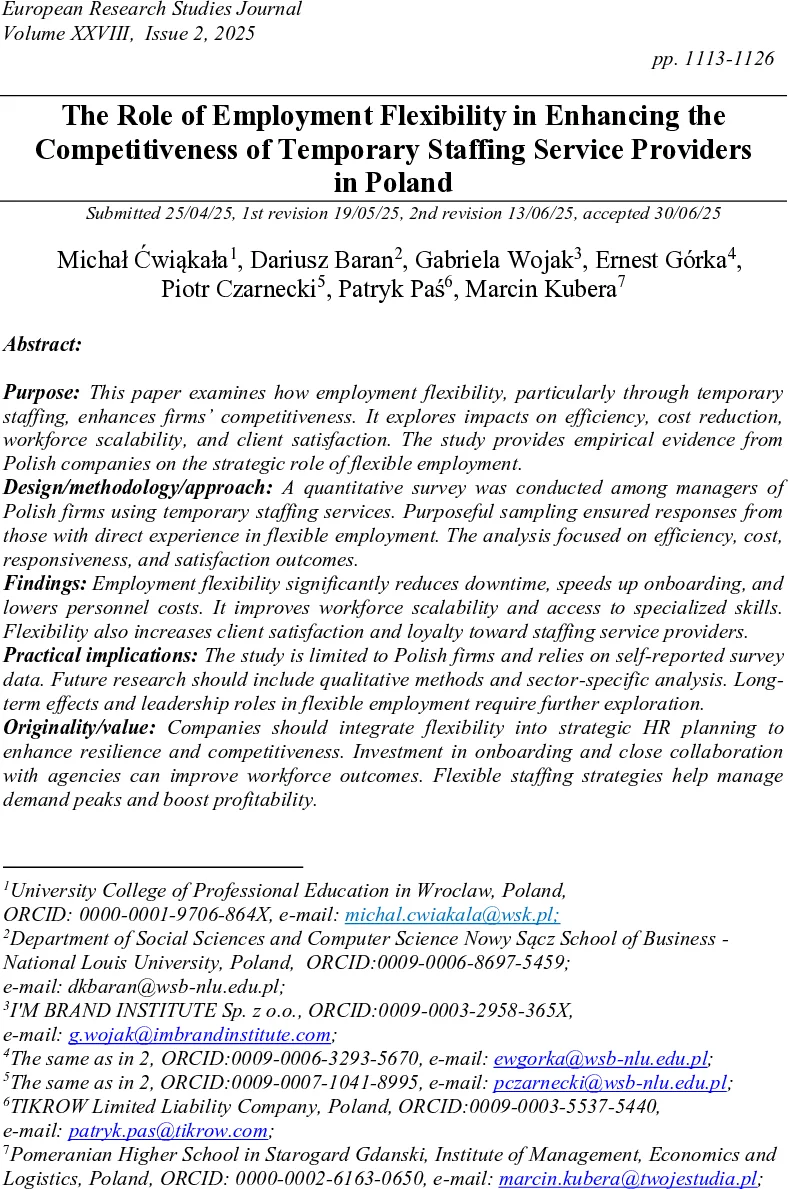
This paper examines the role of employment flexibility in enhancing the competitiveness of firms using temporary staffing services, with empirical evidence from Poland. The study focuses on how flexible employment arrangements influence operational efficiency, cost reduction, workforce scalability, market responsiveness, and client satisfaction. A quantitative survey was conducted among managers and owners of Polish enterprises that cooperate with temporary staffing agencies, using purposeful sampling to capture informed managerial perspectives. The findings show that employment flexibility significantly reduces downtime, accelerates onboarding processes, and lowers personnel and recruitment costs. Flexible staffing enables rapid workforce scaling during demand fluctuations and facilitates access to specialized skills without long-term commitments. The results also indicate that employment flexibility enhances organizational responsiveness, improves profitability in short-term projects, and strengthens resilience to seasonal and market volatility. Additionally, flexibility is identified as a key determinant of client satisfaction and loyalty toward staffing service providers. The study demonstrates that employment flexibility is not merely a cost-control mechanism but a strategic human resource capability that supports competitiveness, operational adaptability, and sustainable performance in dynamic labor markets.
💡 Research Summary
The article investigates how employment flexibility, primarily through the use of temporary staffing agencies, enhances the competitiveness of Polish firms. Drawing on Atkinson’s “flexible firm” model and the resource‑based view, the authors frame flexibility as a strategic human‑resource capability rather than a mere cost‑saving tool. A quantitative survey was administered to 92 managers and owners of companies that have employed temporary workers, covering sectors such as services, production, logistics and trade. The sample is dominated by medium‑sized enterprises, reflecting the typical user base of the Polish temporary‑staffing market.
Statistical analysis shows that flexibility significantly reduces downtime, accelerates onboarding, lowers personnel costs, and enables rapid scaling of the workforce in response to demand fluctuations. These operational gains translate into higher short‑term project profitability, improved resilience to seasonal and market volatility, and stronger client satisfaction and loyalty toward staffing providers. The study also highlights that temporary staffing gives firms access to specialized skills without long‑term commitments, thereby supporting strategic agility.
Practical implications include integrating flexibility into HR strategy, strengthening collaboration with agencies, and leveraging digital recruitment platforms for faster talent matching. Limitations are acknowledged: reliance on self‑reported survey data, geographic focus on Poland, and the absence of qualitative insights. The authors recommend future research that incorporates case studies, sector‑specific analyses, and the role of leadership competencies in sustaining flexible employment arrangements. Overall, the paper provides empirical evidence that employment flexibility is a pivotal driver of operational efficiency, market responsiveness, and sustainable competitive advantage in dynamic labor markets.
Comments & Academic Discussion
Loading comments...
Leave a Comment