A two-stage approach to heat-mortality risk assessment comparing multiple exposure-to-temperature models: the case study in Lazio, Italy
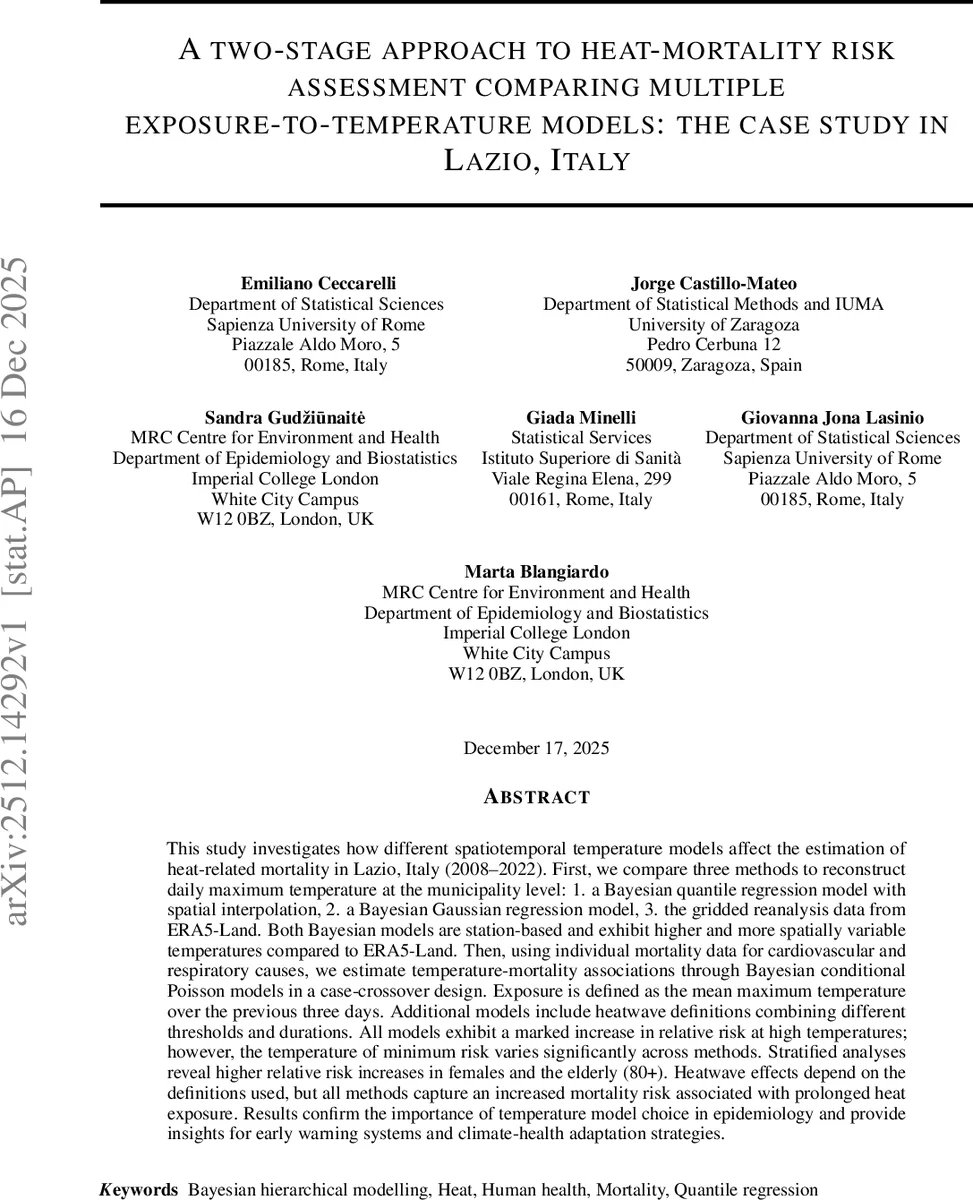
This study investigates how different spatiotemporal temperature models affect the estimation of heat-related mortality in Lazio, Italy (2008–2022). First, we compare three methods to reconstruct daily maximum temperature at the municipality level: 1. a Bayesian quantile regression model with spatial interpolation, 2. a Bayesian Gaussian regression model, 3. the gridded reanalysis data from ERA5-Land. Both Bayesian models are station-based and exhibit higher and more spatially variable temperatures compared to ERA5-Land. Then, using individual mortality data for cardiovascular and respiratory causes, we estimate temperature-mortality associations through Bayesian conditional Poisson models in a case-crossover design. Exposure is defined as the mean maximum temperature over the previous three days. Additional models include heatwave definitions combining different thresholds and durations. All models exhibit a marked increase in relative risk at high temperatures; however, the temperature of minimum risk varies significantly across methods. Stratified analyses reveal higher relative risk increases in females and the elderly (80+). Heatwave effects depend on the definitions used, but all methods capture an increased mortality risk associated with prolonged heat exposure. Results confirm the importance of temperature model choice in epidemiology and provide insights for early warning systems and climate-health adaptation strategies.
💡 Research Summary
This study presents a rigorous two-stage analytical framework to evaluate how different spatiotemporal temperature reconstruction models influence the estimation of heat-related mortality risk in the Lazio region, Italy, covering the period from 2008 to 2022.
In the first stage, the study compares three distinct methods for reconstructing daily maximum temperatures at the municipal level: (1) a Bayesian quantile regression model with spatial interpolation (QR-GP) utilizing an asymmetric Laplace likelihood and Gaussian Process to capture spatial autocorrelation and quantile-specific distributions; (2) a Bayesian Gaussian regression model; and (3) the ERA5-Land gridded reanalysis data. The findings revealed that both Bayesian models produced higher and more spatially heterogeneous temperature surfaces compared to ERA5-Land, with mean maximum temperatures being 0.8–1.5°C higher. This suggests that standard reanalysis products may smooth out critical local temperature extremes in complex terrains.
In the second stage, the researchers employed a case-crossover design using individual mortality records for cardiovascular and respiratory causes to estimate temperature-mortality associations. The exposure variable was defined as the mean maximum temperature over the preceding three days. The study also incorporated various heatwave definitions based on different temperature thresholds (e.g., the 90th percentile) and durations (≥2 or ≥3 days). Using Bayesian conditional Poisson models with spline functions, the study quantified the non-linear relationship between heat exposure and mortality.
Key findings include:
- Significant Discrepancy in Risk Thresholds: While all models demonstrated a sharp increase in relative risk (RR) at high temperatures, the temperature of minimum risk ($T_{min}$) varied significantly between models, ranging from 24–26°C in Bayesian models to 28–30°C in ERA5-Land.
- Identification of Vulnerable Populations: Stratified analyses highlighted that females and the elderly (aged 80+) experienced much higher increases in relative risk, with RR increases ranging from 1.3 to 1.6 times.
- Impact of Heatwave Duration: The highest mortality risk (RR = 1.45, 95% CI 1.20–1.73) was observed during prolonged heatwave events, specifically when temperatures exceeded the 90th percentile for at least three consecutive days.
In conclusion, the study demonstrates that the choice of temperature exposure model is a critical determinant in epidemiological research and public health policy. Because Bayesian models better capture extreme temperature peaks, relying on smoothed reanalysis data may lead to an underestimation of heat-related risks. These results underscore the necessity of integrating high-resolution, station-based modeling into early warning systems and climate health adaptation strategies to prevent under-preparedness to extreme heat events.
Comments & Academic Discussion
Loading comments...
Leave a Comment