Revealing the baryon cycle in Galaxy Clusters: connecting galaxy dynamics and gas thermodynamics using (sub-)mm-wave and optical IFU surveys
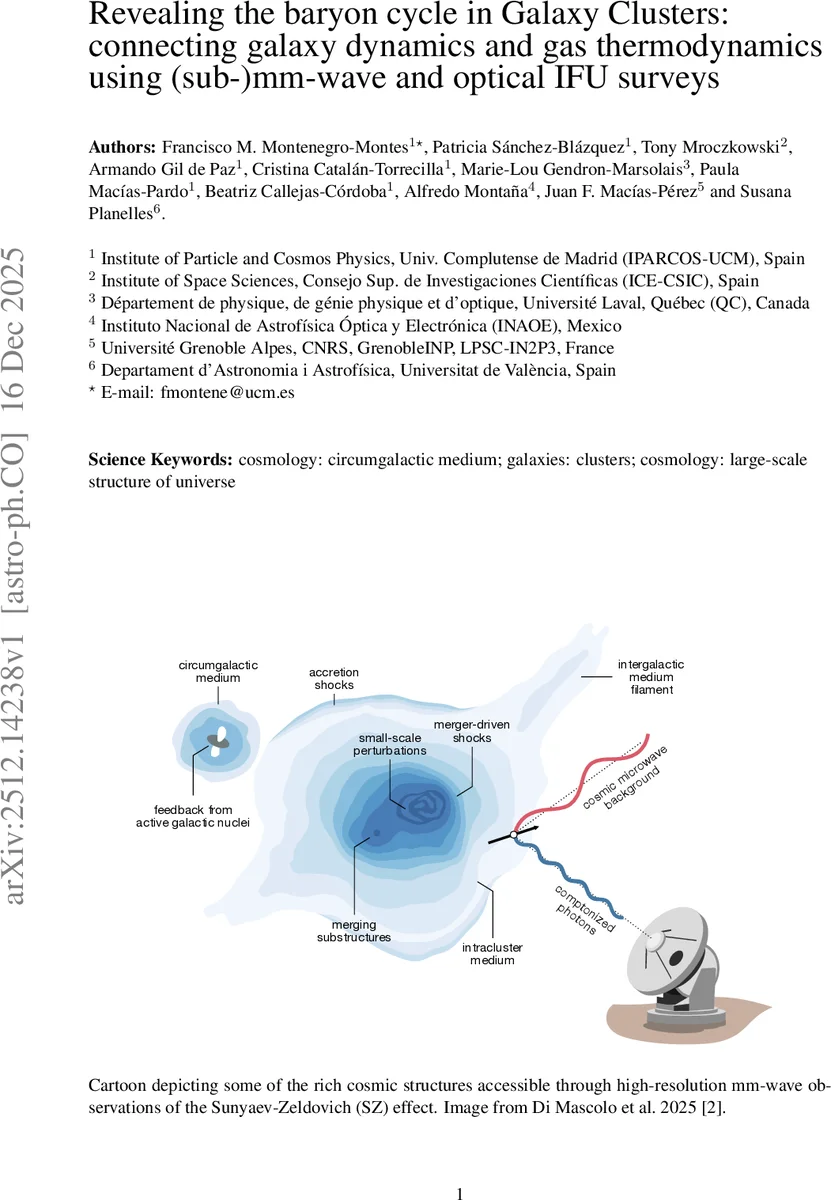
Observations in the visible and near infrared are transforming our view of the processes affecting galaxy evolution, much of which is dominated by interactions with the large scale environment. Yet a complete picture is missing, as no corresponding high resolution view of the warm/hot intracluster, circumgalactic, and intergalactic media exists over large areas and a comparably broad range of redshifts. Combined with wide-field optical IFU surveys such as CATARSIS, a large diameter sub-mm telescope with a degree-scale field of view would enable a joint view of galaxy dynamics and gas thermodynamics, transforming our understanding of environmental processes.
💡 Research Summary
The paper presents a compelling scientific case for a next‑generation, large‑aperture (≥50 m) single‑dish sub‑millimetre telescope—AtLAST—to be operated in concert with the upcoming wide‑field optical integral‑field spectroscopic survey CATARSIS. The authors argue that while optical IFU observations will soon deliver unbiased redshifts, velocity fields, stellar populations and star‑formation rates for thousands of cluster galaxies out to several virial radii, the thermodynamic context of the intracluster medium (ICM), circumgalactic medium (CGM) and intergalactic filaments remains inaccessible with current facilities.
Existing X‑ray measurements are limited by the n² dependence of surface brightness, making the low‑density outskirts (beyond r₅₀₀) photon‑starved. Low‑resolution Sunyaev‑Zel’dovich (SZ) surveys provide azimuthally averaged pressure profiles but lack the angular resolution and mapping speed needed to resolve sub‑structures, shocks, and turbulence that encode the history of accretion, feedback and non‑thermal pressure support. Interferometers such as ALMA can achieve arcsecond resolution but suffer from small fields of view and spatial filtering, while current single‑dish bolometer cameras (MUSTANG‑2, TolTEC, etc.) offer limited instantaneous fields (≈5′) and cannot efficiently map degree‑scale cluster environments.
To bridge this gap, the authors define a set of technical requirements that AtLAST must meet:
- Frequency coverage 90–350 GHz (including the thermal SZ decrement, the null at ~220 GHz, and the increment up to ~350 GHz) to separate thermal SZ, kinetic SZ, relativistic corrections, and dust emission.
- Angular resolution ≤10″ at 150 GHz (≈5–15″ across the full band) to resolve ICM sub‑structures and to distinguish cluster galaxies from diffuse gas. Higher frequencies should reach ≤2″ to aid in cosmic‑infrared‑background source removal.
- Mapping speed >1000 deg² hr⁻¹ mJy⁻², roughly two to three orders of magnitude faster than present single‑dish instruments, enabling µK‑level surface‑brightness sensitivity in the outskirts.
- Instantaneous field of view ≥1°, sufficient to capture scales out to 3 r₂₀₀ for low‑redshift clusters.
- Robust data handling and joint analysis pipelines that combine SZ/continuum maps with CATARSIS velocity fields, star‑formation rates and stellar population diagnostics on matched astrometric grids, employing hierarchical Bayesian frameworks to reconstruct mass, pressure and velocity fields simultaneously.
With these capabilities, AtLAST can directly address three tightly coupled science questions:
- Where and how do clusters accrete baryons from the cosmic web? By mapping pressure discontinuities (splash‑back radius, accretion shocks) across a wide radial range, the telescope will measure the physical boundaries of clusters and their evolution with mass and accretion rate.
- What drives the transformation of infalling galaxies? Spatially resolved ICM pressure and turbulence maps will be cross‑correlated with galaxy orbits and star‑formation histories from CATARSIS, quantifying ram‑pressure stripping, strangulation and quenching efficiencies as a function of local thermodynamic conditions rather than projected radius.
- Where are the “missing baryons”? Multi‑frequency SZ observations will separate thermal from non‑thermal pressure components and assess gas clumping, thereby testing whether the outskirts are truly depleted or merely hidden by non‑thermal support.
The paper also outlines a concrete comparison (Figure 1) showing that mock observations with ALMA or a 100‑m Green Bank Telescope + MUSTANG‑2 fail to capture the large‑scale, low‑surface‑brightness features that a modest first‑generation AtLAST instrument can reveal.
In summary, the authors conclude that AtLAST’s unique combination of wide‑field, multi‑band, high‑sensitivity, arcsecond‑scale SZ imaging is the indispensable thermodynamic counterpart to CATARSIS’s dynamical mapping. Together, these facilities will transform galaxy clusters from static cosmological probes into dynamic laboratories where the baryon cycle—accretion, feedback, and environmental transformation—can be measured directly, advancing both astrophysics and precision cosmology.
Comments & Academic Discussion
Loading comments...
Leave a Comment