A note on spherical algebras
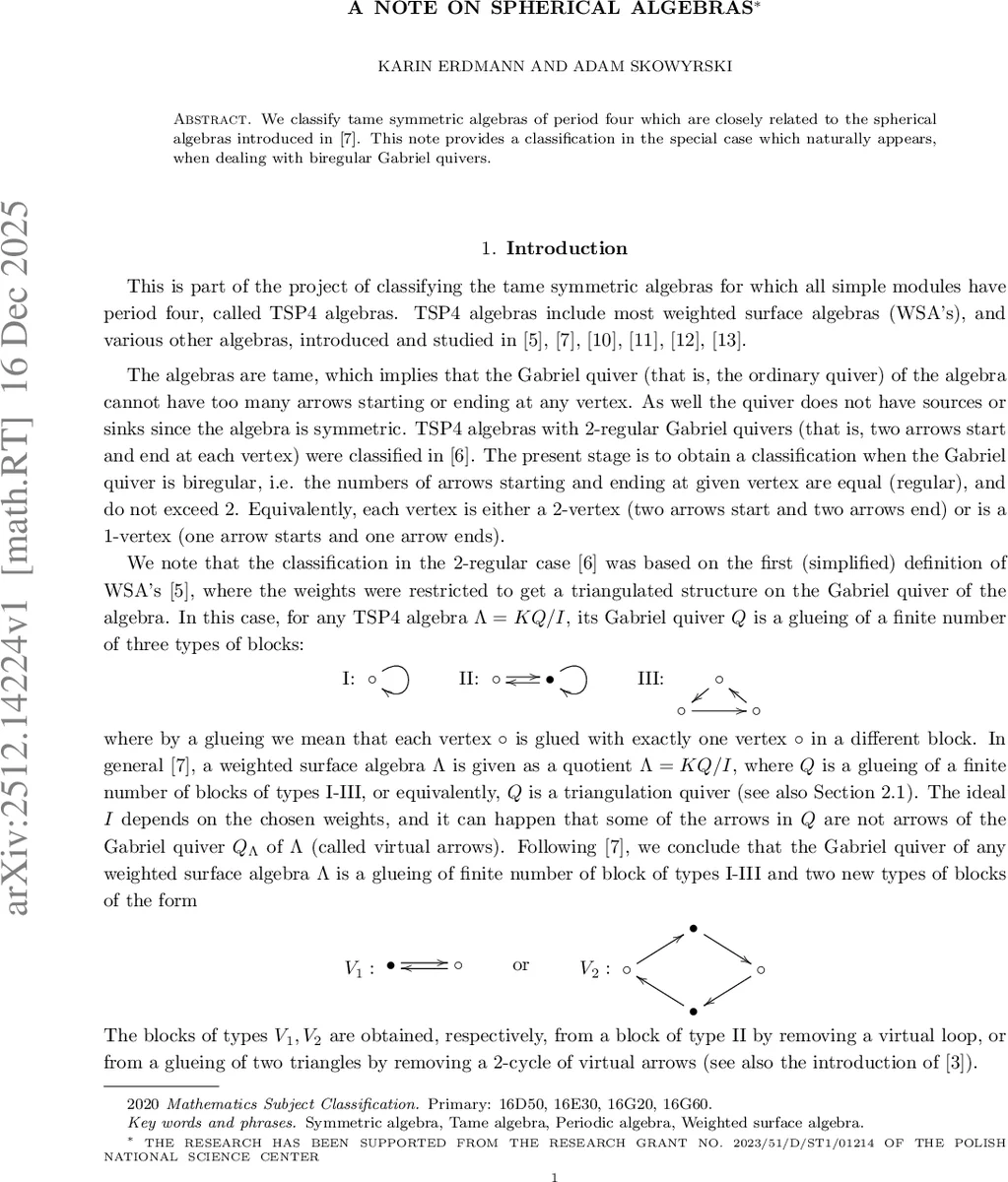
We classify tame symmetric algebras of period four which are closely related to the spherical algebras introduced in [7]. This note provides a classification in the special case which naturally appears, when dealing with biregular Gabriel quivers.
💡 Research Summary
The paper investigates symmetric tame algebras whose simple modules have period four (referred to as TSP4 algebras) and focuses on the case where the ordinary Gabriel quiver is biregular, i.e., each vertex has the same number of incoming and outgoing arrows, which is either one or two. Earlier work classified the 2‑regular case (exactly two arrows in and out of every vertex). The present work completes the classification for the biregular situation by distinguishing two families of quivers: the spherical quiver Q_S (a gluing of two V₂‑type blocks) and the almost‑spherical quiver Q_S′ (a gluing of one V₂ block together with two triangular blocks of type I–II).
The authors first show that any 1‑vertex in a biregular Gabriel quiver must belong to a block of type V₁ or V₂, confirming a conjecture that such algebras share the same quiver shapes as weighted surface algebras (WSA). They then describe the precise relations that define the algebras associated with Q_S and Q_S′. When all four “virtual” arrows (ξ, η, ε, μ) are present (i.e., their weights equal one), the Gabriel quiver coincides with Q_S, and the algebra is generated by a set of commutativity relations (S1–S4) together with a long list of zero relations (Z1–Z16). If only two virtual arrows remain, the Gabriel quiver is Q_S′ and a similar but slightly shorter list of relations (S′1–S′4, Z′1–Z′20) applies.
A central technical tool is the analysis of minimal relations involving paths of length three. Lemma 2.1 shows that any such minimal relation must be accompanied by a reverse arrow, preventing length‑two paths between 1‑vertices from appearing in minimal relations. Lemma 2.2 guarantees the existence of minimal relations for any pair of length‑three paths sharing the same start and end vertices, a consequence of the tameness condition. These lemmas are used to derive the explicit shape of the minimal relations at each 1‑vertex, which always appear in pairs and involve two scalar parameters (denoted r₁, r₂ in the paper).
The authors then study the projective modules at 1‑vertices. For a 1‑vertex b₁, the radical of the indecomposable projective P_{b₁} is generated by the arrow β, while the top quotient P_{b₁}/S_{b₁} is generated by α. The exact sequence 0 → αΛ → P₁ → P₂ → βΛ → 0 encodes the minimal relations and leads to two scalar coefficients r₁, r₂ together with an error term E lying in a higher radical power. Depending on whether one of the scalars vanishes, the algebra collapses to a weighted surface algebra; if both are non‑zero, the algebra acquires additional structure and becomes a Higher Spherical Algebra (HSA).
The main classification results are:
-
Theorem 1.1: If a TSP4 algebra has Gabriel quiver Q_S, then it is either (a) a weighted surface algebra (with four virtual arrows) or (b) a Higher Spherical Algebra S(m, λ) with m > 1. The case m = 1 recovers the ordinary weighted surface algebra.
-
Theorem 1.2: If the Gabriel quiver is Q_S′, then the algebra is necessarily a weighted surface algebra (with two virtual arrows). Thus Q_S′ does not give rise to new families beyond WSAs.
The proof strategy for both theorems follows a common pattern: (1) identify all minimal relations, (2) construct bases for the indecomposable projective modules, (3) define a surjective algebra homomorphism ψ from the candidate algebra (either a WSA or an HSA) onto the given algebra Λ, and (4) show that ψ is injective by comparing dimensions of the source and target, thereby establishing an isomorphism.
Section 2 reviews the definition of weighted surface algebras via triangulation quivers (Q, f), weight functions m·, and parameter functions c·. The authors explain how virtual arrows arise when mα nα = 2, and how they are omitted from the Gabriel quiver. Section 3 derives the explicit minimal relations and spanning sets for projective modules at 2‑vertices, introducing two scalar parameters that control the interaction between the two V₂ blocks. Section 4 handles the degenerate case where at least one scalar is zero, proving that the resulting algebra coincides with a weighted surface algebra. Section 5 treats the generic case where both scalars are non‑zero, showing that the algebra is an HSA (or a WSA when one of the weights equals one). The final section completes the proof of Theorem 1.2 for the almost‑spherical quiver.
Overall, the paper fills the missing piece in the classification of TSP4 algebras by treating the biregular quivers that are not 2‑regular. It demonstrates that, despite the apparent complexity introduced by the presence of 1‑vertices and virtual arrows, the algebras fall into two well‑understood families: weighted surface algebras and higher spherical algebras. This result not only extends the known classification but also clarifies the role of the spherical quiver in the broader landscape of tame symmetric algebras of period four.
Comments & Academic Discussion
Loading comments...
Leave a Comment