Analogue gravity with Bose-Einstein condensates
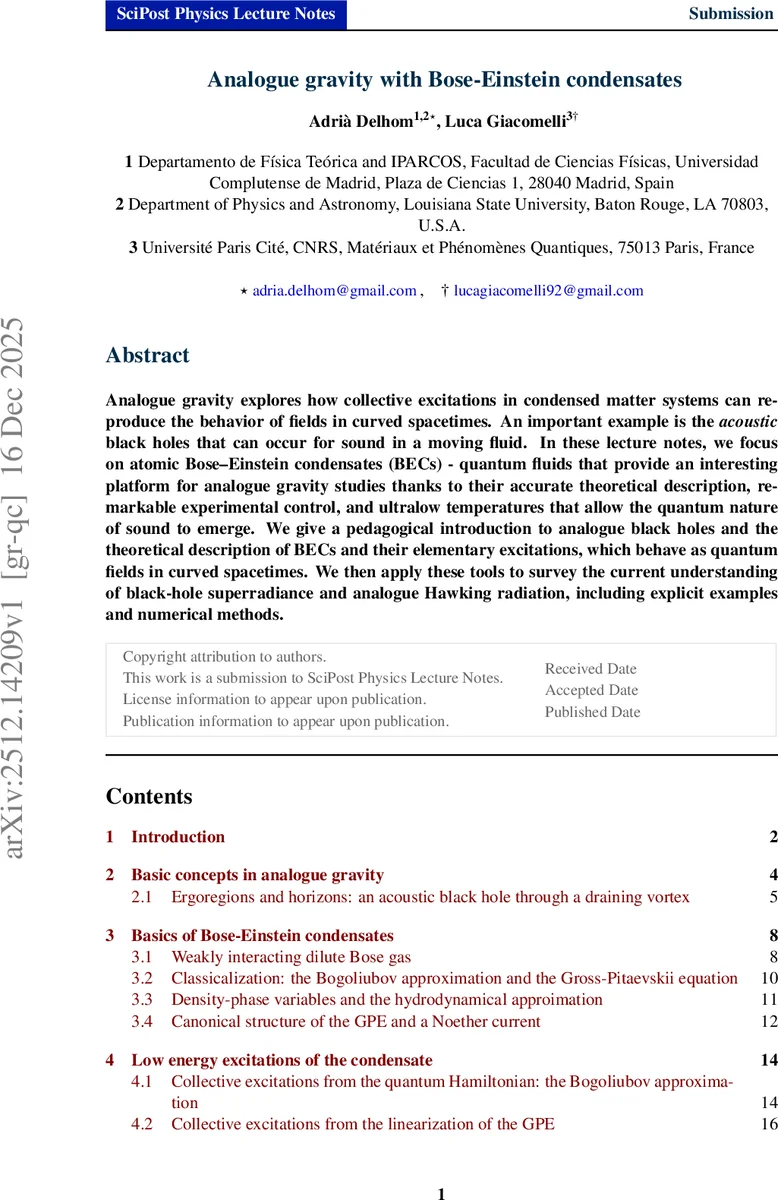
Analogue gravity explores how collective excitations in condensed matter systems can reproduce the behavior of fields in curved spacetimes. An important example is the acoustic black holes that can occur for sound in a moving fluid. In these lecture notes, we focus on atomic Bose-Einstein condensates (BECs), quantum fluids that provide an interesting platform for analogue gravity studies thanks to their accurate theoretical description, remarkable experimental control, and ultralow temperatures that allow the quantum nature of sound to emerge. We give a pedagogical introduction to analogue black holes and the theoretical description of BECs and their elementary excitations, which behave as quantum fields in curved spacetimes. We then apply these tools to survey the current understanding of black-hole superradiance and analogue Hawking radiation, including explicit examples and numerical methods.
💡 Research Summary
The lecture notes “Analogue gravity with Bose‑Einstein condensates” provide a comprehensive, pedagogical treatment of how atomic Bose‑Einstein condensates (BECs) can be used as quantum simulators for phenomena traditionally associated with quantum field theory in curved spacetime. The authors begin by reviewing the basic idea of analogue gravity: linear perturbations in a moving fluid obey a wave equation whose characteristic surfaces define an effective Lorentzian metric. For an inviscid, barotropic, irrotational fluid, the acoustic metric depends on the local density, speed of sound, and flow velocity, and regions where the flow exceeds the sound speed give rise to ergoregions and event horizons, directly mimicking black‑hole spacetimes.
The manuscript then turns to the microscopic description of weakly interacting dilute Bose gases. Starting from the many‑body Hamiltonian, the Bogoliubov approximation leads to the Gross‑Pitaevskii equation (GPE) for the condensate order parameter. By expressing the order parameter in density‑phase variables, the authors derive a hydrodynamic formulation that makes the emergence of the acoustic metric transparent. The Bogoliubov‑de Gennes (BdG) equations are presented both from the Hamiltonian diagonalisation and from linearising the GPE, yielding the well‑known Bogoliubov dispersion relation ω(k)=c_s k √{1+(kξ)^2}. The super‑luminal character of this dispersion is highlighted, emphasizing that the effective metric governs only low‑k phonons.
Quantisation of the linear excitations is treated in detail. The authors discuss canonical commutation relations for the density‑phase fields, the construction of creation and annihilation operators in the atomic‑field picture, and the subtleties that arise when the BdG spectrum contains complex eigenvalues (dynamical instabilities). A conserved inner product for BdG modes is introduced, allowing a clear identification of positive‑ and negative‑norm solutions, which is essential for interpreting particle‑creation processes.
Superradiance is explored in Section 6. After a general scattering‑theory framework, the authors analyse dispersion‑relation criteria for amplification (ω < m Ω_H) and apply them to concrete BEC configurations: a shear‑layer flow and a draining vortex. An electrostatic analogy is used to simplify the scattering problem, and a practical algorithm for computing the S‑matrix is supplied. Quantum superradiance is interpreted as spontaneous pair creation of Bogoliubov quasiparticles, and the link between superradiant amplification and dynamical instabilities (black‑hole lasing) is demonstrated through numerical diagonalisation of the BdG operator and time‑dependent GPE simulations.
Section 7 treats the stationary analogue Hawking effect. The trans‑sonic BEC is cast as a stationary scattering problem, with mode decomposition into incoming, outgoing, and trapped branches. The authors present an exact solution for a step‑like horizon, derive the scattering matrix, and compare the resulting thermal spectrum with the Hawking temperature T_H = ℏκ/2πk_B, where κ is the surface gravity of the acoustic horizon. Density‑density correlation functions are identified as experimentally accessible signatures of Hawking radiation, and the phenomenon of black‑hole lasing—exponential growth of self‑amplified Hawking pairs in a cavity formed by two horizons—is illustrated with numerical GPE evolution.
The concluding chapter summarises the state of the field, emphasizing the dual role of BEC analogue systems: they provide a controllable platform to test semiclassical gravity ideas and, simultaneously, a laboratory for non‑perturbative quantum field dynamics in curved backgrounds. The authors outline open theoretical challenges (including handling strong dispersion, back‑reaction, and multi‑mode entanglement) and experimental goals (improved temperature resolution, higher‑dimensional flow engineering, and direct measurement of quantum correlations). An appendix supplies a step‑by‑step algorithm for computing scattering coefficients in stationary problems, and an extensive bibliography points to the latest developments.
Overall, the notes serve as both a textbook for newcomers and a reference for experts, bridging condensed‑matter techniques, quantum‑optical methods, and relativistic field theory to advance analogue gravity research using Bose‑Einstein condensates.
Comments & Academic Discussion
Loading comments...
Leave a Comment