Mass Assembly and Chemical Complexity in the Milky Way
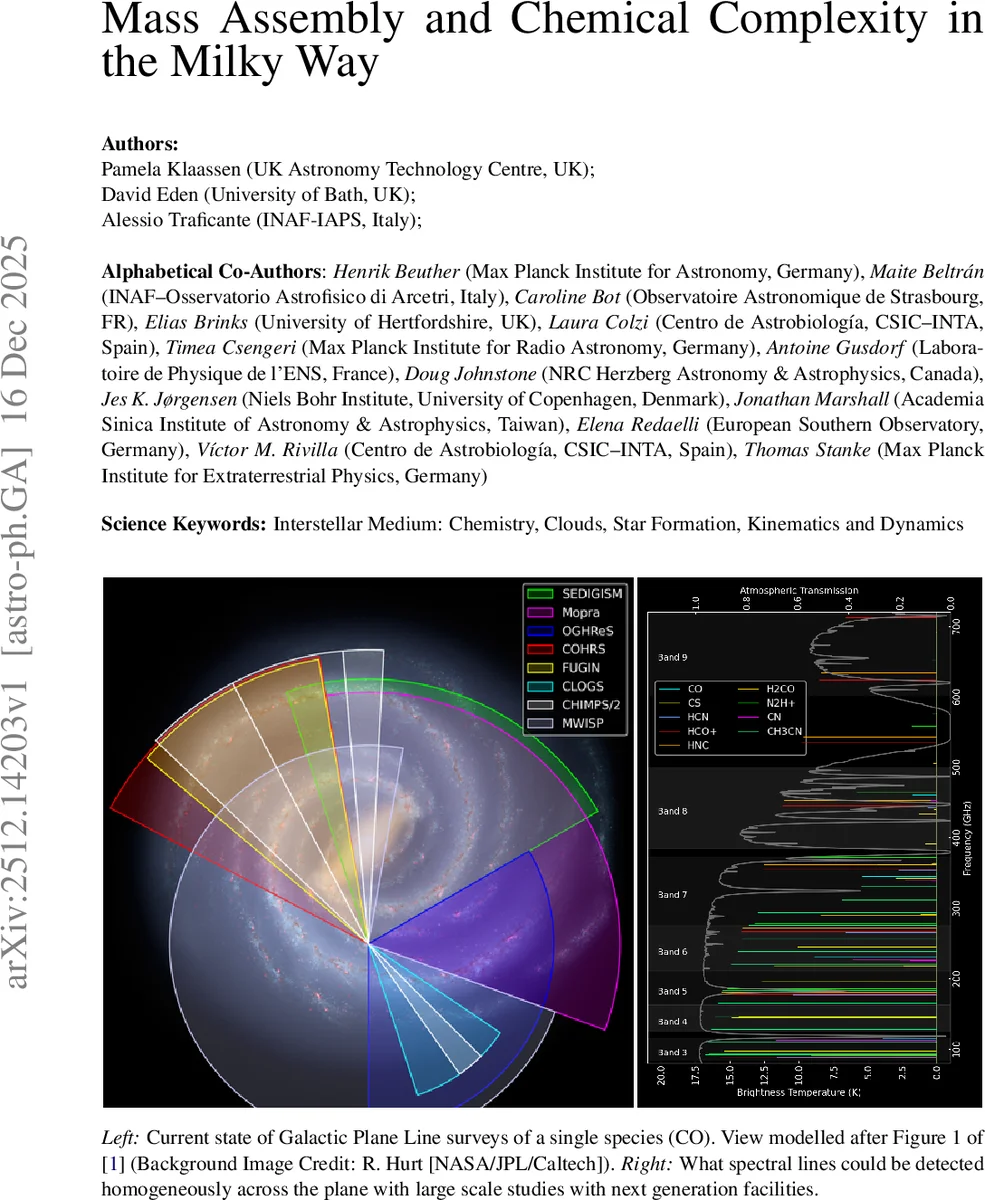
(Sub-)millimeter spectral lines can be used not only to understand the chemical complexity and enrichment history of an observed portion of our Galaxy, but with spectrally resolved lines, they reveal the physical conditions, dynamics, and even the ionisation state and magnetic field strengths of the gas component of our Galaxy. They are prime tracers of mass assembly and structure formation across scales.
💡 Research Summary
This paper presents a comprehensive scientific vision and a detailed observational roadmap to understand mass assembly and chemical evolution in the Milky Way using (sub-)millimeter spectral line observations. It argues that these lines are prime tracers for probing physical conditions (density, temperature, kinematics, ionization, magnetic fields) and chemical complexity across all scales, from giant molecular clouds (GMCs) down to star-forming cores.
The first part of the paper establishes the importance of studying mass assembly. Understanding the flow of mass from GMCs to dense cores is fundamental for constraining the star formation rate and the origin of the stellar initial mass function (IMF), which governs galaxy evolution. Large programs like ALMA-IMF are measuring the core mass function (CMF) across evolutionary stages, providing transformative data that challenges models of early dynamical evolution. Detections of inflowing streamers and hot cores rich in complex organic molecules (COMs) indicate that accretion and chemical enrichment are active from early stages. These findings question the long-assumed universality of the IMF, suggesting that environmental factors and sampling biases may obscure real variations, thus motivating detailed, scale-dependent studies.
The second part delves into the specific physical and chemical diagnostics available in the (sub-)mm regime. Different molecular lines trace different conditions: Neutral atomic carbon (
Comments & Academic Discussion
Loading comments...
Leave a Comment