Simplex Crystal Ground State and Magnetization Plateaus in the Spin-$1/2$ Heisenberg Model on the Ruby Lattice
We investigate the spin-$1/2$ Heisenberg antiferromagnet on the ruby lattice with uniform first- and second-neighbor interactions, which forms a two-dimensional network of corner-sharing tetrahedra. Using infinite projected entangled pair states (iPEPS), we study the ground state of the system to find that it assumes a gapped threefold-degenerate simplex crystal ground state, with strong singlets formed on pairs of neighboring triangles. We argue that the formation of the simplex singlet ground state at the isotropic point relates to the weak inter-triangle coupling limit where an effective spin-chirality Hamiltonian on the honeycomb lattice exhibits an extensively degenerate ground state manifold of singlet coverings at the mean-field level. Under an applied Zeeman field, the iPEPS simulations uncover magnetization plateaus at $m/m_s = 0, 1/3, 1/2,$ and $2/3$, separated by intermediate supersolid phases, all breaking the sixfold rotational symmetry of the lattice. Unlike the checkerboard lattice, these plateaus cannot be described by strongly localized magnons.
💡 Research Summary
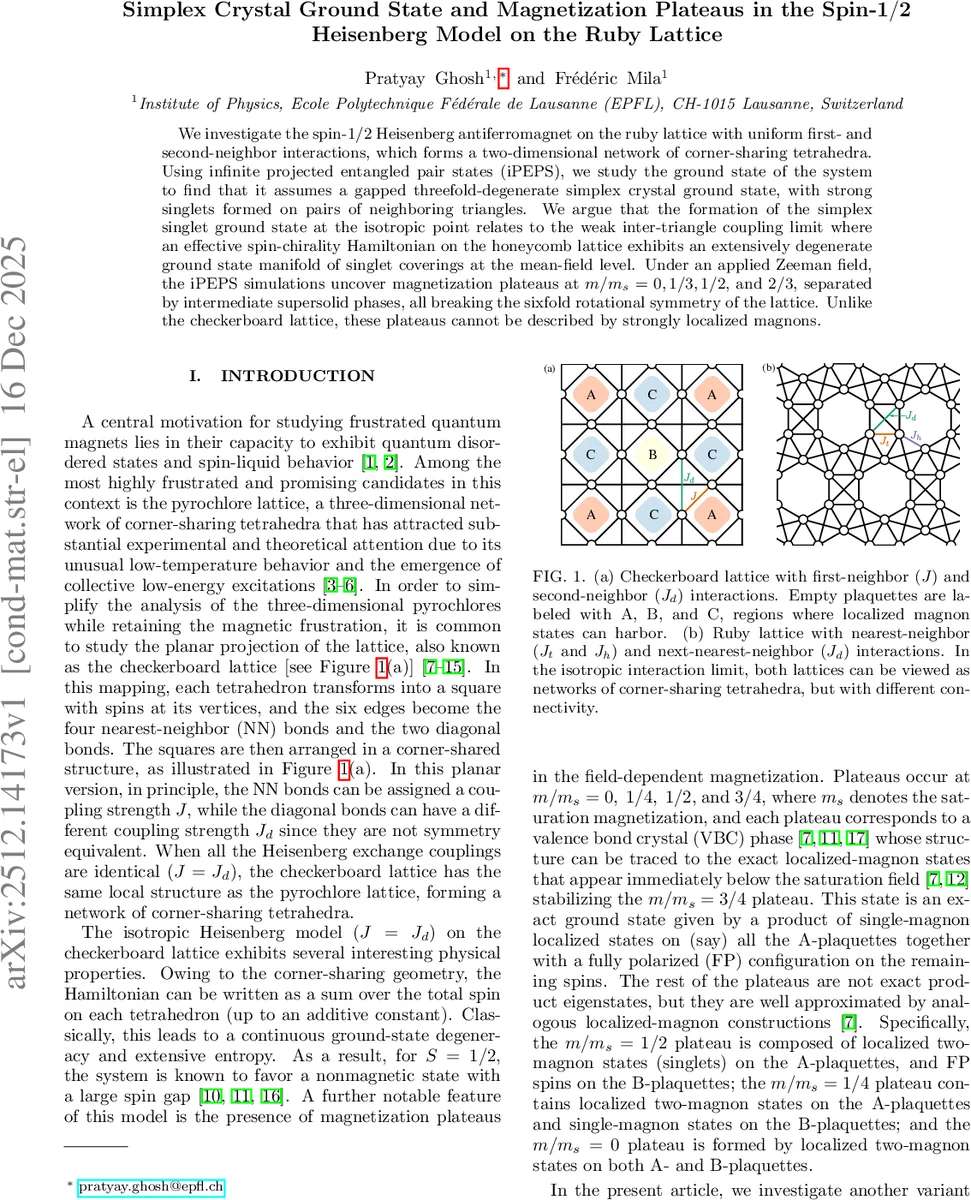
In this work the authors investigate the spin‑½ antiferromagnetic Heisenberg model on the two‑dimensional ruby lattice, a network of corner‑sharing tetrahedra composed of hexagons and triangles. They focus on the isotropic point where the three exchange couplings (nearest‑neighbor on hexagons J_h, nearest‑neighbor on triangles J_t, and second‑neighbor J_d) are equal. Using infinite projected entangled‑pair states (iPEPS) they obtain variational approximations directly in the thermodynamic limit. Each J_t triangle is treated as a single tensor, which maps the problem onto a honeycomb tensor network with a physical dimension d = 2³. Simple‑update imaginary‑time evolution combined with corner‑transfer‑matrix renormalization (CTMRG) is employed; the virtual bond dimension D is pushed up to 12 and the environment dimension χ up to D(D+2)+16, ensuring energy convergence to 10⁻⁶.
At zero magnetic field the iPEPS energy per spin extrapolates to –0.498872, substantially lower than the energy of a uniform hexagonal‑singlet product state (≈–0.467129). Spin‑spin correlations reveal strong antiferromagnetic bonds on pairs of neighboring J_t triangles, while bonds on hexagons and second‑neighbors are much weaker. The authors identify this pattern as a “simplex crystal”: two adjacent J_t triangles form a simplex that hosts a strong singlet, and these simplices arrange in a pattern that breaks the six‑fold rotational symmetry down to three‑fold, giving a threefold degenerate ground state. The energy of an isolated simplex (–(3+2√2)/12 ≈ –0.485702) matches the iPEPS result, indicating that the full lattice ground state can be understood as a weakly coupled array of such simplices.
To rationalize the simplex crystal, the authors consider the limit J_t ≫ J_h = J_d. In this regime each triangle behaves as a four‑fold degenerate object described by spin‑½ and chirality (±) Pauli matrices. Projecting onto the low‑energy manifold yields an effective spin‑chirality Hamiltonian on a honeycomb lattice. A mean‑field decoupling of this Hamiltonian maps the problem onto a quantum dimer model with an extensive manifold of dimer coverings. The simplex crystal corresponds to the “star” (or columnar) dimer phase known from the honeycomb quantum dimer model, where kinetic and potential terms select a particular dimer pattern. This provides a microscopic link between the original Heisenberg model and the effective dimer description.
When a Zeeman field h is applied, the spin gap closes and bosonic triplet excitations (hard‑core bosons) populate an effective kagome‑like lattice formed by the simplices. iPEPS calculations with unit cells up to eighteen sites reveal four magnetization plateaus at m/m_s = 0, 1/3, 1/2, 2/3 (m_s is the saturation magnetization). Each plateau is accompanied by a distinct symmetry‑broken pattern that retains only C₃ rotational symmetry. The 0‑plateau confirms the gapped non‑magnetic simplex crystal. The 1/3, 1/2 and 2/3 plateaus are not describable by localized magnon states (as in the checkerboard lattice), but instead arise from complex arrangements of simplex singlets and partially polarized spins. Between plateaus the system exhibits supersolid‑like phases where the bosons acquire mobility while still feeling strong repulsion, leading to coexistence of diagonal (density) and off‑diagonal (coherence) order.
Overall, the study establishes that the ruby lattice Heisenberg antiferromagnet hosts a novel gapped simplex‑crystal ground state and a series of unconventional magnetization plateaus, both fundamentally different from the well‑studied checkerboard case. The work provides a clear theoretical framework—combining iPEPS numerics, an effective spin‑chirality model, and quantum dimer physics—to understand these phenomena, and it points to experimental platforms such as Rydberg‑atom arrays or engineered superconducting circuits where the ruby geometry could be realized and the predicted phases probed. Future directions include exploring anisotropic couplings, finite‑temperature properties, and dynamical signatures of the simplex crystal and its field‑induced supersolids.
Comments & Academic Discussion
Loading comments...
Leave a Comment