Persistence probabilities of MA(1) sequences with Laplace innovations and $q$-deformed zigzag numbers
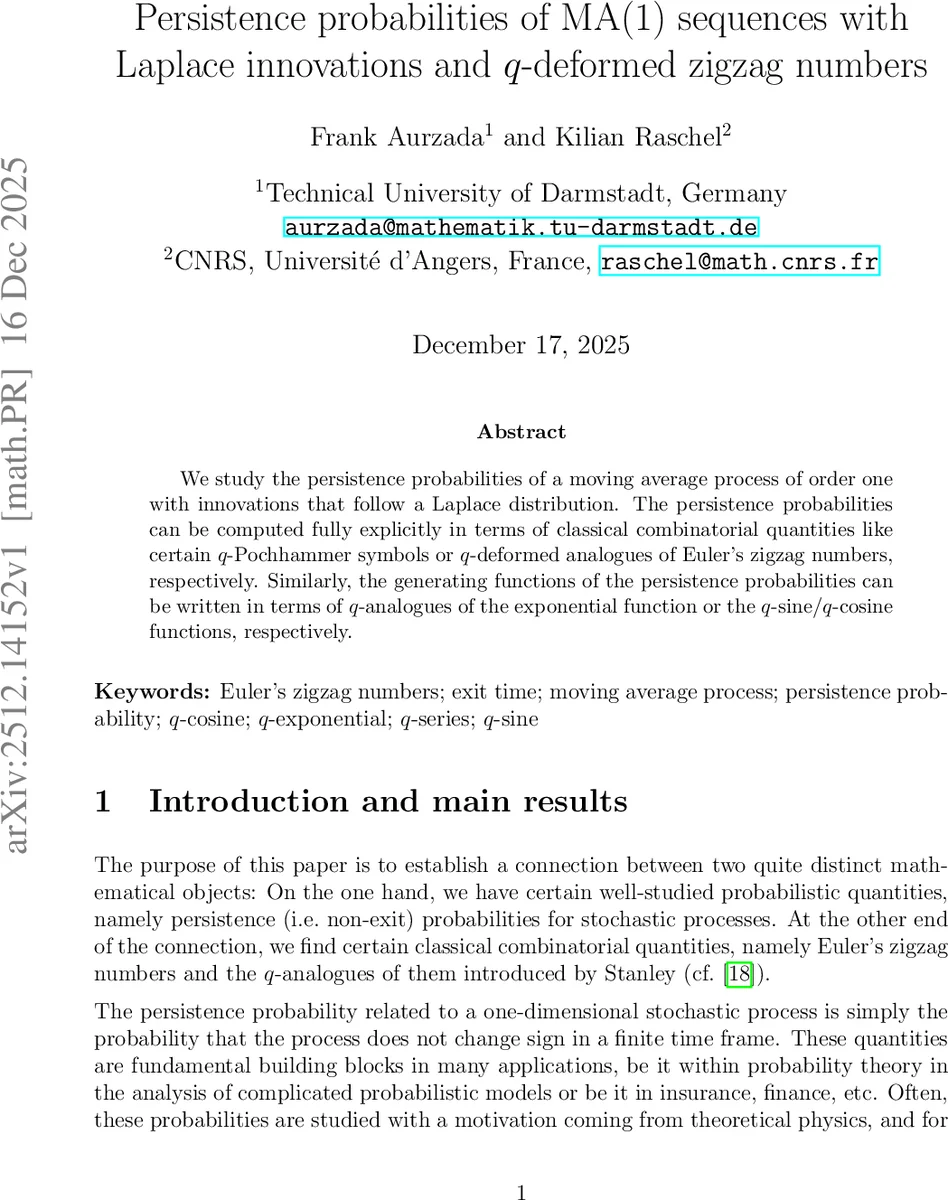
We study the persistence probabilities of a moving average process of order one with innovations that follow a Laplace distribution. The persistence probabilities can be computed fully explicitly in terms of classical combinatorial quantities like certain $q$-Pochhammer symbols or $q$-deformed analogues of Euler’s zigzag numbers, respectively. Similarly, the generating functions of the persistence probabilities can be written in terms of $q$-analogues of the exponential function or the $q$-sine/$q$-cosine functions, respectively.
💡 Research Summary
This research paper presents a profound mathematical bridge between the theory of stochastic processes and the field of q-calculus, specifically focusing on the persistence probabilities of a first-order moving average (MA(1)) process. The study investigates a scenario where the innovations of the MA(1) process follow a Laplace distribution, a distribution characterized by its heavy tails and double-exponential shape, which is frequently utilized in modeling phenomena with significant volatility, such as financial markets and signal processing.
The primary objective of the paper is to derive explicit analytical expressions for the persistence probabilities—the probability that the sequence of values in the MA(1) process remains above or below a certain threshold (zero) for a specified number of consecutive steps. Calculating such probabilities is notoriously difficult in stochastic modeling, often requiring complex numerical simulations or approximations. However, the authors demonstrate that these probabilities can be expressed through elegant and exact combinatorial quantities.
The core technical achievement of the paper lies in the discovery that these persistence probabilities are intrinsically linked to q-deformed combinatorial structures. Specifically, the authors show that the probabilities can be computed using q-Pochhammer symbols and q-deformed analogues of Euler’s zigzag numbers. This connection implies that the probabilistic behavior of the Laplace-driven MA(1) process is governed by the same underlying algebraic structures found in q-series and combinatorial permutations.
Furthermore, the paper extends this analysis to the generating functions of these persistence probabilities. The authors prove that these generating functions can be elegantly represented using q-analogues of fundamental transcendental functions, including the q-exponential function and the q-sine and q-cosine functions. This finding is significant because it provides a closed-form analytical framework for understanding the long-term behavior of the process.
In conclusion, this work contributes a significant advancement to the intersection of probability theory and combinatorics. By transforming a problem of stochastic persistence into a problem of q-deformed combinatorial identities, the authors provide a new toolkit for researchers. This methodology not only offers precise analytical solutions for the Laplace-based MA(1) model but also paves the way for applying q-calculus techniques to more complex stochastic models involving various heavy-tailed distributions. The research highlights the deep-seated mathematical harmony between the randomness of stochastic processes and the structured elegance of q-deformed mathematics.
Comments & Academic Discussion
Loading comments...
Leave a Comment