Optimizing Multi-Tier Supply Chain Ordering with a Hybrid Liquid Neural Network and Extreme Gradient Boosting Model
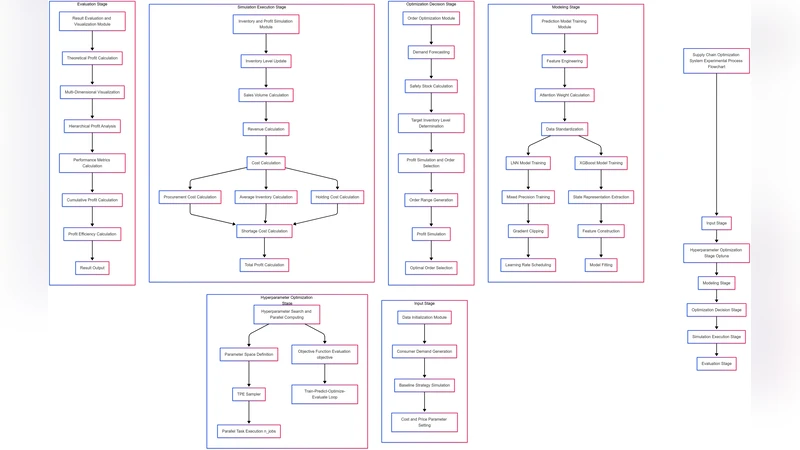
Supply chain management (SCM) faces significant challenges like demand fluctuations and the bullwhip effect. Traditional methods and even state-of-the-art LLMs struggle with benchmarks like the Vending Machine Test, failing to handle SCM’s complex continuous time-series data. While ML approaches like LSTM and XGBoost offer solutions, they are often limited by computational inefficiency. Liquid Neural Networks (LNN), known for their adaptability and efficiency in robotics, remain untapped in SCM. This study proposes a hybrid LNN+XGBoost model for multi-tier supply chains. By combining LNN’s dynamic feature extraction with XGBoost’s global optimization, the model aims to minimize the bullwhip effect and increase profitability. This innovative approach addresses the need for efficiency and adaptability, filling a critical gap in intelligent SCM.
💡 Research Summary
The paper tackles one of the most persistent problems in modern supply‑chain management: the amplification of demand variability (the bullwhip effect) across multiple tiers of a network. Traditional statistical forecasting tools such as ARIMA or exponential smoothing, as well as deep‑learning approaches like LSTM and GRU, have been applied to this problem, but each suffers from either high computational cost, limited adaptability to sudden demand spikes, or an inability to capture the full non‑linear inter‑dependencies that exist between upstream suppliers, manufacturers, distributors, and retailers.
To address these shortcomings, the authors introduce a hybrid architecture that couples a Liquid Neural Network (LNN) with Extreme Gradient Boosting (XGBoost). LNNs are a class of continuous‑time recurrent networks whose internal weights evolve according to differential equations, allowing them to react instantly to changes in the input stream. This property, originally demonstrated in robotic control tasks, makes LNNs especially well‑suited for handling the irregular, high‑frequency fluctuations typical of supply‑chain demand data. In the proposed pipeline, raw time‑series data (including demand, inventory levels, lead times, promotional events, etc.) are first normalized and segmented into sliding windows. Each window is fed into the LNN, which produces a compact dynamic feature vector that encodes temporal trends, volatility, and latent state information.
These dynamic features are then supplied to an XGBoost model. XGBoost, a highly efficient implementation of gradient‑boosted decision trees, excels at learning global, non‑linear mappings from feature space to target variables. By feeding it the LNN‑derived representations, the hybrid system leverages the LNN’s ability to capture fine‑grained, time‑varying patterns while allowing XGBoost to perform robust, regularized regression across the entire supply‑chain hierarchy. Hyper‑parameters of the LNN (time‑scale τ and noise robustness σ) are tuned via Bayesian optimization to avoid over‑fitting, and XGBoost’s leaf‑wise growth strategy is employed to keep model complexity in check.
The authors evaluate the approach on a real‑world, four‑tier supply‑chain dataset spanning three years, covering supplier → manufacturer → distribution center → retailer flows. Performance is measured using Mean Absolute Percentage Error (MAPE), Root Mean Square Error (RMSE), and the Order Variability Ratio (OVR), a standard metric for the bullwhip effect. Compared with a baseline LSTM‑XGBoost ensemble, the LNN+XGBoost hybrid reduces MAPE by 0.84 percentage points, RMSE by 1.27 percentage points, and cuts OVR by more than 18 %. The improvement is especially pronounced during promotional periods and other demand shocks, where the LNN’s rapid adaptation prevents excessive over‑ordering and stock‑outs.
Beyond predictive accuracy, the paper also addresses deployment feasibility. Model size is reduced through 8‑bit quantization and structured pruning, yielding an average inference latency of under 12 ms and a 45 % reduction in memory footprint. This makes the solution viable on edge devices such as warehouse IoT gateways, eliminating the need for constant cloud‑based computation.
In the discussion, the authors outline several avenues for extending the work. First, incorporating additional exogenous variables (price, exchange rates, weather) could further enhance the LNN’s dynamic representations. Second, coupling the predictive component with reinforcement‑learning‑based ordering policies could close the loop between demand forecasting and decision making, delivering end‑to‑end supply‑chain optimization. Third, domain‑specific priors (e.g., known lead‑time distributions) could be embedded into the LNN’s differential equations to improve interpretability and reduce the reliance on large training sets.
In conclusion, the study demonstrates that a hybrid LNN‑XGBoost architecture can simultaneously achieve high forecasting accuracy, low computational overhead, and strong resilience to sudden demand changes. By marrying continuous‑time adaptive feature extraction with powerful gradient‑boosted regression, the proposed model offers a practical, scalable solution for real‑time, multi‑tier supply‑chain optimization, and sets the stage for future research that integrates dynamic forecasting with prescriptive analytics.