FusAD: Time-Frequency Fusion with Adaptive Denoising for General Time Series Analysis
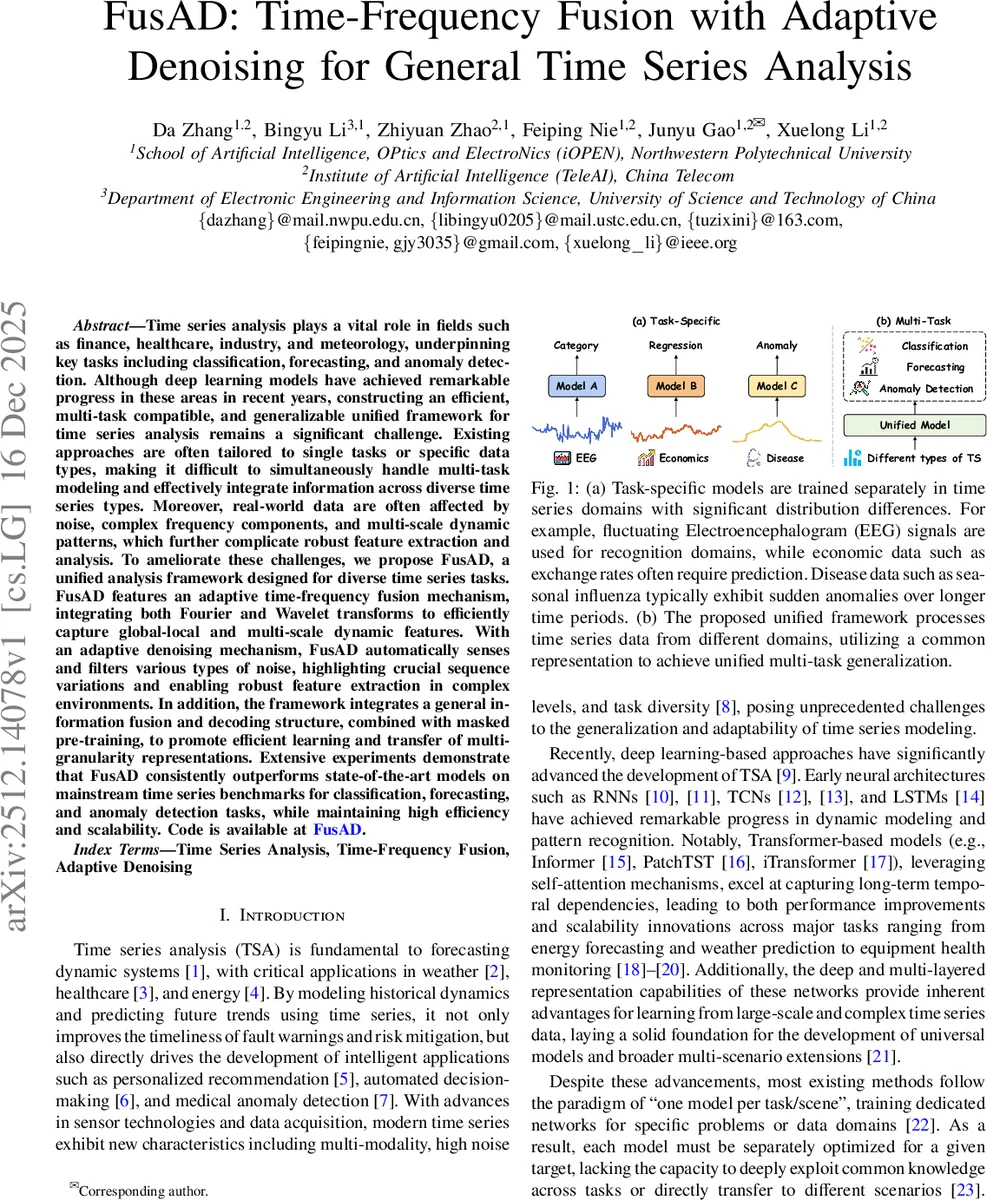
Time series analysis plays a vital role in fields such as finance, healthcare, industry, and meteorology, underpinning key tasks including classification, forecasting, and anomaly detection. Although deep learning models have achieved remarkable progress in these areas in recent years, constructing an efficient, multi-task compatible, and generalizable unified framework for time series analysis remains a significant challenge. Existing approaches are often tailored to single tasks or specific data types, making it difficult to simultaneously handle multi-task modeling and effectively integrate information across diverse time series types. Moreover, real-world data are often affected by noise, complex frequency components, and multi-scale dynamic patterns, which further complicate robust feature extraction and analysis. To ameliorate these challenges, we propose FusAD, a unified analysis framework designed for diverse time series tasks. FusAD features an adaptive time-frequency fusion mechanism, integrating both Fourier and Wavelet transforms to efficiently capture global-local and multi-scale dynamic features. With an adaptive denoising mechanism, FusAD automatically senses and filters various types of noise, highlighting crucial sequence variations and enabling robust feature extraction in complex environments. In addition, the framework integrates a general information fusion and decoding structure, combined with masked pre-training, to promote efficient learning and transfer of multi-granularity representations. Extensive experiments demonstrate that FusAD consistently outperforms state-of-the-art models on mainstream time series benchmarks for classification, forecasting, and anomaly detection tasks, while maintaining high efficiency and scalability. Code is available at https://github.com/zhangda1018/FusAD.
💡 Research Summary
FusAD (Time‑Frequency Fusion with Adaptive Denoising) is presented as a unified framework that simultaneously addresses classification, forecasting, and anomaly detection across heterogeneous time‑series domains. The authors identify three core challenges in existing approaches: insufficient multi‑scale spectral modeling, lack of robustness to diverse noise and anomalies, and limited efficiency when scaling to long or high‑dimensional sequences. To tackle these, FusAD introduces an Adaptive Spectral Module (ASM) that processes each layer’s representations through parallel Fourier and Wavelet transforms. The Fourier branch captures global periodicities, while the Wavelet branch extracts local, transient patterns. A learnable adaptive masking mechanism assigns frequency‑wise thresholds (α, β) that dynamically suppress noisy components and amplify informative ones, thereby providing data‑driven denoising without manual filter design.
Following ASM, an Information Fusion Module (IFM) aggregates multivariate interactions using multiple 1‑D convolutional pathways combined with GELU activations, enabling cross‑channel dependency modeling. The overall architecture stacks L identical layers, each preceded by Layer Normalization, to progressively refine representations. Input series are first divided into non‑overlapping patches, projected via a Conv1D embedding, and enriched with positional embeddings to preserve temporal order. After the hierarchical stack, a linear head projects the final representation to task‑specific outputs (softmax for classification, linear regression for forecasting, and a dedicated anomaly‑score head).
Training proceeds in two stages. First, a masked pre‑training phase randomly masks contiguous segments of the input and forces the model to reconstruct them, encouraging the backbone to learn robust, context‑aware embeddings. Second, multi‑task fine‑tuning optimizes a weighted sum of task‑specific losses (cross‑entropy, MSE, and anomaly‑detection loss). This self‑supervised pre‑training endows FusAD with strong transferability across tasks and domains.
Extensive experiments were conducted on a wide range of benchmarks: 128 classification datasets from the UCR archive, multivariate forecasting datasets such as Electricity, Traffic, and Weather, and anomaly‑detection corpora including Yahoo and NAB. Across all settings, FusAD consistently outperformed state‑of‑the‑art baselines (TimesNet, TV‑Net, PatchTST, and others) by 2–4 percentage points in accuracy or by comparable margins in RMSE and F1‑score. Notably, when synthetic Gaussian noise of varying signal‑to‑noise ratios was added, FusAD’s adaptive denoising preserved performance far better than static denoising pipelines, confirming the efficacy of the frequency‑wise masking. In terms of efficiency, FusAD uses fewer than 7 M parameters and roughly 1.2 GFLOPs, representing a 30–50 % reduction in computational cost relative to models achieving similar accuracy.
The paper also discusses limitations. The dual spectral transforms increase per‑layer computation, which may be a bottleneck for extremely long sequences. Fixed patch sizes and static window functions could hinder adaptability to irregular sampling rates or very low‑frequency trends. Moreover, aggressive early‑stage masking might inadvertently suppress useful high‑frequency signals, requiring careful hyper‑parameter tuning.
Future work suggested includes (1) lightweight approximations or hardware acceleration for the Fourier/Wavelet stages, (2) dynamic patching and adaptive windowing to better capture long‑range dependencies, (3) extension to multimodal time‑series (e.g., combined sensor, text, and image streams), and (4) Bayesian formulations of the adaptive mask to quantify uncertainty in denoising decisions.
Overall, FusAD demonstrates that integrating time‑frequency analysis with learnable denoising within a hierarchical, self‑supervised architecture yields a versatile and efficient solution for general time‑series analysis, advancing the field toward truly universal models capable of handling diverse tasks and noisy real‑world data.
Comments & Academic Discussion
Loading comments...
Leave a Comment