Complete weight enumerators and weight hierarchies for linear codes from quadratic forms
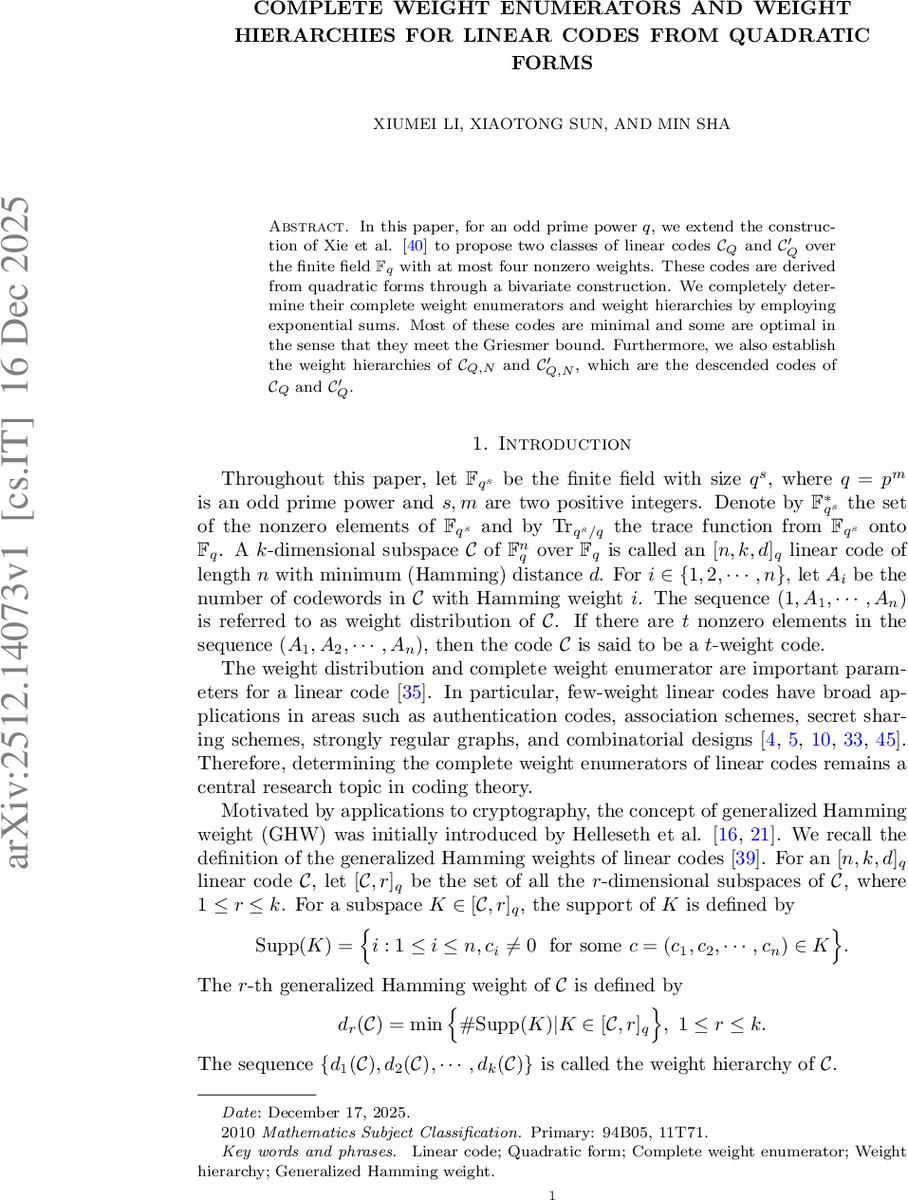
In this paper, for an odd prime power $q$, we extend the construction of Xie et al. \cite{XOYM2023} to propose two classes of linear codes $\mathcal{C}{Q}$ and $\mathcal{C}{Q}’$ over the finite field $\mathbb{F}{q}$ with at most four nonzero weights. These codes are derived from quadratic forms through a bivariate construction. We completely determine their complete weight enumerators and weight hierarchies by employing exponential sums. Most of these codes are minimal and some are optimal in the sense that they meet the Griesmer bound. Furthermore, we also establish the weight hierarchies of $\mathcal{C}{Q,N}$ and $\mathcal{C}{Q,N}’$, which are the descended codes of $\mathcal{C}{Q}$ and $\mathcal{C}_{Q}’$.
💡 Research Summary
This research paper presents a significant advancement in the field of algebraic coding theory by introducing new classes of linear codes derived from quadratic forms. The primary objective of the study is to construct and analyze two specific classes of linear codes, denoted as $\mathcal{C}{Q}$ and $\mathcal{C}{Q}’$, over a finite field $\mathbb{F}_{q}$, where $q$ is an odd prime power. Building upon the foundational work of Xie et al. (2023), the authors employ a sophisticated bivariate construction method that leverages the algebraic properties of quadratic forms to control the weight distribution of the resulting codes.
One of the most striking features of the proposed codes is their highly structured weight profile, characterized by having at most four distinct nonzero weights. Such a restricted weight distribution is highly desirable in coding theory for simplifying the analysis of error-correcting capabilities and for designing efficient decoding algorithms. To achieve a complete understanding of these codes, the authors focus on determining their Complete Weight Enumerators (CWE) and weight hierarchies. The mathematical complexity of calculating these values is addressed through the strategic application of exponential sums over finite fields. By utilizing exponential sums, the researchers were able to precisely evaluate the weight distribution, providing a rigorous mathematical foundation for the structural properties of $\mathcal{C}{Q}$ and $\mathcal{C}{Q}’$.
The paper further demonstrates the practical and theoretical significance of these constructions by proving that many of these codes possess the “minimal” property, which is crucial for certain applications in secret sharing schemes and cryptography. Furthermore, the authors identify specific instances where these codes are “optimal,” meaning they meet the Griesmer bound—a fundamental lower bound on the length of a code given its dimension and minimum distance. This optimality suggests that the proposed construction is highly efficient in terms of redundancy and error-correction performance. Finally, the scope of the research is extended to include the analysis of descended codes, $\mathcal{C}{Q,N}$ and $\mathcal{C}{Q,N}’$, establishing their weight hierarchies as well. This comprehensive analysis provides a complete picture of the algebraic landscape of these quadratic-form-based codes, offering valuable insights for the development of next-generation error-correcting codes in digital communication and data storage systems.
Comments & Academic Discussion
Loading comments...
Leave a Comment