Spiral-induced Anomalous Hall Effect from Odd-parity Spin-nodal Lines
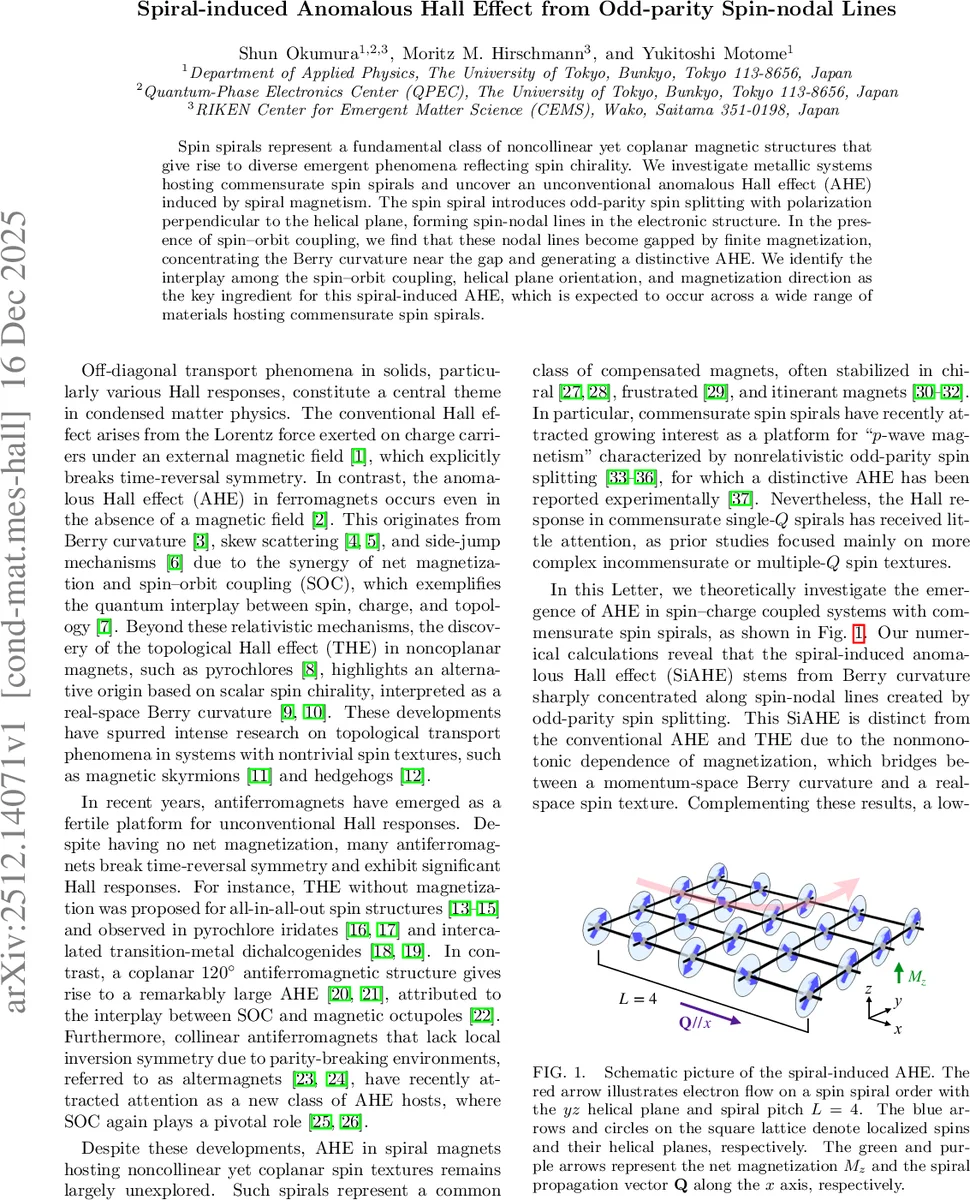
Spin spirals represent a fundamental class of noncollinear yet coplanar magnetic structures that give rise to diverse emergent phenomena reflecting spin chirality. We investigate metallic systems hosting commensurate spin spirals and uncover an unconventional anomalous Hall effect (AHE) induced by spiral magnetism. The spin spiral introduces odd-parity spin splitting with polarization perpendicular to the helical plane, forming spin-nodal lines in the electronic structure. In the presence of spin-orbit coupling, we find that these nodal lines become gapped by finite magnetization, concentrating the Berry curvature near the gap and generating a distinctive AHE. We identify the interplay among the spin-orbit coupling, helical plane orientation, and magnetization direction as the key ingredient for this spiral-induced AHE, which is expected to occur across a wide range of materials hosting commensurate spin spirals.
💡 Research Summary
This research presents a profound theoretical investigation into the emergence of an unconventional Anomalous Hall Effect (AHE) within metallic systems characterized by commensurate spin spirals. Spin spirals, a fundamental class of noncollinear yet coplanar magnetic structures, are renowned for inducing diverse emergent phenomena driven by their intrinsic spin chirality. The study focuses on how the unique geometry of these spiral magnetic structures fundamentally alters the electronic band structure to produce a distinctive Hall response.
The core mechanism identified by the authors begins with the “odd-parity” spin splitting induced by the spin spiral. Unlike standard magnetic configurations, the spin spiral structure generates spin splitting where the polarization is oriented perpendicular to the helical plane. This specific type of splitting leads to the formation of spin-nodal lines within the electronic structure. These nodal lines represent regions where the spin-split bands meet, creating a unique topological feature in the momentum space.
The pivotal discovery lies in the role of spin-orbit coupling (SOC) and magnetization. The researchers demonstrate that when a finite magnetization is present alongside spin-orbit coupling, the previously continuous spin-nodal lines undergo a transition, developing an energy gap. This gapping process is not merely a structural change; it is the catalyst for a massive concentration of Berry curvature near the newly formed gap. Since the Anomalous Hall Effect is fundamentally driven by the integration of Berry curvature over the occupied electronic states, this intense concentration of curvature near the gap serves as the primary driver for the observed, distinctive AHE.
Furthermore, the study highlights that the characteristics of this spiral-induced AHE are not random but are governed by a precise interplay between three critical ingredients: the strength of the spin-orbit coupling, the orientation of the helical plane, and the direction of the magnetization. This intricate dependency suggests that the AHE can be finely tuned by manipulating the magnetic texture and the crystal’s spin-orbit properties.
The implications of this work are far-reaching. Because the mechanism relies on the intrinsic properties of commensurate spin spirals rather than specific impurities or rare-earth elements, the authors suggest that this phenomenon is expected to be observable across a wide range of materials hosting such magnetic structures. This provides a new paradigm for the development of spintronic devices, where the Hall transport properties can be engineered through the precise control of spin-spiral-induced topological features, opening new frontiers in the field of topological magnetism and low-power electronic applications.
Comments & Academic Discussion
Loading comments...
Leave a Comment