Multivariate Time Series Forecasting with Hybrid Euclidean-SPD Manifold Graph Neural Networks
Multivariate Time Series (MTS) forecasting plays a vital role in various real-world applications, such as traffic management and predictive maintenance. Existing approaches typically model MTS data in either Euclidean or Riemannian space, limiting their ability to capture the diverse geometric structures and complex spatio-temporal dependencies inherent in real-world data. To overcome this limitation, we propose the Hybrid Symmetric Positive-Definite Manifold Graph Neural Network (HSMGNN), a novel graph neural network-based model that captures data geometry within a hybrid Euclidean-Riemannian framework. To the best of our knowledge, this is the first work to leverage hybrid geometric representations for MTS forecasting, enabling expressive and comprehensive modeling of geometric properties. Specifically, we introduce a Submanifold-Cross-Segment (SCS) embedding to project input MTS into both Euclidean and Riemannian spaces, thereby capturing spatio-temporal variations across distinct geometric domains. To alleviate the high computational cost of Riemannian distance, we further design an Adaptive-Distance-Bank (ADB) layer with a trainable memory mechanism. Finally, a Fusion Graph Convolutional Network (FGCN) is devised to integrate features from the dual spaces via a learnable fusion operator for accurate prediction. Experiments on three benchmark datasets demonstrate that HSMGNN achieves up to a 13.8 percent improvement over state-of-the-art baselines in forecasting accuracy.
💡 Research Summary
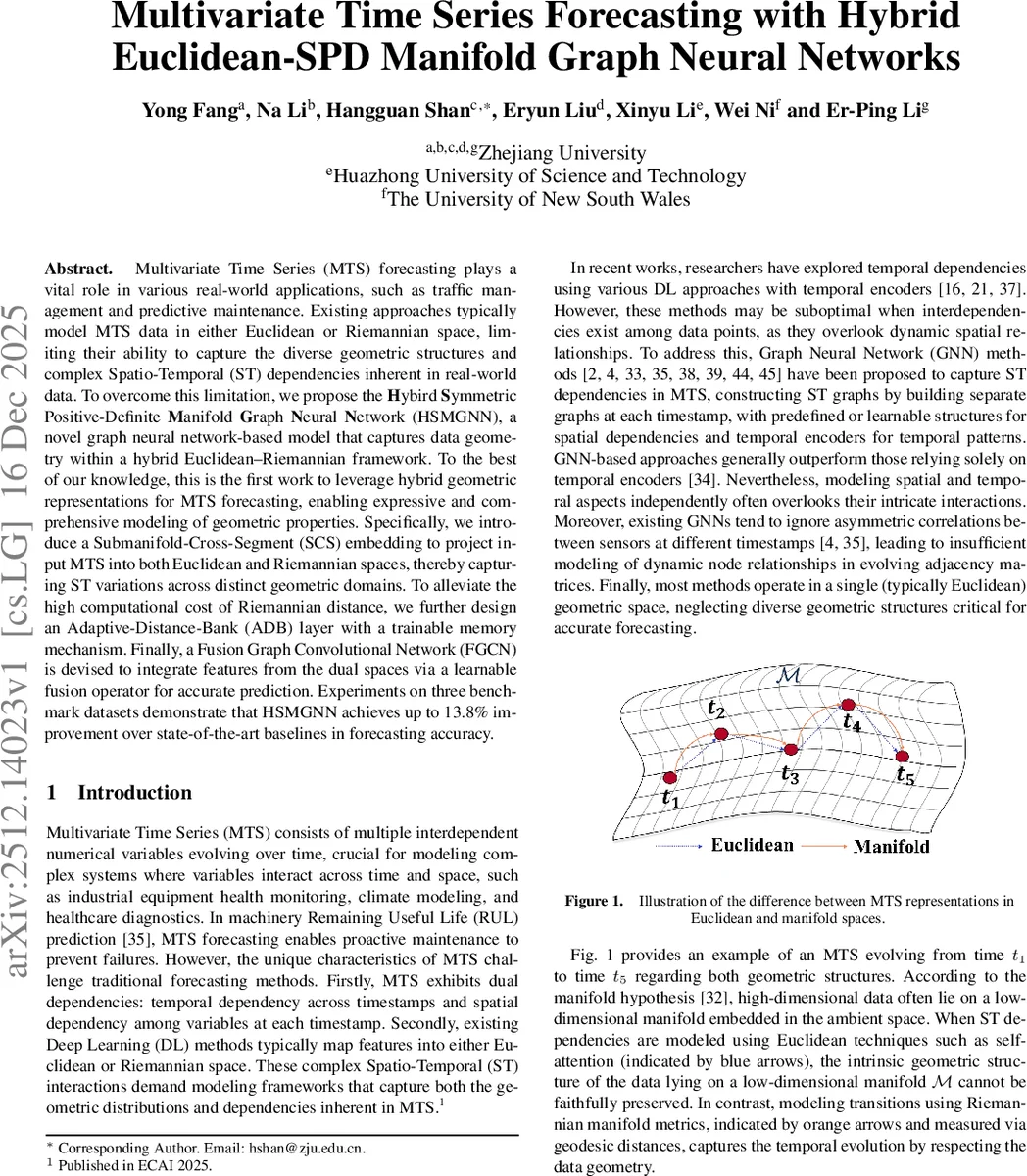
This paper introduces the Hybrid Symmetric Positive-Definite Manifold Graph Neural Network (HSMGNN), a novel framework designed to significantly improve the accuracy of Multivariate Time Series (MTS) forecasting. The core innovation of HSMGNN lies in its pioneering hybrid geometric representation, which concurrently models MTS data in both Euclidean space and on the Symmetric Positive-Definite (SPD) Riemannian manifold. This approach overcomes a key limitation of prior works, which typically operated in only one of these spaces, thereby failing to fully capture the diverse linear and non-linear geometric structures inherent in complex real-world spatio-temporal data.
The HSMGNN architecture is built around three meticulously designed components. First, the Submanifold-Cross-Segment (SCS) embedding module processes the input MTS. It employs a sliding window to partition the time series into segments. For each segment, it extracts Euclidean features using a 1D CNN while simultaneously projecting the data points within that segment onto the SPD manifold by computing their sample covariance matrix. This creates dual, complementary representations: Euclidean features capture linear temporal dynamics, and SPD manifold features encapsulate non-linear, statistical geometric relationships among variables over local time windows.
Second, to address the well-known computational bottleneck associated with Riemannian operations (like Log-Euclidean metrics), the authors propose the Adaptive-Distance-Bank (ADB) layer. Instead of computing expensive Riemannian distances on-the-fly, the ADB employs a trainable memory bank that learns a set of prototypical geometric relationships. During processing, it adaptively retrieves and combines these pre-learned relationships to approximate complex manifold interactions efficiently, dramatically reducing computational overhead while preserving expressive power.
Third, the Fusion Graph Convolutional Network (FGCN) serves as the decision layer that integrates information from the dual geometric pathways. It takes the graph-structured representations from both the Euclidean and the SPD (refined by ADB) spaces—each with its own node features and adjacency matrices encoding relationships specific to that space. The FGCN performs graph convolution operations separately on each graph and then fuses the resulting features using a learnable, weighted fusion operator. This allows the model to dynamically determine the contribution of each geometric perspective to the final prediction. The fused representation is finally passed through a Multi-Layer Perceptron (MLP) to generate the forecast.
The paper validates HSMGNN through extensive experiments on three benchmark datasets for traffic flow, solar power, and road speed forecasting. The results demonstrate state-of-the-art performance, with HSMGNN achieving improvements of up to 13.8% in Root Mean Squared Error (RMSE) compared to strong baselines, including pure Euclidean GNN models and existing SPD manifold-based methods. The work makes significant contributions by being the first to successfully leverage hybrid Euclidean-Riemannian representations for MTS forecasting, introducing mechanisms for efficient manifold computation, and providing a unified framework that balances high expressive power with practical computational efficiency.
Comments & Academic Discussion
Loading comments...
Leave a Comment