Scaling solutions for gauge invariant flow equations in dilaton quantum gravity
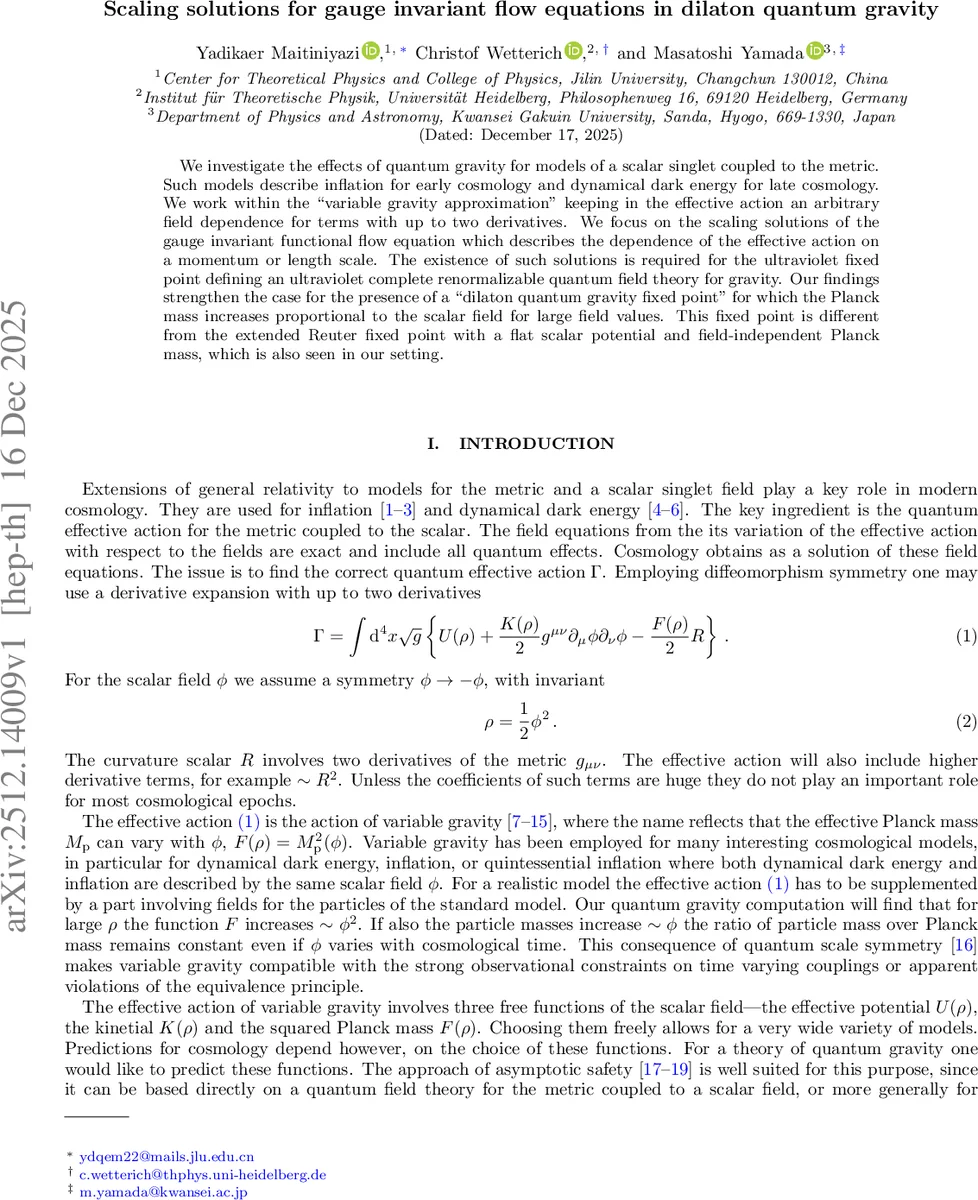
We investigate the effects of quantum gravity for models of a scalar singlet coupled to the metric. Such models describe inflation for early cosmology and dynamical dark energy for late cosmology. We work within the ‘‘variable gravity approximation" keeping in the effective action an arbitrary field dependence for terms with up to two derivatives. We focus on the scaling solutions of the gauge invariant functional flow equation which describes the dependence of the effective action on a momentum or length scale. The existence of such solutions is required for the ultraviolet fixed point defining an ultraviolet complete renormalizable quantum field theory for gravity. Our findings strengthen the case for the presence of a ‘‘dilaton quantum gravity fixed point" for which the Planck mass increases proportional to the scalar field for large field values. This fixed point is different from the extended Reuter fixed point with a flat scalar potential and field-independent Planck mass, which is also seen in our setting.
💡 Research Summary
This paper presents a comprehensive investigation into scaling solutions within the functional renormalization group (FRG) flow for quantum gravity coupled to a scalar singlet field, a framework relevant for modeling both early-universe inflation and late-time dynamical dark energy. The authors employ the “variable gravity” approximation, considering an effective action with up to two derivatives, parameterized by a field-dependent potential (U(\rho)), Planck mass function (F(\rho)), and kinetic function (K(\rho)).
The central technical achievement is the derivation of the precise flow equations (Eqs. 5-7) and the corresponding scaling equations (Eqs. 11-13) for the dimensionless functions (u=U/k^4), (w=F/2k^2), and (\kappa=K), which depend on the dimensionless field (\tilde{\rho}=\rho/k^2). A scaling solution, where these functions depend solely on (\tilde{\rho}) and not explicitly on the RG scale (k), is a prerequisite for an ultraviolet (UV) fixed point, ensuring the theory’s non-perturbative renormalizability (asymptotic safety).
Through numerical integration, the authors successfully identify global scaling solutions valid across the entire range (0 \leq \tilde{\rho} < \infty). The solutions exhibit a clear crossover behavior between two distinct fixed point regimes:
- Infrared (IR) Fixed Point ((\tilde{\rho} \to \infty)): For large field values, the dimensionless Planck mass (\sqrt{2w}) becomes large, effectively decoupling gravity. The functions approach constants: (u \to u_\infty = 3/(128\pi^2)) (dictated by the free massless graviton and scalar contributions), (w \sim \xi_\infty \tilde{\rho}), and (\kappa \to \kappa_\infty). Here, (\xi_\infty) and (\kappa_\infty) are free parameters subject only to the stability condition (\kappa_\infty/\xi_\infty > -6).
- Ultraviolet (UV) Fixed Point ((\tilde{\rho} \to 0)): This is identified as the “dilaton quantum gravity fixed point.” Its key signature is that (w(\tilde{\rho})) interpolates from a finite constant (w_0) at (\tilde{\rho}=0) to the linear behavior (w \approx w_0 + \xi_\infty \tilde{\rho}) for large (\tilde{\rho}). This implies a non-zero non-minimal coupling (\xi) even at the fixed point, leading to a field-dependent Planck mass—the defining feature of variable gravity.
This UV fixed point is fundamentally different from the often-studied extended Reuter fixed point, which typically assumes a flat potential and a field-independent Planck mass. The paper also demonstrates that stable scaling solutions can exist for negative values of the kinetic function (\kappa) (e.g., (\kappa_\infty = -0.3)), exploring a wider parameter space relevant for the kinetic mixing between the scalar and metric degrees of freedom.
In conclusion, the findings robustly support the existence of a distinct dilaton quantum gravity fixed point within the FRG framework. This fixed point naturally incorporates a field-dependent Planck mass and provides a viable UV-completion scenario for gravity-scalar systems, strengthening the link between quantum gravity predictions and cosmological phenomenology for both the very early and the very late universe.
Comments & Academic Discussion
Loading comments...
Leave a Comment