On Glaisher's Partition Theorem
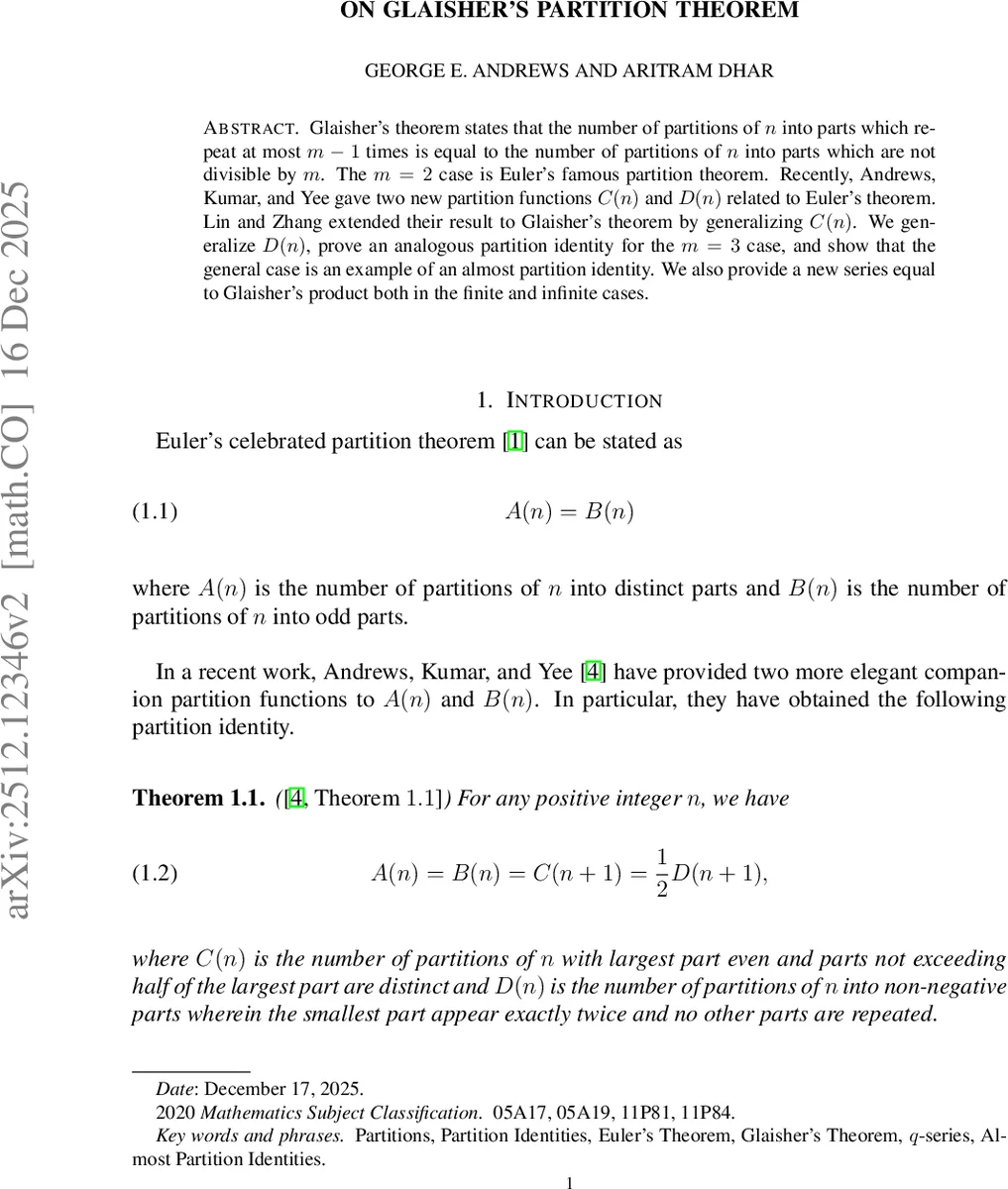
Glaisher’s theorem states that the number of partitions of $n$ into parts which repeat at most $m-1$ times is equal to the number of partitions of $n$ into parts which are not divisible by $m$. The $m=2$ case is Euler’s famous partition theorem. Recently, Andrews, Kumar, and Yee gave two new partition functions $C(n)$ and $D(n)$ related to Euler’s theorem. Lin and Zhang extended their result to Glaisher’s theorem by generalizing $C(n)$. We generalize $D(n)$, prove an analogous partition identity for the $m=3$ case, and show that the general case is an example of an almost partition identity. We also provide a new series equal to Glaisher’s product both in the finite and infinite cases.
💡 Research Summary
The paper investigates extensions of Glaisher’s partition theorem by introducing two families of partition functions, (C_m(n)) and (D_m(n)), which generalize the recent functions (C(n)) and (D(n)) of Andrews, Kumar, and Yee (originally tied to Euler’s theorem). For a fixed integer (m\ge2), (A_m(n)) counts partitions of (n) in which each part appears fewer than (m) times, while (B_m(n)) counts partitions whose parts are not divisible by (m). Glaisher’s theorem asserts (A_m(n)=B_m(n)).
The authors define:
- (C_m(n)): partitions of (n) whose largest part is a multiple of (m) (say (mj)) and every part (\le j) appears fewer than (m) times.
- (D_m(n)): partitions of (n) into non‑negative parts where the smallest part occurs exactly (m) times and all other parts appear fewer than (m) times.
A third auxiliary function (E_m(n)) is introduced to capture the discrepancy between (C_m) and (D_m). Its generating function is
\
Comments & Academic Discussion
Loading comments...
Leave a Comment