Binary and Non-Binary Self-Dual Sequences and Maximum Period Single-Track Gray Codes
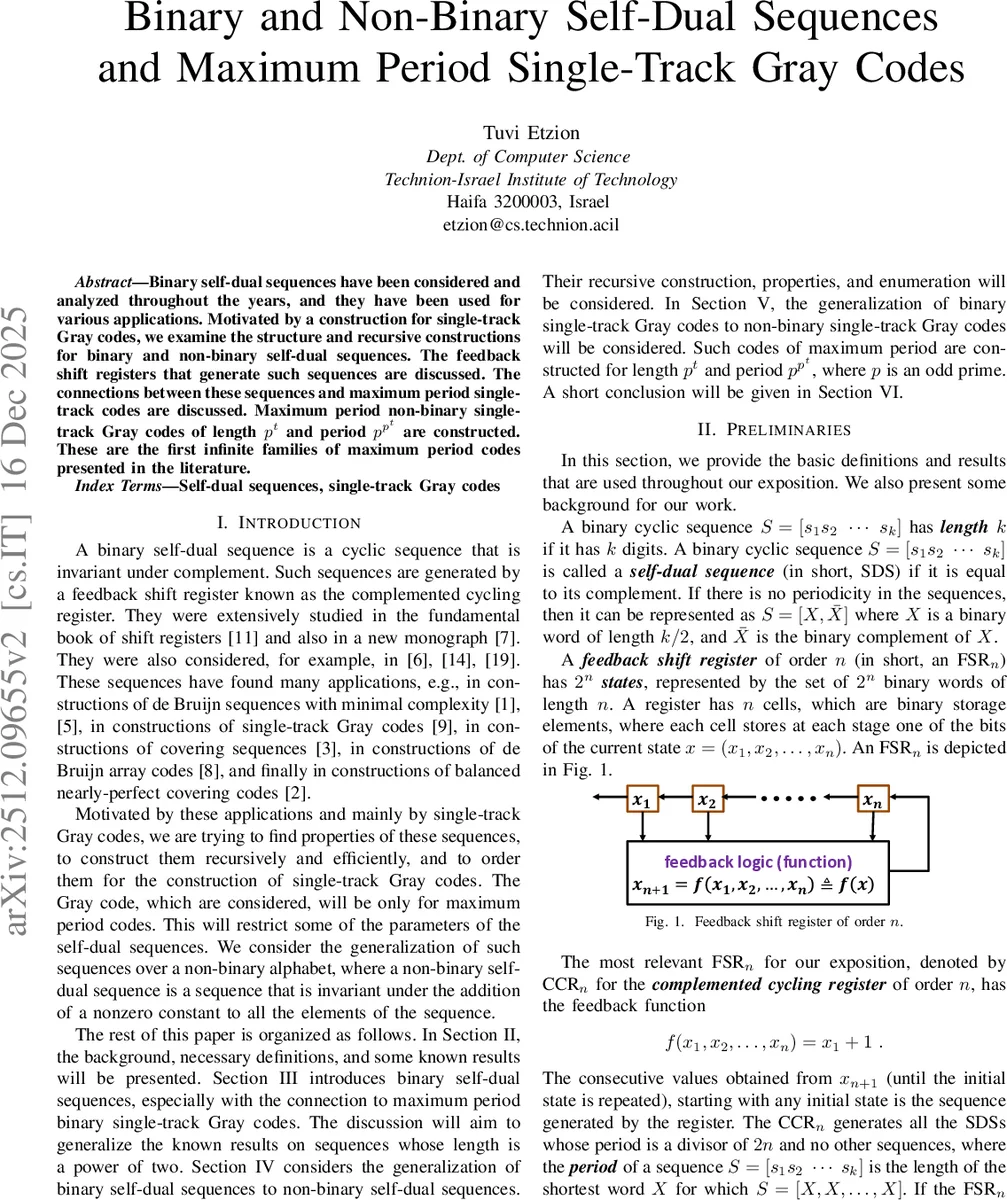
Binary self-dual sequences have been considered and analyzed throughout the years, and they have been used for various applications. Motivated by a construction for single-track Gray codes, we examine the structure and recursive constructions for binary and non-binary self-dual sequences. The feedback shift registers that generate such sequences are discussed. The connections between these sequences and maximum period single-track codes are discussed. Maximum period non-binary single-track Gray codes of length $p^t$ and period $p^{p^t}$ are constructed. These are the first infinite families of maximum period codes presented in the literature.
💡 Research Summary
The paper investigates binary and non‑binary self‑dual sequences (SDS) and their use in constructing maximum‑period single‑track Gray codes (STGC). A self‑dual sequence is a cyclic word that is invariant under complement (binary case) or under addition of a non‑zero constant (non‑binary case). The authors focus on the complemented cycling register (CCR), a feedback shift register (FSR) whose feedback function is f(x₁,…,xₙ)=x₁+1 (mod m). For binary alphabets (m = 2) CCRₙ generates exactly all binary SDS whose period divides 2ⁿ. The number of generated sequences is given by Z⁎(n)=½ⁿ∑_{d|n, d odd} φ(d)·2^{n/d} (Theorem 1) and relates to the count SD(d) of SDS of period d (Lemma 1).
Two key operators are introduced: the difference operator D (equivalent to a cyclic shift minus identity) and its inverse D⁻¹, which map between sequences of different periods while preserving or creating self‑duality. Applying D⁻¹ repeatedly (2ⁿ times) to a binary sequence of period 2ⁿ+1 yields a structured four‑block word
Comments & Academic Discussion
Loading comments...
Leave a Comment