A Hybrid Anyon-Otto thermal machine
We propose a four-stroke quantum thermal machine based on the 1D anyon Hubbard model, which is capable of extracting the excess energy arising from anyon exclusion statistics at low temperature into finite work. Defining a hybrid anyon-Otto (HAO) cycle, we find that the low-temperature work, in the absence of any interactions, is maximized in the pseudo-fermionic limit, where the anyons most closely resemble free fermions. However, when weak interactions are introduced, the work output is no longer maximized at the bosonic or pseudo-fermionic extremes but instead peaks at intermediate statistical angles. This clearly demonstrates that interactions and anyonic statistics conspire non-trivially to enhance performance, with interacting anyons offering greater quantum thermodynamic advantage than either bosons or pseudo-fermions, in this regime. Furthermore, we also outline an experimental protocol to realize the HAO cycle using ultracold atoms in an optical lattice.
💡 Research Summary
In this work the authors introduce a novel quantum heat engine based on the one‑dimensional anyon Hubbard model (AHM) and formulate a four‑stroke cycle that they call the Hybrid Anyon‑Otto (HAO) engine. The key innovation is the inclusion of a statistical parameter θ, which continuously interpolates between bosonic (θ = 0) and pseudo‑fermionic (θ = π) exchange statistics, as an active control knob during the thermalisation strokes of the cycle. By varying θ together with the usual Hamiltonian parameters (the hopping amplitude J or the on‑site interaction U), the engine can convert not only heat supplied by two thermal reservoirs but also the “anyon energy” that originates from the exclusion statistics of the particles.
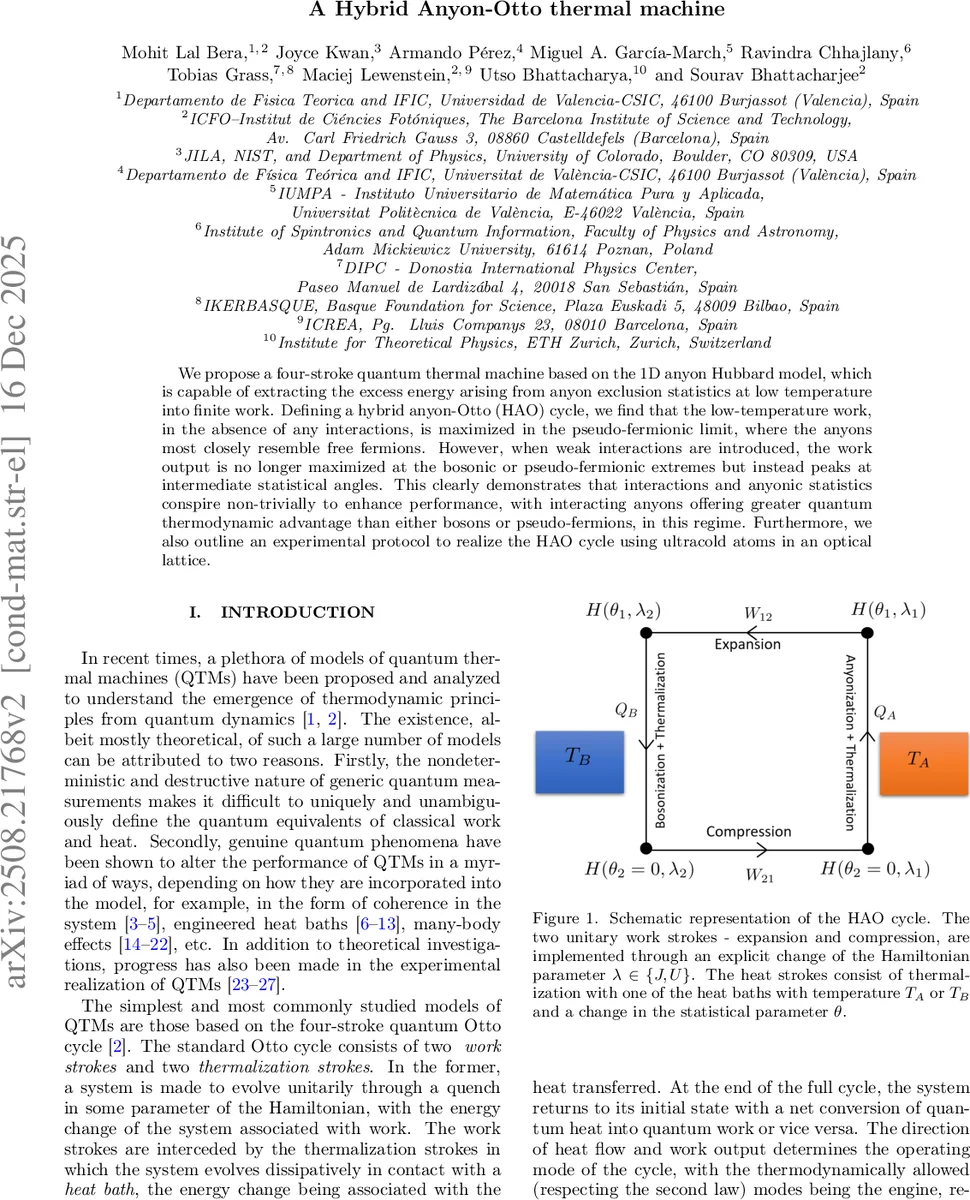
The cycle proceeds as follows: (1) a unitary expansion where λ (either J or U) is ramped from λ₁ to λ₂ while the system is isolated, generating work W₁₂; (2) a combined anyonisation‑thermalisation stroke in which θ is changed from θ₁ to θ₂ while the system is brought into contact with the hot bath at temperature T_B, resulting in a heat exchange Q_B (the work associated with the θ‑change is deliberately counted as heat for bookkeeping); (3) a unitary compression λ₂ → λ₁ producing work W₂₁; (4) a reverse anyonisation‑thermalisation stroke θ₂ → θ₁ with the cold bath at temperature T_A, delivering heat Q_A. Energy conservation gives W = W₁₂ + W₂₁ = Q_A + Q_B. The crucial difference from the standard Otto engine is the explicit modification of the particle statistics during the two thermalisation strokes.
In the non‑interacting limit (U = 0) the work strokes commute, so the evolution is effectively adiabatic and independent of the stroke duration. At high bath temperatures (T_A, T_B ≫ 1) the anyonic statistics become indistinguishable from Boltzmann statistics, and the HAO reduces to the ordinary Otto engine with the usual three operating modes: engine, refrigerator, and accelerator. At low temperatures (T_A, T_B → 0) the exclusion statistics generate a finite “anyon energy” when θ is switched from bosonic to pseudo‑fermionic values. This stored energy can be harvested as work even when the baths provide essentially no heat. Remarkably, for θ₁ = π and θ₂ = 0 the engine operates in an “inverse accelerator” mode: heat flows from the colder bath to the hotter one while a net positive work is extracted. The authors argue that this does not violate the second law because the work required to change θ (the statistical work) must be added to the bookkeeping; when included, the total entropy production remains non‑negative.
When a weak on‑site interaction is introduced (U ≪ J) the picture changes dramatically. Numerical simulations on chains of length L = 8 with particle numbers N ≈ L/2 show that the work per particle, W/N, becomes a non‑monotonic function of the initial statistical angle θ₁. Instead of being maximal at the bosonic or pseudo‑fermionic extremes, the work peaks at intermediate angles (roughly θ ≈ π/2). This behavior is explained as a cooperative effect: (i) the interaction shifts the ground‑state energy by a first‑order correction ΔE_G ≈ U⟨n_i(n_i − 1)⟩, thereby raising the overall energy scale; (ii) intermediate anyonic statistics provide partial exclusion, reducing double occupancy and thus enhancing the benefit of the interaction energy. The net result is that interacting anyons can outperform pure bosons or pure pseudo‑fermions in terms of work output at low temperatures.
The authors also propose a concrete experimental implementation using ultracold atoms in an optical lattice. The anyonic phase θ can be engineered by imposing a synthetic gauge field through laser‑induced Peierls phases or Raman‑assisted tunnelling, while J is tuned by the lattice depth and U by a Feshbach resonance. The two thermal reservoirs are realized by coupling the lattice system to auxiliary atomic clouds at controlled temperatures, allowing controlled thermalisation during the θ‑change strokes. Parameter regimes suggested in the paper (J₁ = 1, J₂ = 2, U ≈ 0.1 J, τ ≈ ms) are within current experimental capabilities.
In summary, the paper makes four major contributions: (1) it introduces a statistical control parameter into a quantum Otto cycle, thereby defining a “statistical work” channel; (2) it demonstrates that weak interactions combined with anyonic statistics can non‑trivially boost work output beyond the bosonic or pseudo‑fermionic limits; (3) it uncovers a low‑temperature inverse‑accelerator regime where work is extracted without net heat flow, consistent with the second law once statistical work is accounted for; and (4) it outlines a realistic protocol for realizing the HAO engine in state‑of‑the‑art cold‑atom platforms. These results open a new avenue for exploiting exotic quantum statistics in quantum thermodynamic devices and suggest that many‑body effects, when paired with tunable statistics, can be harnessed for enhanced energy conversion at the quantum scale.
Comments & Academic Discussion
Loading comments...
Leave a Comment