Multi-top signals of vectorlike quarks at the LHC
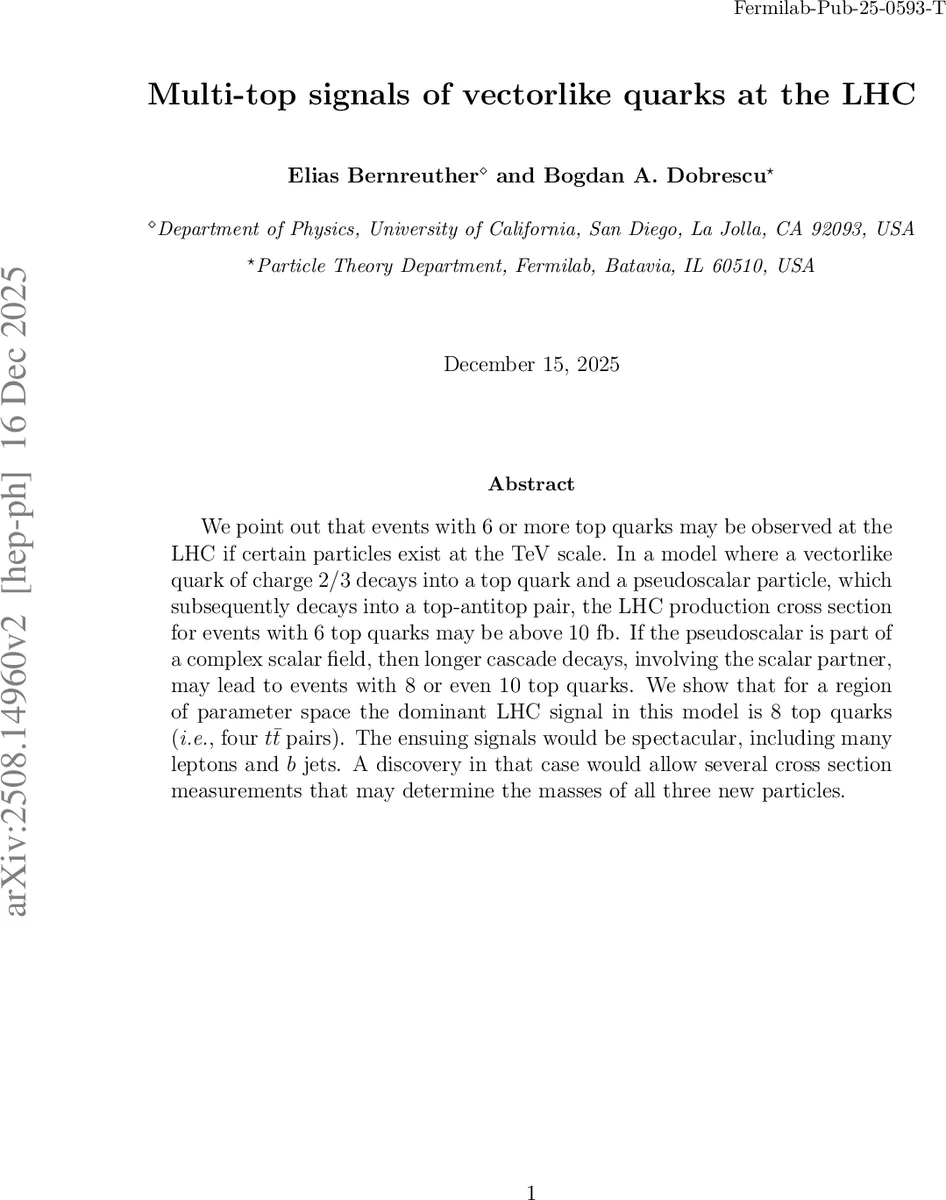
We point out that events with 6 or more top quarks may be observed at the LHC if certain particles exist at the TeV scale. In a model where a vectorlike quark of charge 2/3 decays into a top quark and a pseudoscalar particle, which subsequently decays into a top-antitop pair, the LHC production cross section for events with 6 top quarks may be above 10 fb. If the pseudoscalar is part of a complex scalar field, then longer cascade decays, involving the scalar partner, may lead to events with 8 or even 10 top quarks. We show that for a region of parameter space the dominant LHC signal in this model is 8 top quarks (i.e., four $t\bar t $ pairs). The ensuing signals would be spectacular, including many leptons and $b$ jets. A discovery in that case would allow several cross section measurements that may determine the masses of all three new particles.
💡 Research Summary
The paper proposes a concrete, renormalizable extension of the Standard Model that can generate spectacular events containing six, eight, or even ten top quarks at the LHC. The model introduces a weak‑singlet vector‑like quark χ with electric charge +2/3 and a gauge‑singlet complex scalar ϕ. χ mixes with the third‑generation up‑type quark, giving rise to the observed top t and a heavy partner t′. The mixing angle θL is constrained by electroweak precision observables (the T parameter), the measured CKM element |Vtb|, and the Higgs‑top coupling κt, leading to an upper bound sin θL ≲ 0.12 for a 1 TeV t′ mass.
The complex scalar ϕ is decomposed into a CP‑even scalar φt and a CP‑odd pseudoscalar at (mass > 2 mt). The pseudoscalar at essentially any mass above the t t̄ threshold decays promptly to a top‑antitop pair. If the scalar is heavier than twice the pseudoscalar mass, it dominantly decays as φt → at at, each at subsequently yielding a t t̄ pair. Consequently, a single decay chain t′ → t φt → t (at at) can produce up to five top quarks. Pair production of t′ (pp → t′t′) therefore leads to final states with 6, 8, or 10 tops depending on whether the intermediate φt is present.
Cross‑section calculations performed with MadGraph5_aMC@NLO (including NLO K‑factors) show that for a representative parameter choice m_{t′}=1.5–2 TeV, M_{φ}=0.8 m_{t′}, and M_{a}=0.4 m_{t′}, the production rate σ(pp → t′t′) lies in the 30–50 fb range. Multiplying by the appropriate branching fractions yields signal cross sections of roughly 5–15 fb for the 6t, 8t, and 10t topologies. Notably, when the mass ratio m_{t′}/M_{φ} is large, the 8‑top (four t t̄ pairs) channel dominates because the cascade t′ → t φt is kinematically favored and has a sizable branching fraction.
Experimentally, these multi‑top events are characterized by a very high multiplicity of b‑jets (up to eight) and multiple isolated leptons (electrons or muons). The authors propose selection cuts such as ≥3 leptons, ≥4 b‑jets, and a large scalar sum of transverse momenta H_T > 2 TeV, which suppress the dominant SM backgrounds (t t̄+jets, t t̄ W/Z, and SM 4‑top production). Simulated signal efficiencies after these cuts are estimated at 10–20 %, implying that with the full Run‑2 dataset (≈140 fb⁻¹) one could already observe a handful of events, while the High‑Luminosity LHC (3000 fb⁻¹) would yield several hundred 8‑top events.
A key advantage of the proposed scenario is the possibility of reconstructing the masses of the three new particles from the same dataset. The invariant mass of each at → t t̄ pair gives M_a, the combination of two at’s from a φt decay yields M_φ, and the overall invariant mass of the t′ decay products provides m_{t′}. This multi‑step mass reconstruction would allow a direct test of the model’s spectrum and couplings.
In summary, the work demonstrates that a modestly extended SM containing a vector‑like quark and a complex scalar can naturally produce multi‑top final states with cross sections well above the tiny SM expectations. The 8‑top signature is especially promising, offering a clean, high‑multiplicity final state that can be isolated with existing LHC analyses. Observation of such events would constitute compelling evidence for new colored fermions and scalar dynamics at the TeV scale, and would open a new window onto theories of compositeness, composite Higgs models, or other mechanisms that predict heavy vector‑like quarks and singlet scalars.
Comments & Academic Discussion
Loading comments...
Leave a Comment