MTLoc: A Confidence-Based Source-Free Domain Adaptation Approach For Indoor Localization
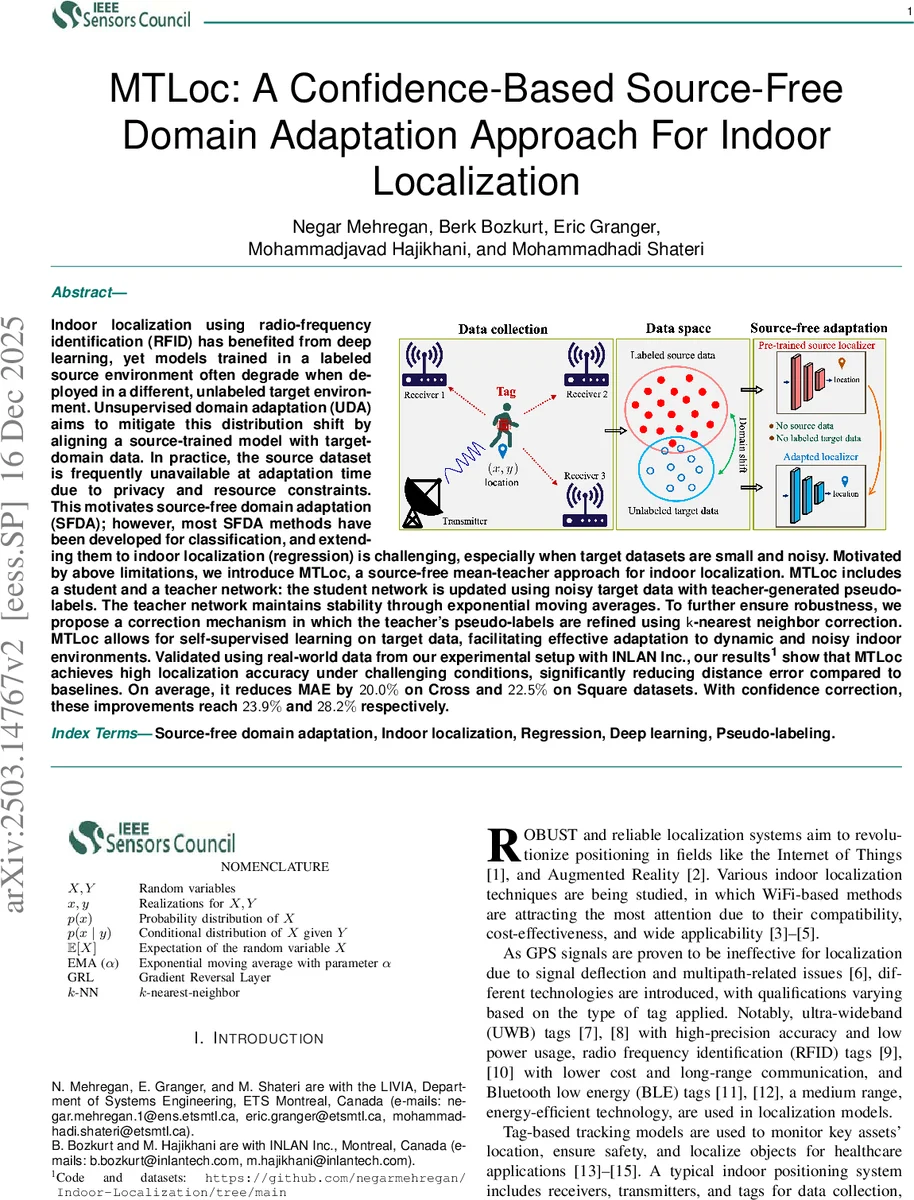
Various deep learning models have been developed for indoor localization based on radio-frequency identification (RFID) tags. However, they often require adaptation to ensure accurate tracking in new target operational domains. To address this challenge, unsupervised domain adaptation (UDA) methods have been proposed to align pre-trained models with data from target environments. However, they rely on large annotated datasets from the initial domain (source). Source data access is limited by privacy, storage, computational, and transfer constraints. Although many source-free domain adaptation (SFDA) methods address these constraints in classification, applying them to regression models for localization remains challenging. Indeed, target datasets for indoor localization are typically small, with few features and samples, and are noisy. Adapting regression models requires high-confidence target pseudo-annotation to avoid over-training. In this paper, a specialized mean-teacher method called MTLoc is proposed for SFDA. MTLoc updates the student network using noisy data and teacher-generated pseudo-labels. The teacher network maintains stability through exponential moving averages. To further ensure robustness, the teacher’s pseudo-labels are refined using k-nearest neighbor correction. MTLoc allows for self-supervised learning on target data, facilitating effective adaptation to dynamic and noisy indoor environments. Validated using real-world data from our experimental setup with INLAN Inc., our results show that MTLoc achieves high localization accuracy under challenging conditions, significantly reducing localization error compared to baselines, including the state-of-the-art adversarial UDA approach with access to source data.
💡 Research Summary
This paper addresses the practical problem of adapting deep‑learning based indoor localization models that rely on RFID signals to new, unlabeled target environments without any access to the original source data. While unsupervised domain adaptation (UDA) methods can align source‑trained models to target domains, they presuppose that the source dataset remains available—a condition often violated by privacy regulations, storage constraints, or corporate policies. Moreover, most source‑free domain adaptation (SFDA) research focuses on classification; extending these ideas to regression tasks such as indoor positioning is non‑trivial because target datasets are typically small, noisy, and highly sensitive to erroneous pseudo‑labels.
To overcome these challenges, the authors propose MTLoc, a confidence‑driven, source‑free domain adaptation framework built on the mean‑teacher paradigm. The system comprises two identical networks—a student and a teacher—both initialized with a localization model pre‑trained on the source domain (the “Ceiling” dataset). During adaptation, the student receives raw RFID measurements from the target domain (either the “Cross” or “Square” layouts) and is trained to regress the device’s (X, Y) coordinates using pseudo‑labels generated by the teacher. The teacher’s parameters are updated via an exponential moving average (EMA) of the student’s weights, which stabilizes the teacher’s predictions and mitigates the propagation of noisy labels.
A key innovation is the confidence‑based k‑nearest‑neighbor (k‑NN) correction applied to the teacher’s outputs. For each target sample, the teacher’s predicted coordinate is refined by computing a distance‑weighted average of the k most similar target samples’ predictions. If the discrepancy between the original and refined predictions falls below a predefined threshold, the label is deemed high‑confidence and passed to the student; otherwise it is discarded. This selective training dramatically reduces over‑fitting to erroneous pseudo‑labels and improves robustness against the inherent noise of RFID measurements.
The underlying localization model consists of a feature extractor (F) that ingests multi‑modal RFID features (RSSI, phase, CSI, etc.) and a regression head (R) that maps the extracted embedding to a 2‑D position. The loss function follows a Laplacian error model, i.e., an L1 loss, which is more appropriate for indoor environments where outliers and non‑Gaussian errors are common. Consistency regularization is also employed: small Gaussian perturbations are added to the inputs so that the student and teacher produce consistent outputs, further stabilizing training.
Experiments were conducted in a real‑world testbed at INLAN Inc., featuring four receivers, one transmitter, and an RFID tag. Three datasets were collected: a source “Ceiling” set and two target sets (“Cross” and “Square”). Each target set contains only a few hundred samples with a signal‑to‑noise ratio of roughly 10‑15 %. Baselines include: (1) a source‑only model (no adaptation), (2) an oracle trained on fully labeled target data, (3) a GRL‑based adversarial UDA method derived from FreeLoc, and (4) the existing SFDA regression approach TAS‑FAR.
Results show that MTLoc reduces mean absolute error (MAE) by 20.0 % on the Cross set and 22.5 % on the Square set relative to the source‑only baseline. When the confidence‑based k‑NN refinement is activated (MTLoc‑Conf), the improvements increase to 23.9 % and 28.2 %, respectively. The method also exhibits faster convergence and negligible over‑fitting compared with the adversarial UDA baseline, which, while competitive, requires access to source data. TAS‑FAR lags behind, achieving less than 10 % MAE reduction.
The authors highlight three main contributions: (1) a novel SFDA framework tailored for regression‑based indoor localization, (2) the combination of EMA‑stabilized mean‑teacher learning with k‑NN confidence correction to produce high‑quality pseudo‑labels, and (3) a thorough empirical validation on real RFID data demonstrating substantial performance gains without any source data. Limitations include the computational cost of exact k‑NN for larger target sets and sensitivity to hyper‑parameters (EMA decay α and the choice of k). Future work will explore approximate nearest‑neighbor search (e.g., FAISS), extensions to multi‑tag and multi‑antenna scenarios, and Bayesian uncertainty modeling for more principled confidence estimation.
In summary, MTLoc offers a practical, privacy‑preserving solution for adapting indoor RFID localization systems to new environments, achieving significant error reductions while eliminating the need for source data. Its design makes it well‑suited for deployment in smart factories, logistics hubs, and healthcare facilities where rapid, reliable re‑calibration of positioning systems is essential.
Comments & Academic Discussion
Loading comments...
Leave a Comment