Primer C-VAE: An interpretable deep learning primer design method to detect emerging virus variants
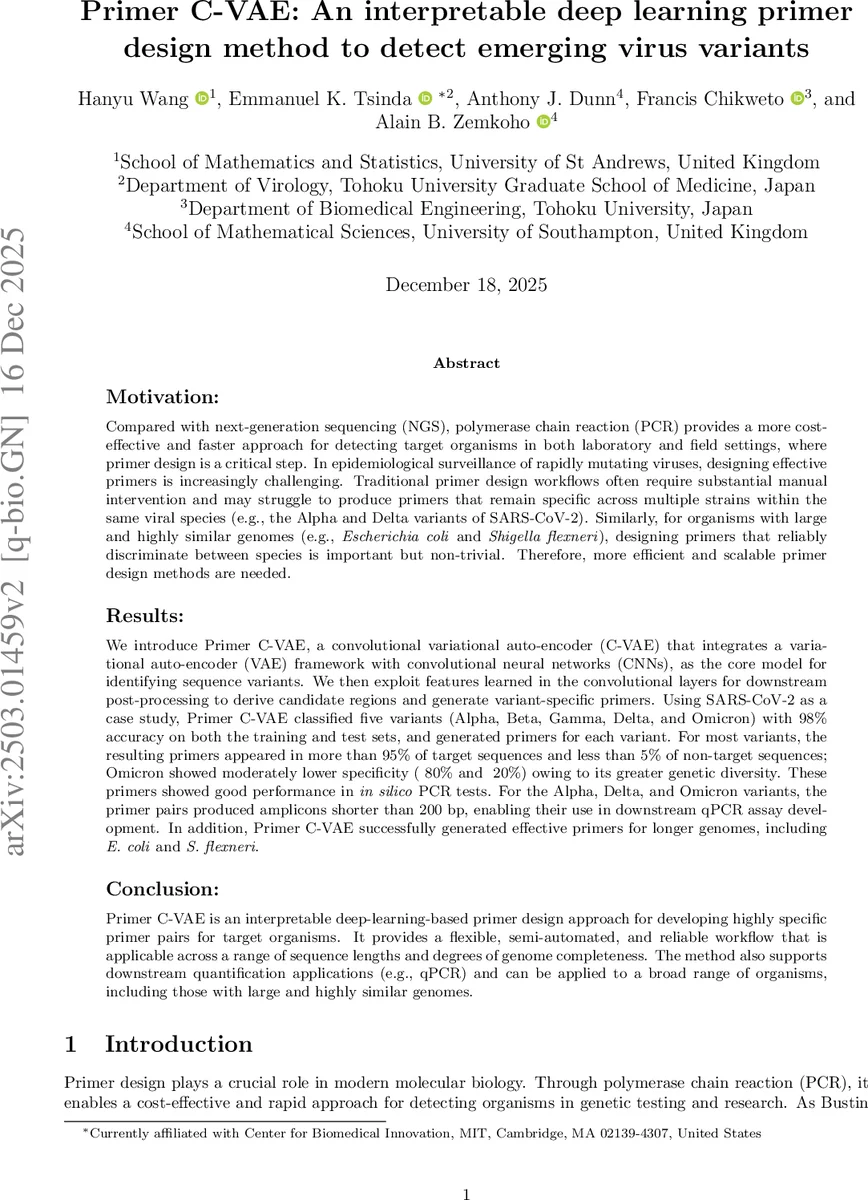
Motivation: PCR is more economical and quicker than Next Generation Sequencing for detecting target organisms, with primer design being a critical step. In epidemiology with rapidly mutating viruses, designing effective primers is challenging. Traditional methods require substantial manual intervention and struggle to ensure effective primer design across different strains. For organisms with large, similar genomes like Escherichia coli and Shigella flexneri, differentiating between species is also difficult but crucial. Results: We developed Primer C-VAE, a model based on a Variational Auto-Encoder framework with Convolutional Neural Networks to identify variants and generate specific primers. Using SARS-CoV-2, our model classified variants (alpha, beta, gamma, delta, omicron) with 98% accuracy and generated variant-specific primers. These primers appeared with >95% frequency in target variants and <5% in others, showing good performance in in-silico PCR tests. For Alpha, Delta, and Omicron, our primer pairs produced fragments <200 bp, suitable for qPCR detection. The model also generated effective primers for organisms with longer gene sequences like E. coli and S. flexneri. Conclusion: Primer C-VAE is an interpretable deep learning approach for developing specific primer pairs for target organisms. This flexible, semi-automated and reliable tool works regardless of sequence completeness and length, allowing for qPCR applications and can be applied to organisms with large and highly similar genomes.
💡 Research Summary
The paper introduces Primer C‑VAE, a novel deep‑learning framework that combines convolutional neural networks (CNNs) with a variational auto‑encoder (VAE) to automate the design of highly specific PCR primers for rapidly evolving viruses and for closely related bacterial species. Traditional primer design tools such as Primer3 rely heavily on manual curation, are limited to input sequences shorter than 10 kb, and provide no guarantee of variant‑level specificity. Primer C‑VAE addresses these shortcomings by (1) accepting full‑length genomes (30 kb for SARS‑CoV‑2, >5 Mb for bacteria) as raw input, (2) learning discriminative sequence motifs in an interpretable latent space, and (3) generating both forward and reverse primers within a unified pipeline.
The architecture consists of a multi‑layer 1‑D CNN encoder that extracts local patterns, followed by a VAE bottleneck that compresses the information into a latent vector. Supervised training uses labeled sequences (target variant vs. non‑target) to enforce variant discrimination while the VAE reconstruction loss preserves overall sequence fidelity. The final convolutional layer’s activation map highlights regions that contribute most to classification; sliding windows of 18–25 bp over these hotspots produce candidate forward primers. Thermodynamic filters (GC content, melting temperature, secondary‑structure avoidance) and dimer checks prune the list. Once a forward primer is fixed, downstream sequence is extracted and a second C‑VAE model, trained against a synthetic background matching nucleotide composition, yields reverse‑primer candidates. Primer‑BLAST screening removes off‑target hits to human or other microbial genomes, and in‑silico PCR evaluates amplicon length and amplification feasibility.
Evaluation on SARS‑CoV‑2 data shows 98 % classification accuracy across five variants (Alpha, Beta, Gamma, Delta, Omicron). Generated primers appear in >95 % of target‑variant sequences while occurring in <5 % of non‑target sequences; Omicron, being the most diverse, shows ~80 %/20 % specificity. In‑silico PCR confirms that primers for Alpha, Delta and Omicron produce short amplicons (<200 bp), suitable for quantitative PCR. For bacterial case studies (Escherichia coli vs. Shigella flexneri) the model attains >96 % classification accuracy and similar primer specificity, demonstrating scalability to multi‑megabase genomes where conventional tools fail.
Interpretability is provided by visualizing the CNN filters that flag variant‑specific motifs and by projecting the latent space with t‑SNE/UMAP to reveal clear variant clusters, thereby explaining the high classification performance. The authors highlight four main advantages: (i) scalability to long genomes, (ii) automated discovery of discriminative regions without prior mutation annotation, (iii) simultaneous forward‑reverse primer generation, and (iv) reduced manual effort while maintaining high sensitivity and specificity. Limitations include the need for sizable labeled datasets and periodic retraining as viral genomes evolve rapidly. Overall, Primer C‑VAE represents a significant step toward fully automated, interpretable, and robust primer design for diagnostic PCR across a wide range of pathogens.
Comments & Academic Discussion
Loading comments...
Leave a Comment