Independent Sets in Hypergraphs
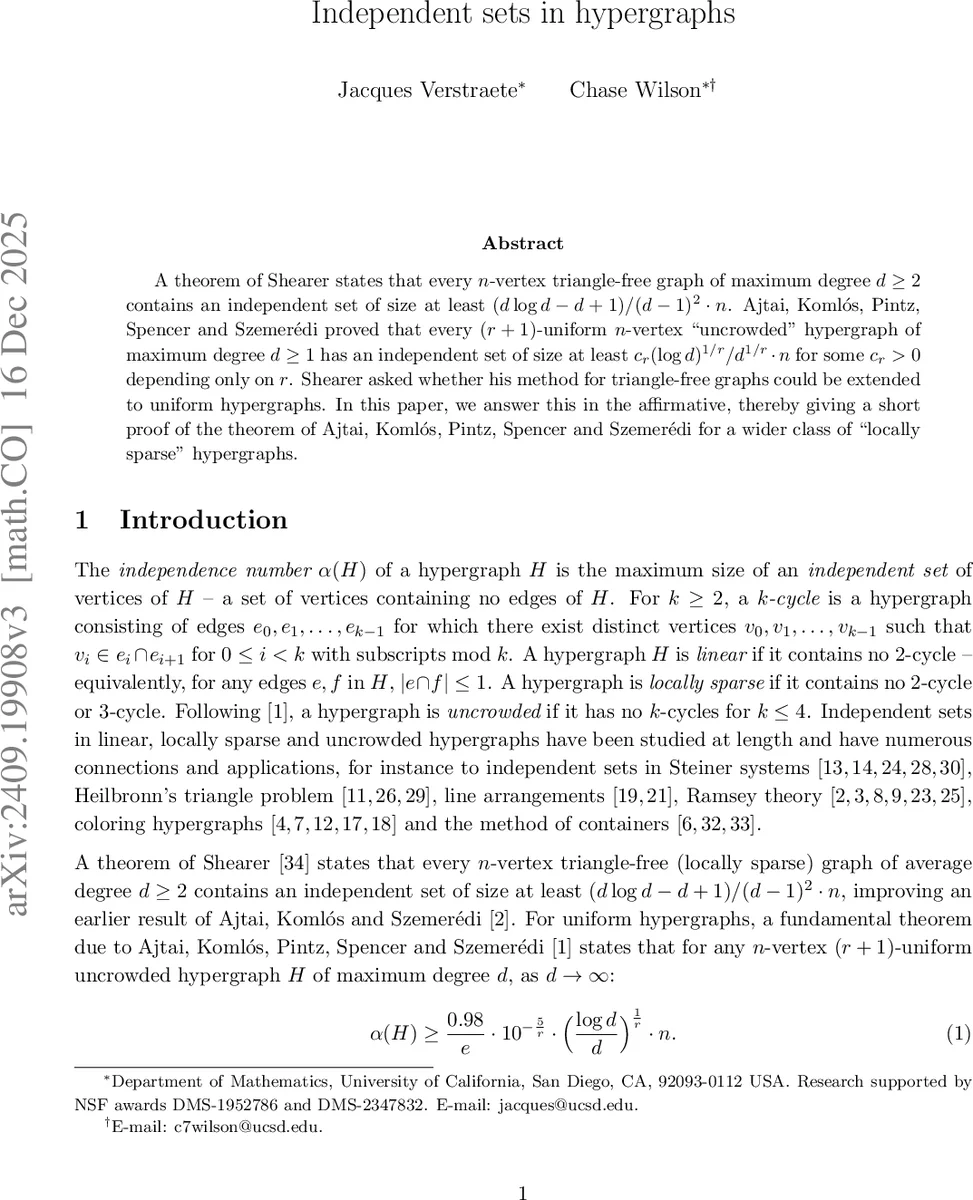
A theorem of Shearer states that every $n$-vertex triangle-free graph of maximum degree $d \geq 2$ contains an independent set of size at least $(d\log d - d + 1)/(d - 1)^2 \cdot n$. Ajtai, Komlós, Pintz, Spencer and Szemerédi proved that every $(r + 1)$-uniform $n$-vertex uncrowded'' hypergraph of maximum degree $d \geq 1$ has an independent set of size at least $c_r(\log d)^{1/r}/d^{1/r} \cdot n$ for some $c_r > 0$ depending only on $r$. Shearer asked whether his method for triangle-free graphs could be extended to uniform hypergraphs. In this paper, we answer this in the affirmative, thereby giving a short proof of the theorem of Ajtai, Komlós, Pintz, Spencer and Szemerédi for a wider class of locally sparse’’ hypergraphs.
💡 Research Summary
The paper addresses the problem of finding large independent sets in hypergraphs, extending a celebrated result of Shearer for triangle‑free graphs to the setting of locally sparse uniform hypergraphs. Shearer proved that any n‑vertex triangle‑free graph with maximum degree d ≥ 2 contains an independent set of size at least ((d\log d-d+1)/(d-1)^2\cdot n). For hypergraphs, Ajtai, Komlós, Pintz, Spencer and Szemerédi (AKPSS) showed that every (r + 1)‑uniform n‑vertex “uncrowded’’ hypergraph of maximum degree d has an independent set of size at least (c_r(\log d)^{1/r}/d^{1/r}\cdot n) for some constant (c_r>0) depending only on r. Their proof relies on a sophisticated randomized greedy (Rödl nibble) algorithm and yields a very small constant factor.
Shearer asked whether his method for triangle‑free graphs could be adapted to uniform hypergraphs. The authors answer this affirmatively. They give a short, conceptually clear proof of the AKPSS theorem for a slightly broader class—namely, (r + 1)‑uniform hypergraphs that are “locally sparse’’ (i.e., contain no 2‑cycles or 3‑cycles). Moreover, they improve the constant factor for small r (for example, they obtain (c_2=1/8) for large enough d, which is dramatically larger than the constant in the original AKPSS bound).
The core of the argument is a non‑uniform probability distribution on independent sets. Instead of sampling an independent set uniformly, they weight each independent set I by (\exp\bigl(-\delta\sum_{k=2}^{r}|∂_k I|\bigr)), where (∂_k I) denotes the k‑shadow (the collection of k‑subsets of vertices that lie inside some edge of H) and (\delta\approx(\log d)/d). This weighting heavily penalizes independent sets whose shadows are large, thereby giving the authors control over the quantities (|∂_k I|) that were previously intractable.
For each vertex v they define a random variable \
Comments & Academic Discussion
Loading comments...
Leave a Comment