Nowcasting using regression on signatures
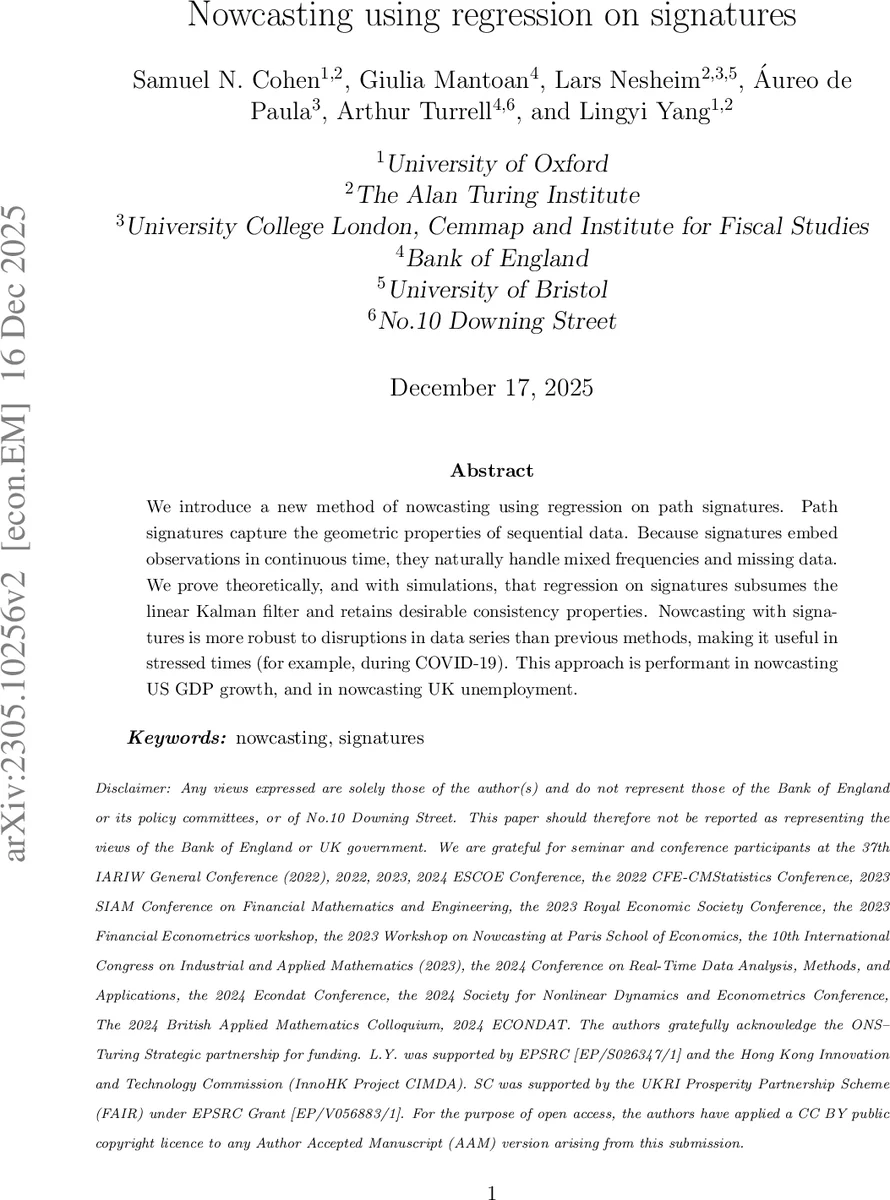
We introduce a new method of nowcasting using regression on path signatures. Path signatures capture the geometric properties of sequential data. Because signatures embed observations in continuous time, they naturally handle mixed frequencies and missing data. We prove theoretically, and with simulations, that regression on signatures subsumes the linear Kalman filter and retains desirable consistency properties. Nowcasting with signatures is more robust to disruptions in data series than previous methods, making it useful in stressed times (for example, during COVID-19). This approach is performant in nowcasting US GDP growth, and in nowcasting UK unemployment.
💡 Research Summary
The paper introduces a novel nowcasting methodology that leverages path signatures—a mathematical representation of continuous‑time trajectories—as regressors in a linear regression framework. By embedding discrete observations of economic indicators into a continuous‑time path and extracting its signature (a collection of iterated integrals up to a chosen order), the authors obtain a set of features that naturally handle mixed‑frequency data, irregular sampling, and ragged‑edge missingness. The key theoretical contribution is a proof that the linear Kalman‑Bucy filter can be expressed as a linear function of signatures, implying that signature regression subsumes the Kalman filter as a special case. Moreover, higher‑order signature terms capture non‑linear interactions, allowing the same linear regression machinery to approximate general non‑linear state‑space models. Consistency and minimum‑variance properties of the estimator are demonstrated analytically and validated through Monte‑Carlo simulations.
Empirically, the method is applied to two benchmark nowcasting tasks: (1) US quarterly GDP growth using a suite of high‑frequency alternative indicators (e.g., credit‑card spending, mobility data) and (2) UK monthly unemployment changes using weekly survey and web‑scraped labor‑market data. In both cases, the signature‑based model outperforms standard dynamic factor models (DFM) and a Kalman‑filter implementation in terms of mean absolute error (MAE) and root mean squared error (RMSE). The advantage is especially pronounced during the COVID‑19 pandemic, when data releases were irregular and heavily delayed; the signature approach maintains lower error growth as missingness increases.
Because signatures can become high‑dimensional, the authors propose a two‑step pipeline: first apply a conventional dimension‑reduction technique (principal component analysis or a DFM) to the raw indicators, then compute signatures of the reduced series. This dramatically reduces computational burden while preserving the ability to model non‑linear interactions. The linear nature of the final regression also ensures interpretability: coefficients directly reflect the contribution of individual indicators (first‑order terms) and their interactions (higher‑order terms), avoiding the opacity of deep‑learning black boxes.
The paper acknowledges limitations: selecting the signature order remains heuristic, higher orders increase memory and time costs, and the abstract nature of signature terms can make economic interpretation less straightforward. Future research directions include automated order selection, sparsity‑inducing regularization, online updating of signatures for streaming data, and richer post‑hoc visualization tools to aid policymakers.
Overall, the study provides a compelling blend of rigorous theory and practical performance, positioning signature regression as a flexible, transparent, and robust alternative to traditional Kalman‑filter and factor‑model based nowcasting techniques. It opens a pathway for broader adoption of rough‑path theory in macro‑economic forecasting and real‑time policy analysis.
Comments & Academic Discussion
Loading comments...
Leave a Comment