AtLAST -- A five fold increase in the number of identified Strongly Lensed Galaxies in the sub-millimetre and its consequences
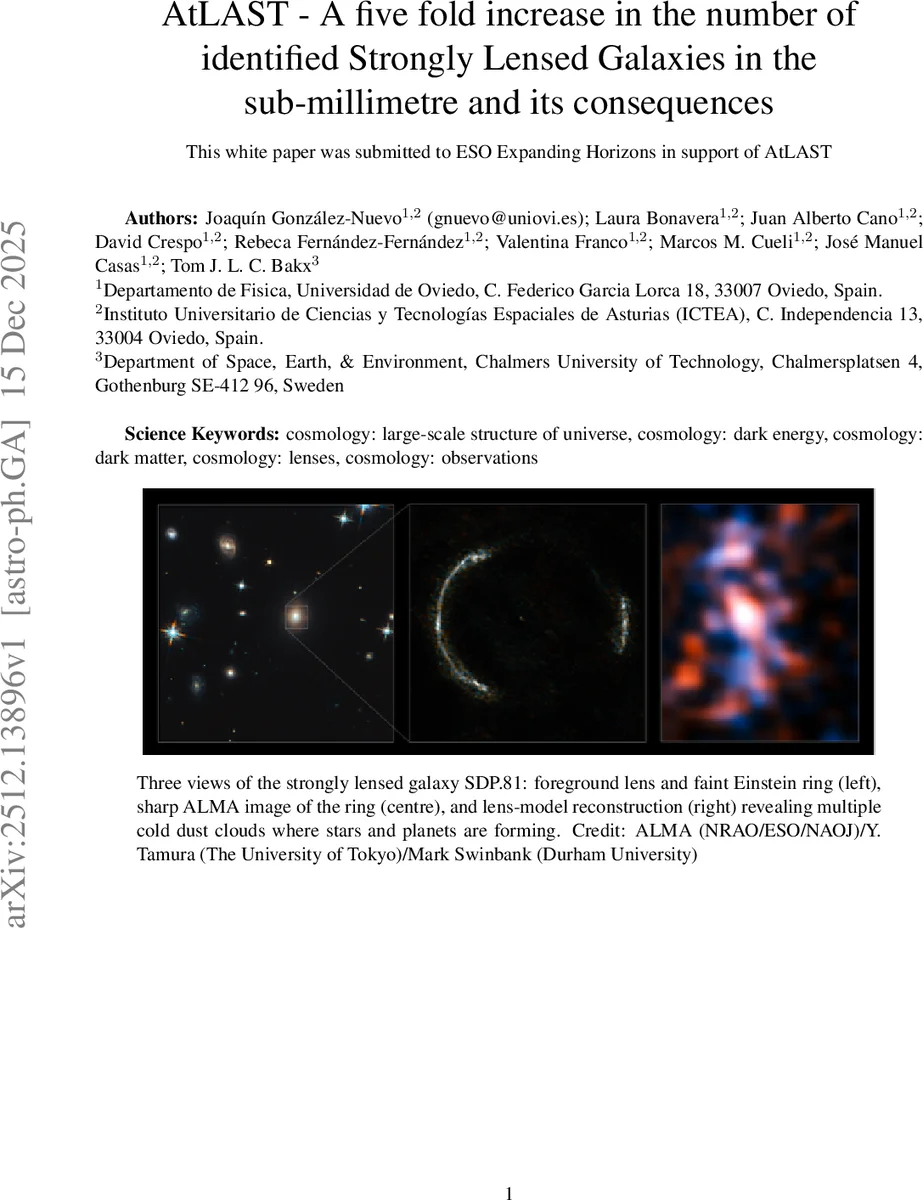
Strong gravitational lensing is a powerful probe of cosmology, dark matter (DM), and high-redshift galaxy evolution, but current samples of strongly lensed galaxies (SLGs) remain far too small to exploit its full potential. $\textit{Herschel}$’s submillimeter (submm) surveys demonstrated that submm selection provides the most efficient and least biased route to identifying high-redshift SLGs, yet produced only a few hundred systems over limited, heterogeneous fields. Achieving the thousands of SLGs required for precision cosmology and detailed studies of distant dusty star-forming galaxies demands a new, wide-area, homogeneous sub-mm survey. A facility like AtLAST, capable of extending $\textit{Herschel}$-like methodologies to much larger areas, is uniquely positioned to deliver the order-of-magnitude increase in SLG numbers needed for transformative progress.
💡 Research Summary
This white paper advocates for the construction of the Atacama Large Aperture Submillimeter Telescope (AtLAST) as a transformative facility for strong gravitational lensing science. It argues that while strong lensing is a powerful probe of cosmology, dark matter, and high-redshift galaxy evolution, current samples of strongly lensed galaxies (SLGs) are too small and heterogeneous to fully exploit its potential.
The paper reviews historical methods for finding SLGs, including optical (e.g., SLACS), radio (e.g., CLASS), wide-field imaging (e.g., DES), and millimeter surveys (e.g., SPT). These methods typically yielded only tens to a few hundred lenses, suffered from low efficiency, low surface density, and biases towards lower redshifts or specific source types. The Herschel Space Observatory revolutionized the field by demonstrating that submillimeter selection, leveraging the steep number counts and magnification bias of high-redshift dusty star-forming galaxies (DSFGs), provides a highly efficient and clean method. A simple 500 µm flux cut (S500 ≥ 100 mJy) achieved near-100% efficiency and surface densities around 0.3 deg⁻², leading to the first statistically significant samples (e.g., ~80 in H-ATLAS). More refined methods pushed densities to 1.5-2 deg⁻². However, Herschel’s coverage was limited to ~600-700 deg², producing only a few hundred SLGs in total.
Upcoming facilities like Euclid (optical/NIR) and the SKA (radio) will discover orders of magnitude more lenses (tens to hundreds of thousands) over vast areas. However, their selection functions, wavelength regimes, and redshift sensitivities differ fundamentally from sub-mm selection. Sub-mm selection uniquely and efficiently targets high-redshift DSFGs (z ~ 2-4), is minimally biased by lens properties, suffers negligible contamination, and directly probes dust-obscured star formation at the peak epoch of galaxy assembly. Therefore, these future surveys are complementary, not replacements.
The science case for a large, homogeneous sample of several thousand sub-mm-selected SLGs is compelling. In cosmology, such a sample would enable precise constraints on the dark energy equation-of-state parameter w and probe the Universe’s geometry at redshifts inaccessible to optical lens surveys. For dark matter, it allows statistical tests of the cold dark matter paradigm by measuring the abundance of low-mass subhalos and mapping the evolution of halo mass profiles across cosmic time. For galaxy evolution, the magnification acts as a “cosmic telescope,” revealing the internal structure (down to ~0.01 arcsec in the source plane), star formation, gas dynamics, and dust properties of thousands of faint, high-redshift DSFGs that would otherwise be below the confusion limit.
No existing or planned facility can deliver the required wide-area, homogeneous, confusion-limited sub-mm survey. AtLAST is designed to meet this need. Its key technical specifications include a 50-meter aperture providing ~1.5 arcsec resolution at 950 GHz (essential for deblending sources and reducing confusion noise), a two-degree instantaneous field of view, and mapping speeds orders of magnitude faster than ALMA. With next-generation large-format cameras and broad frequency coverage (30–950 GHz), AtLAST can uniformly survey 2000-3000 deg², identifying approximately 5000 SLGs—a fivefold increase over current numbers. The paper also highlights AtLAST’s pioneering commitment to sustainable astronomy, aiming for a fully off-grid renewable energy system with hybrid battery/hydrogen storage.
In conclusion, AtLAST is positioned as the essential next-generation facility to extend the highly successful sub-mm selection methodology to the large areas necessary for a statistically powerful SLG catalog, thereby unlocking transformative progress across multiple frontiers of astrophysics.
Comments & Academic Discussion
Loading comments...
Leave a Comment