AtLAST -- Determination of Halo Mass Density Profiles at kpc Scales through Magnification Bias
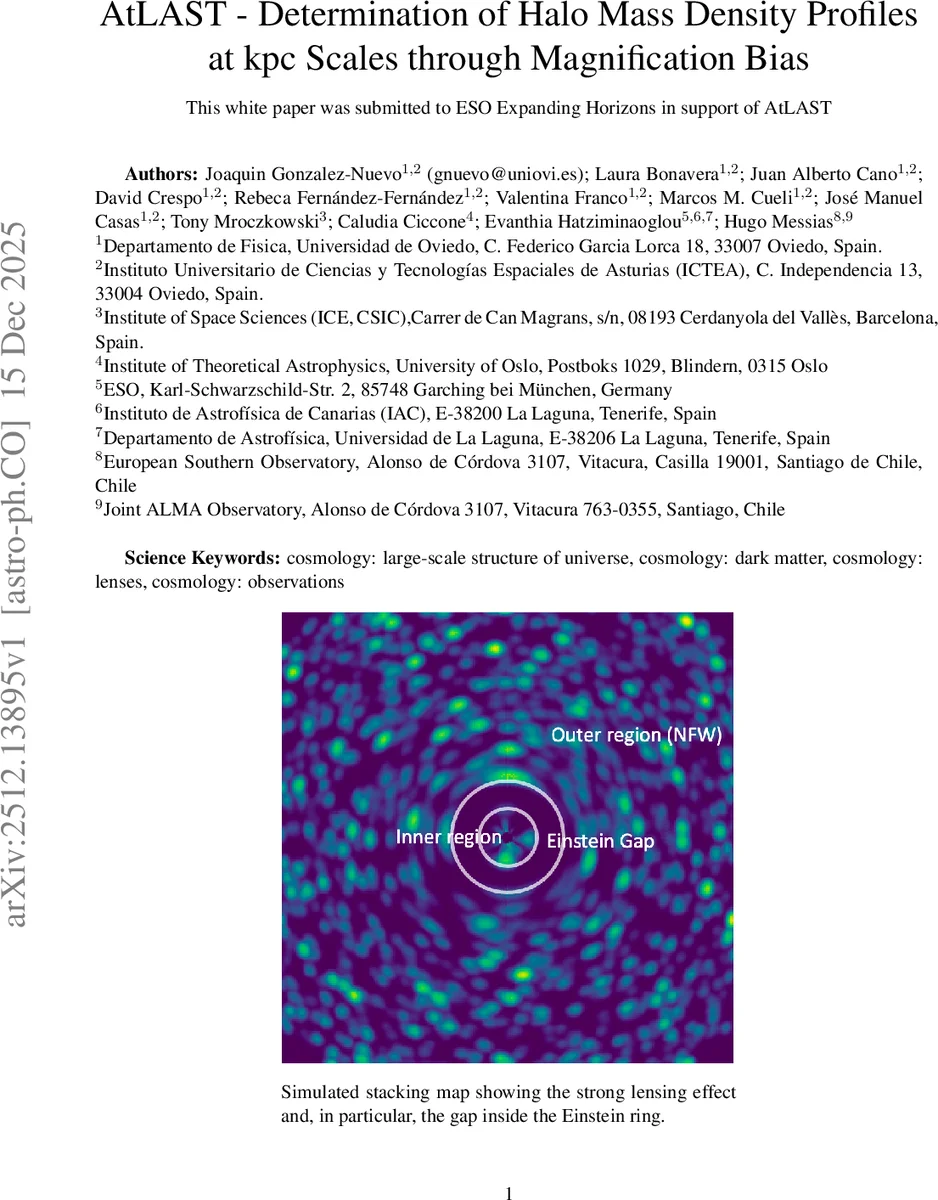
Magnification bias, the lensing-induced modification of background source number counts, provides a uniquely powerful probe of the mass density profiles of galaxies and clusters down to kpc scales. Unlike shear-based weak lensing, magnification bias does not rely on galaxy shapes and thus avoids dominant small-scale systematics. Existing studies, however, are limited by sky coverage, positional uncertainty, and insufficiently deep, confusion-limited submillimetre (submm) surveys. A next-generation wide-field, high-throughput submm facility like the proposed 50m-telescope AtLAST is required to unlock this technique’s full diagnostic power.
💡 Research Summary
This white paper advocates for the construction of the Atacama Large Aperture Submillimeter Telescope (AtLAST) to unlock the full potential of “magnification bias” as a transformative tool for probing the internal structure of dark matter halos at kiloparsec scales. The central problem addressed is the unknown density profile of dark matter halos at radii of 1-10 kpc, a regime critical for understanding baryonic feedback, halo assembly, and the fundamental nature of dark matter itself.
The paper begins by contrasting existing methods. Weak gravitational lensing shear, while revolutionary for large-scale (>100 kpc) halo mapping, fails at small scales due to shape noise and systematics. Strong lensing probes these scales but is only applicable to a handful of massive, rare clusters. Magnification bias is presented as a powerful complementary technique. It measures the lensing-induced change in the number density of background sources via the angular cross-correlation between foreground lenses (e.g., galaxies, clusters) and high-redshift submillimeter galaxies (SMGs). Crucially, it does not rely on measuring galaxy shapes, thereby avoiding the dominant systematics that plague shear measurements on small scales. The steep number-count slope of SMGs (β > 3) maximizes the magnification signal, making the technique particularly sensitive.
Recent studies using data from facilities like Herschel, cross-matched with high-accuracy positions from WISE, have demonstrated the feasibility of this approach. They have successfully reconstructed halo profiles and revealed key features like the “Einstein gap”—a deficit in the correlation function at ~10 arcseconds caused by strong-lensing effects—and oscillatory patterns at larger radii attributed to the influence of massive satellite galaxies. These results prove magnification bias is a sensitive probe of small-scale halo structure and substructure.
However, the paper argues that current magnification-bias studies are severely limited by the quality and coverage of existing submillimeter surveys. Limited sky area reduces statistical power and weakens the signal at large angular separations. Confusion noise and insufficient depth constrain the usable density of background SMGs. The achievable angular resolution, ultimately set by the astrometric precision of source catalogs (~0.3 arcseconds currently), limits access to the very innermost halo regions.
To overcome these limitations and turn magnification bias into a precision cosmology tool, the paper outlines three high-impact science cases: 1) Determining the inner density profile slope at sub-10 kpc for a statistical sample of halos to test CDM predictions against cores produced by baryonic feedback or alternative dark matter models. 2) Investigating the cause of persistent lensing anomalies (excess signal and oscillations) in lower-mass clusters, likely linked to substructure. 3) Measuring the splashback radius—the physical boundary of a halo—for less massive systems, which is difficult with shear-based methods.
Achieving these goals requires a facility that simultaneously provides: wide-area coverage (thousands of square degrees), high angular resolution (~1.5 arcseconds at 950 GHz to beat confusion noise), exceptional sensitivity for deep surveys, and superb astrometric precision (<0.5 arcseconds). The paper contends that no existing or planned facility—not ALMA (too small a field of view), SPT-3G, SO, or FYST (insufficient resolution/sensitivity)—can meet all these requirements.
The proposed 50-meter AtLAST telescope is presented as the definitive solution. Its large aperture provides the necessary resolution and sensitivity. Its two-degree instantaneous field of view, coupled with mapping speeds projected to be 10^3 to 10^5 times faster than ALMA, makes large-area surveys feasible. Next-generation instruments with mega-pixel cameras will deliver the deep, high-fidelity maps needed to create dense catalogs of high-redshift SMGs. Furthermore, its broad frequency coverage (30–950 GHz) will enable photometric redshift estimation and characterization of sources. The paper also highlights AtLAST’s pioneering design for a fully off-grid renewable energy system.
In conclusion, the paper positions AtLAST as an essential facility for a paradigm shift in small-scale lensing cosmology. By providing the deep, wide, and high-resolution submillimeter surveys that are currently the missing piece, AtLAST will enable magnification bias to precisely map halo density profiles from 1 kpc to the outskirts, offering unprecedented insights into dark matter and galaxy evolution.
Comments & Academic Discussion
Loading comments...
Leave a Comment