Spirals and Vertical Motions in the Planet-Forming Disk around HD 100546. A multi-line study of its gas kinematics
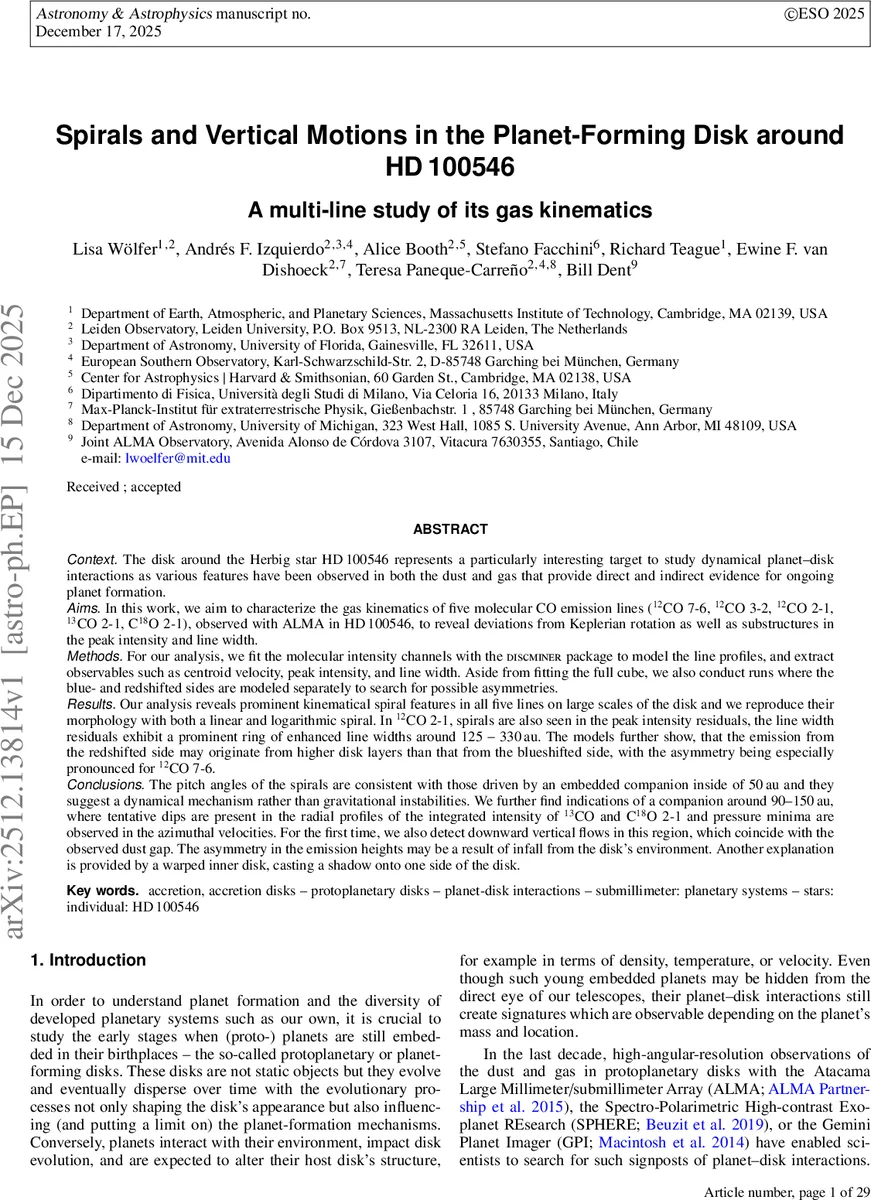
HD100546 represents a particularly interesting target to study dynamical planet-disk interactions as various features have been observed in both the dust and gas that provide direct and indirect evidence for ongoing planet formation. In this work, we aim to characterize the gas kinematics of five molecular CO emission lines observed with ALMA in HD 100546, to reveal deviations from Keplerian rotation as well as substructures in the peak intensity and line width. We fit the molecular intensity channels with the Discminer package to model the line profiles. Aside from fitting the full cube, we also conduct runs where the blue- and redshifted sides are modeled separately to search for possible asymmetries. Our analysis reveals prominent kinematical spiral features in all five lines on large scales of the disk and we reproduce their morphology with both a linear and logarithmic spiral. In 12CO 2-1, spirals are also seen in the peak intensity residuals, the line width residuals exhibit a prominent ring of enhanced line widths around 125-330 au. The models further show, that the emission from the redshifted side may originate from higher disk layers than that from the blueshifted side. The pitch angles of the spirals are consistent with those driven by an embedded companion inside of 50 au and they suggest a dynamical mechanism rather than gravitational instabilities. We further find indications of a companion around 90-150 au, where tentative dips are present in the radial profiles of the integrated intensity of 13CO and C18O and pressure minima are observed in the azimuthal velocities. For the first time, we also detect downward vertical flows in this region, which coincide with the observed dust gap. The asymmetry in the emission heights may be a result of infall from the disk’s environment. Another explanation is provided by a warped inner disk, casting a shadow onto one side of the disk.
💡 Research Summary
This study presents a sophisticated kinematic analysis of the protoplanetary disk surrounding HD 100546, utilizing high-resolution ALMA observations of five molecular CO emission lines. The primary objective was to characterize deviations from Keplerian rotation and identify substructures within the gas distribution, providing direct evidence for ongoing planet formation. By employing the Discminer package, the researchers modeled the line profiles, specifically examining the asymmetries between the blueshifted and redshifted sides of the disk to search for structural irregularities.
A key finding is the presence of prominent large-scale spiral features across all observed CO lines, which can be accurately modeled using both linear and logarithmic spiral geometries. The analysis of the spiral pitch angles suggests that these structures are driven by a dynamical mechanism—likely an embedded companion located within 50 AU—rather than being a result of gravitational instabilities within the disk itself. Furthermore, the study identifies evidence for a potential second companion in the 90-150 AU range, evidenced by localized dips in the integrated intensity of $^{13}$CO and C$^{18}$O, alongside observed pressure minima in the azimuthal velocities.
One of the most significant breakthroughs reported is the first-ever detection of downward vertical flows within the dust gap region. This discovery provides direct evidence of gas moving vertically through the disk, a crucial component in understanding the accretion and mass transport processes during planet formation. Additionally, the researchers noted an asymmetry in emission heights, where the redshifted side appears to originate from higher disk layers than the blueshifted side. This phenomenon is attributed to either the infall of gas from the surrounding environment or a warped inner disk that casts a shadow on one side of the outer disk. Collectively, these findings paint a picture of a highly dynamic and complex environment where multiple planetary-mass objects are actively sculpting the gas and dust of the HD 100546 disk.
Comments & Academic Discussion
Loading comments...
Leave a Comment