Millimeter-Wavelength Observations of the Active Sun: Unveiling the Origins of Space Weather
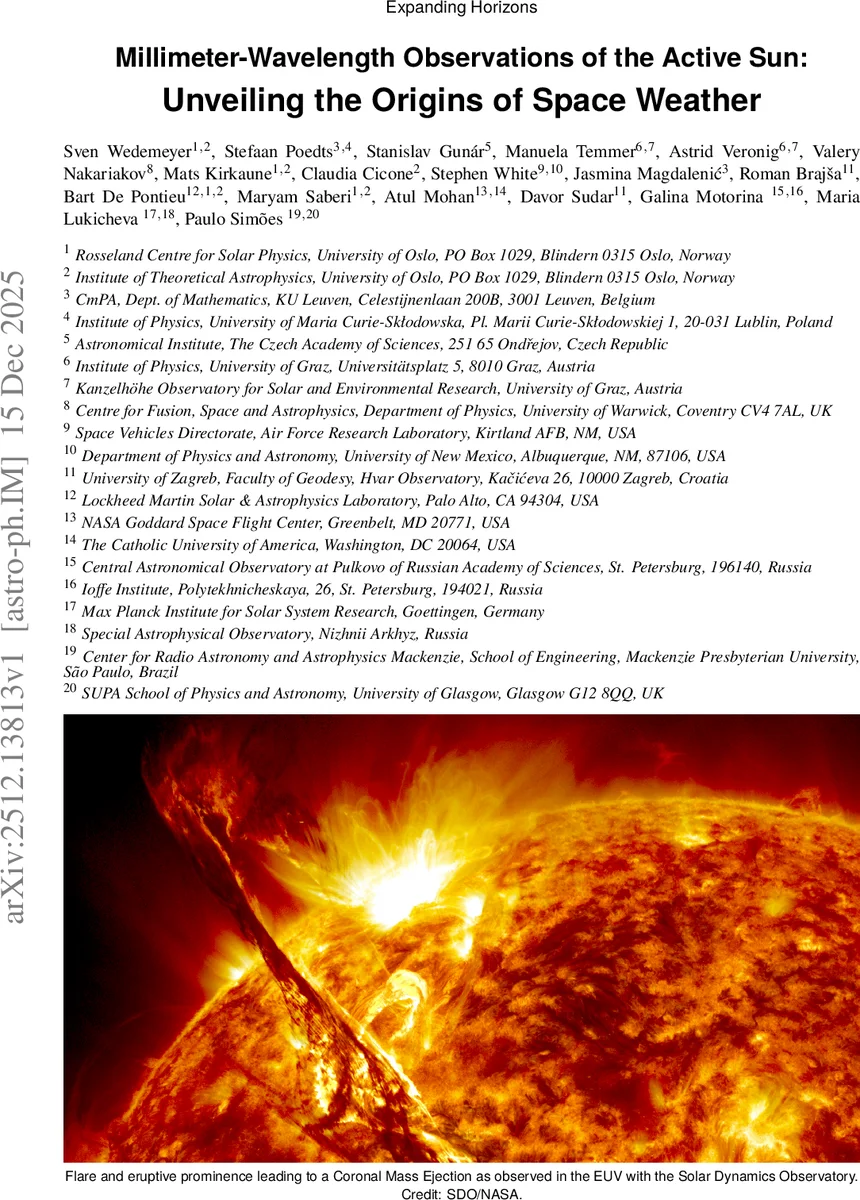
Societal dependence on space-based services demands major advances in predicting the impacts of eruptive solar events. Millimeter-wavelength observations offer uniquely direct access to the time-dependent physical conditions in the atmospheric layers of the Sun where these events originate. A facility capable of full-disk, high-cadence, multi-frequency imaging would provide a transformative view of the Sun and its influence on the heliosphere. AtLAST is ideally suited to deliver this capability, and to establish a European leadership role in advancing the scientific foundations that will enable reliable, operational space-weather forecasting for the first time.
💡 Research Summary
The paper makes a compelling case that modern society’s reliance on satellite‑based services—communication, navigation, power‑grid stability, and aviation—creates an urgent need for reliable space‑weather forecasting. Solar flares, eruptive prominences, coronal mass ejections (CMEs), solar energetic particles (SEPs), and the continuous solar wind are identified as the primary drivers of space‑weather disturbances. All of these phenomena originate in the highly dynamic layers of the solar atmosphere that span the photosphere, chromosphere, transition region, and corona. While existing optical, UV, EUV, and X‑ray observations have advanced our understanding, they suffer from strong non‑local‑thermodynamic‑equilibrium (non‑LTE) effects and limited temporal and spatial resolution, making it difficult to obtain direct, quantitative measurements of the temperature and magnetic field in the chromosphere—the layer where the energy that fuels space‑weather events is first stored and released.
Millimeter (mm) and sub‑millimeter wavelengths provide a unique diagnostic window. The continuum emission at these frequencies is formed under conditions close to LTE, so its brightness temperature is essentially a linear proxy for the local electron temperature. Moreover, circular polarization of the mm continuum carries information about the line‑of‑sight magnetic field, a measurement that is otherwise extremely challenging. Because the opacity—and therefore the effective formation height—varies strongly with wavelength, simultaneous observations across a broad spectral range (30–700 GHz) enable a tomographic reconstruction of the chromosphere’s thermal and magnetic structure as a function of height and time.
The authors argue that the Atacama Large Aperture Submillimeter Telescope (AtLAST) is uniquely suited to deliver the required capabilities. With a large single‑dish aperture (≈50 m) and fast scanning mechanics, AtLAST can image the full solar disk at a cadence of about one second during eruptive events and a few seconds during quiet monitoring. A multi‑pixel, multi‑band receiver would allow simultaneous acquisition of 10–20 frequency channels, providing the spectral coverage needed for height‑resolved tomography. The instrument concept includes full Stokes polarimetry to retrieve the chromospheric magnetic field vector. This combination of full‑disk coverage, high cadence, and simultaneous multi‑frequency imaging overcomes the principal limitations of the Atacama Large Millimeter/submillimeter Array (ALMA), whose interferometric mode offers higher spatial resolution but suffers from a narrow field of view, single‑band operation, and slower cadence.
Four key scientific objectives are outlined: (1) Directly measure how magnetic reconnection deposits energy into the chromospheric plasma, producing impulsive heating, mass motions, and particle acceleration. (2) Identify reliable precursors to flares and CMEs by detecting rapid temperature and magnetic topology changes in the chromosphere that precede eruptions. (3) Pinpoint the source regions and physical conditions that govern the acceleration and release of solar energetic particles. (4) Quantify the small‑scale dynamics, temperature gradients, and magnetic connectivity that control the solar wind’s origin and variability. Achieving these goals would transform descriptive knowledge of solar activity into a predictive framework grounded in physics.
Technical requirements are explicitly listed: full‑disk field of view, angular resolution sufficient to resolve energy‑release structures across the disk, absolute brightness calibration for reliable temperature retrieval, and simultaneous multi‑band coverage to avoid ambiguities caused by temporal evolution. The paper emphasizes that these specifications exceed the capabilities of any existing facility and define the next technological leap needed for space‑weather diagnostics.
In synergy with other major solar observatories—ALMA, the Daniel K. Inouye Solar Telescope (DKIST), the European Solar Telescope (EST), and space missions such as ESA’s Vigil, Solar Orbiter, and future SDO successors—AtLAST would place Europe at the forefront of global efforts to understand and forecast solar activity. The resulting data set would feed physics‑based models (e.g., magnetohydrodynamic simulations) and enable the development of operational, real‑time space‑weather prediction tools. Ultimately, the authors contend that AtLAST’s millimeter observations will provide the missing link between sub‑surface helioseismic measurements and coronal remote sensing, delivering the essential physical parameters needed to protect both space‑ and ground‑based technological infrastructure from solar disturbances.
Comments & Academic Discussion
Loading comments...
Leave a Comment