Freeness Reined in by a Single Qubit
Free probability provides a framework for describing correlations between non-commuting observables in complex quantum systems whose Hilbert-space states follow maximum-entropy distributions. We examine the robustness of this framework under a minimal deviation from freeness: the coupling of a single ancilla qubit to a Haar-distributed quantum circuit of dimension $D0 \gg 1$. We find that, even in this setting, the correlation functions predicted by free probability theory receive corrections of order $O(1)$. These modifications persist at long times, when the dynamics of the coupled system is already ergodic. We trace their origin to non-uniformly distributed stationary quantum states, which we characterize analytically and confirm numerically.
💡 Research Summary
This paper presents a rigorous investigation into the robustness of free probability theory when applied to physical quantum systems. Free probability offers a powerful mathematical framework for describing correlations between non-commuting observables in the limit of large Hilbert space dimension, provided the quantum states follow a maximum-entropy (uniform) distribution. It establishes elegant equalities, such as ⟨AB_t⟩ = K(t)⟨AB⟩, linking dynamical correlation functions to spectral form factors.
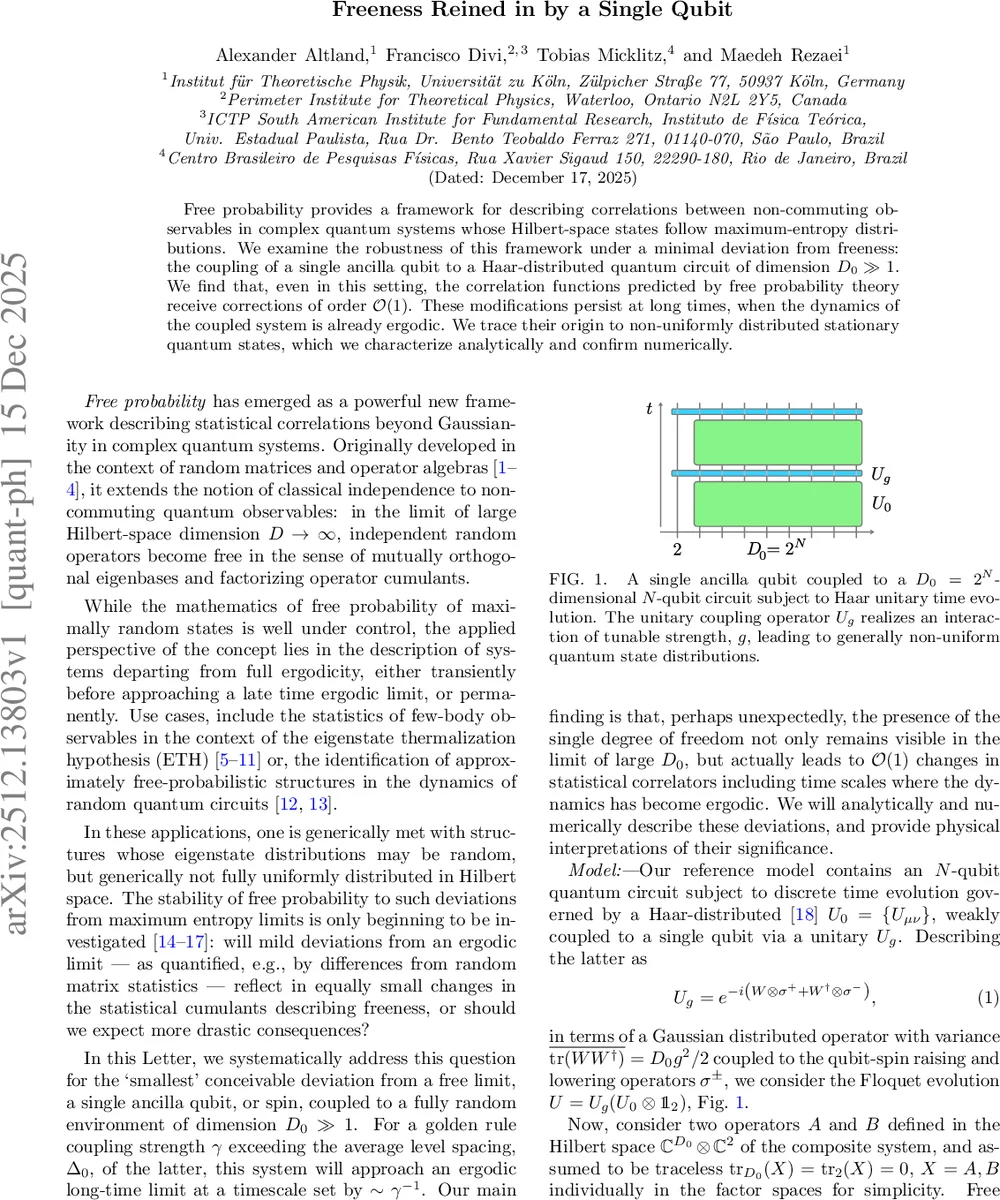
The central question addressed is: how sensitive is this theoretical equivalence to minimal deviations from the ideal “free” limit? To test this, the authors construct a deliberately simple yet profound model: a single ancilla qubit is weakly coupled to a much larger, maximally random environment—a D0-dimensional quantum circuit undergoing Haar-distributed unitary evolution, with D0 ≫ 1. The coupling strength is governed by a Golden Rule parameter γ.
The analysis proceeds by computing two key quantities: the spectral form factor K(t) = |tr(U^t)|^2 and the two-point dynamical correlation function ⟨AB_t⟩ for traceless observables A and B. Using a sophisticated mode analysis based on a path-integral and diagrammatic technique, the authors decompose the dynamics of the composite system into distinct “modes”: a spin-singlet (ergodic) mode and three spin-triplet (decaying) modes with decay rates 0, γ, γ, and 2γ, respectively.
The form factor K(t), calculated as a sum of convolutions of these modes, eventually exhibits the characteristic ramp-plateau behavior of random matrix theory corresponding to the full dimension D = 2D0. This indicates that the system becomes dynamically ergodic after a time scale ~ γ^{-1}.
However, the calculation of the correlation function ⟨AB_t⟩ reveals a crucial breakdown. The dominant contribution comes from a two-loop diagram where the triplet modes interact with the spin structure of the observables A and B in a non-trivial way. The result can be expressed as ⟨AB_t⟩ = K(t)⟨AB⟩ + Δ(t). The correction term Δ(t) originates from cross-terms between different triplet modes and is of order O(1/D^2γ). Strikingly, for characteristic times on the ramp (t ~ D), this term is of the same parametric order as the form factor K(t) itself. Furthermore, Δ(t) does not vanish at long times (t ≫ γ^{-1}); it saturates to a constant value ~ 1/(γ D^2).
This persistent discrepancy, even in the dynamically ergodic regime, is the paper’s key finding. The authors trace its origin to a fundamental distinction: while the form factor probes a one-loop process where contributions from non-ergodic modes cancel out, the correlation function involves a two-loop process that retains sensitivity to them. This sensitivity is a direct signature of a non-uniform distribution of quantum states in the composite Hilbert space of the environment and the ancilla. The coupling to the single qubit, though small in number, injects a structured correlation that prevents the state distribution from achieving true maximum entropy.
The paper therefore delivers a critical insight: statistical freeness, as defined by free probability theory, requires a stronger condition than mere dynamical ergodicity. It demands a uniform state distribution across the entire Hilbert space. The model demonstrates that even the smallest imaginable perturbation—a single qubit—can violate this stronger condition and lead to O(1) modifications in the predicted correlations. This work establishes the sensitivity of free-probabilistic structures to fine-grained details of system composition and has implications for applying these concepts in many-body physics, such as in analyses related to the Eigenstate Thermalization Hypothesis (ETH).
Comments & Academic Discussion
Loading comments...
Leave a Comment