Cyclotomic Euler-Mahonian polynomials
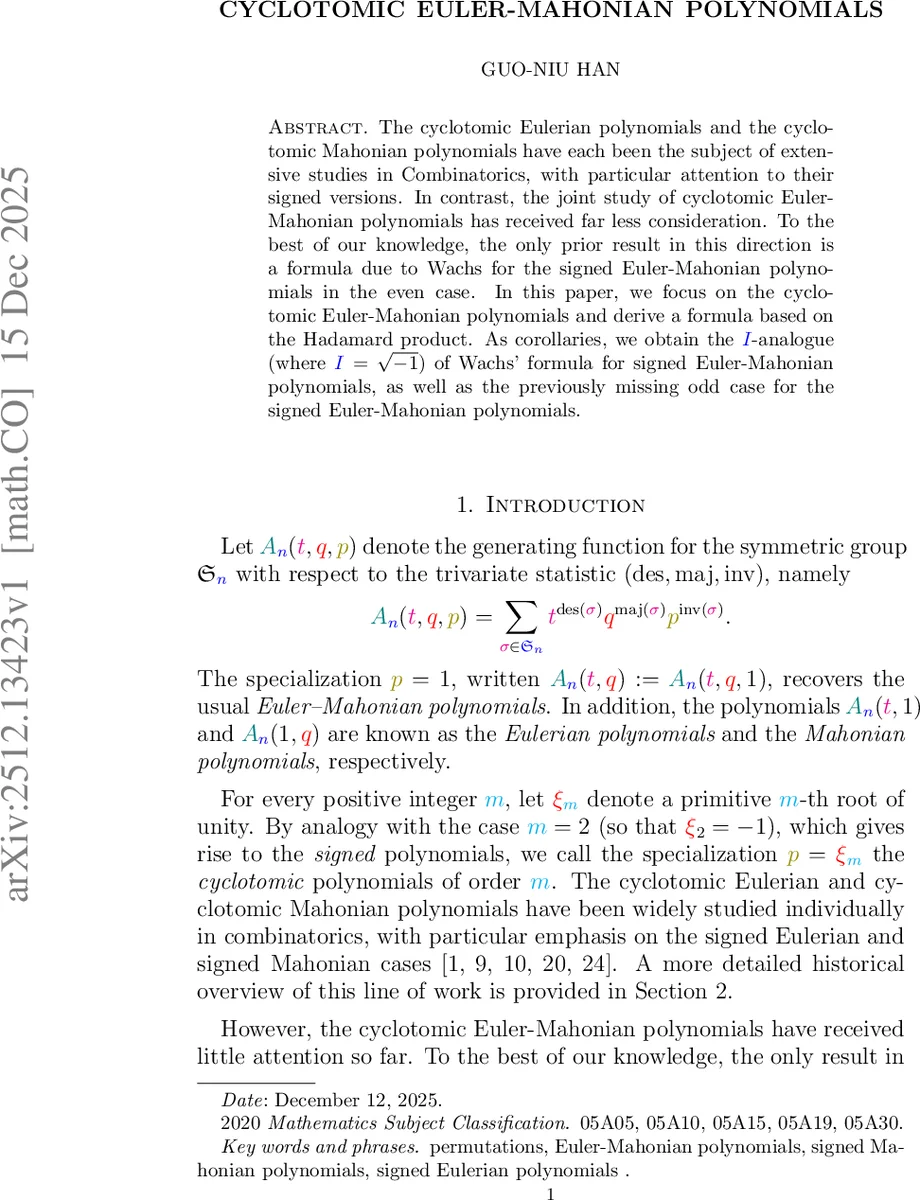
The cyclotomic Eulerian polynomials and the cyclotomic Mahonian polynomials have each been the subject of extensive studies in Combinatorics, with particular attention to their signed versions. In contrast, the joint study of cyclotomic Euler-Mahonian polynomials has received far less consideration. To the best of our knowledge, the only prior result in this direction is a formula due to Wachs for the signed Euler-Mahonian polynomials in the even case. In this paper, we focus on the cyclotomic Euler-Mahonian polynomials and derive a formula based on the Hadamard product. As corollaries, we obtain the $I$-analogue (where $I=\sqrt{-1}$) of Wachs’ formula for signed Euler-Mahonian polynomials, as well as the previously missing odd case for the signed Euler-Mahonian polynomials.
💡 Research Summary
The presented paper addresses a significant gap in the field of algebraic combinatorics, specifically focusing on the intersection of cyclotomic Eulerian and Mahonian polynomials. While the individual properties of cyclotomic Eulerian polynomials (which track the descent statistic) and cyclotomic Mahonian polynomials (which track the inversion statistic) have been extensively documented, their joint distribution—known as the Euler-Mahonian polynomials—within a cyclotomic context has remained largely unexplored.
The primary objective of this research is to bridge this gap by deriving a unified formula for the cyclotomic Euler-Mahonian polynomials. The authors employ a sophisticated mathematical technique involving the Hadamard product. By utilizing the Hadamard product, the researchers are able to manipulate the coefficients of the two distinct polynomial families in a way that captures the simultaneous behavior of both descents and inversions. This approach allows for the construction of a generating function that integrates these two fundamental permutation statistics into a single, cohesive mathematical framework.
The paper’s contributions are multifaceted and mathematically profound. First, the authors successfully derive a new formula for the cyclotomic Euler-Mahonian polynomials, providing a much-needed tool for researchers studying the joint distribution of permutation statistics. Second, the research provides an $I$-analogue (where $I = \sqrt{-1}$) of the previously established formula by Wachs for signed Euler-Mahonian polynomials. This extension into the complex domain (specifically involving roots of unity) offers a deeper understanding of the symmetry and algebraic structure of these polynomials.
Third, and perhaps most importantly, the paper resolves a long-standing incompleteness in the literature. Prior to this work, the “odd case” for signed Euler-Mahonian polynomials remained an unsolved problem, with existing formulas only covering the “even case.” By providing the missing odd case, the authors complete the theoretical landscape for signed cyclotomic Euler-Mahonian polynomials.
In conclusion, this paper represents a significant advancement in combinatorial polynomial theory. By introducing the Hadamard product as a methodological bridge, the authors have not only unified two previously separate areas of study but have also provided the necessary mathematical pieces to complete the theory of signed cyclotomic Euler-Mahonian polynomials. This work is poised to influence future studies in symmetric group representations and the study of complex generating functions in combinatorics.
Comments & Academic Discussion
Loading comments...
Leave a Comment