Lefschetz theorems, Hodge-Riemann relations and Ample vector bundles
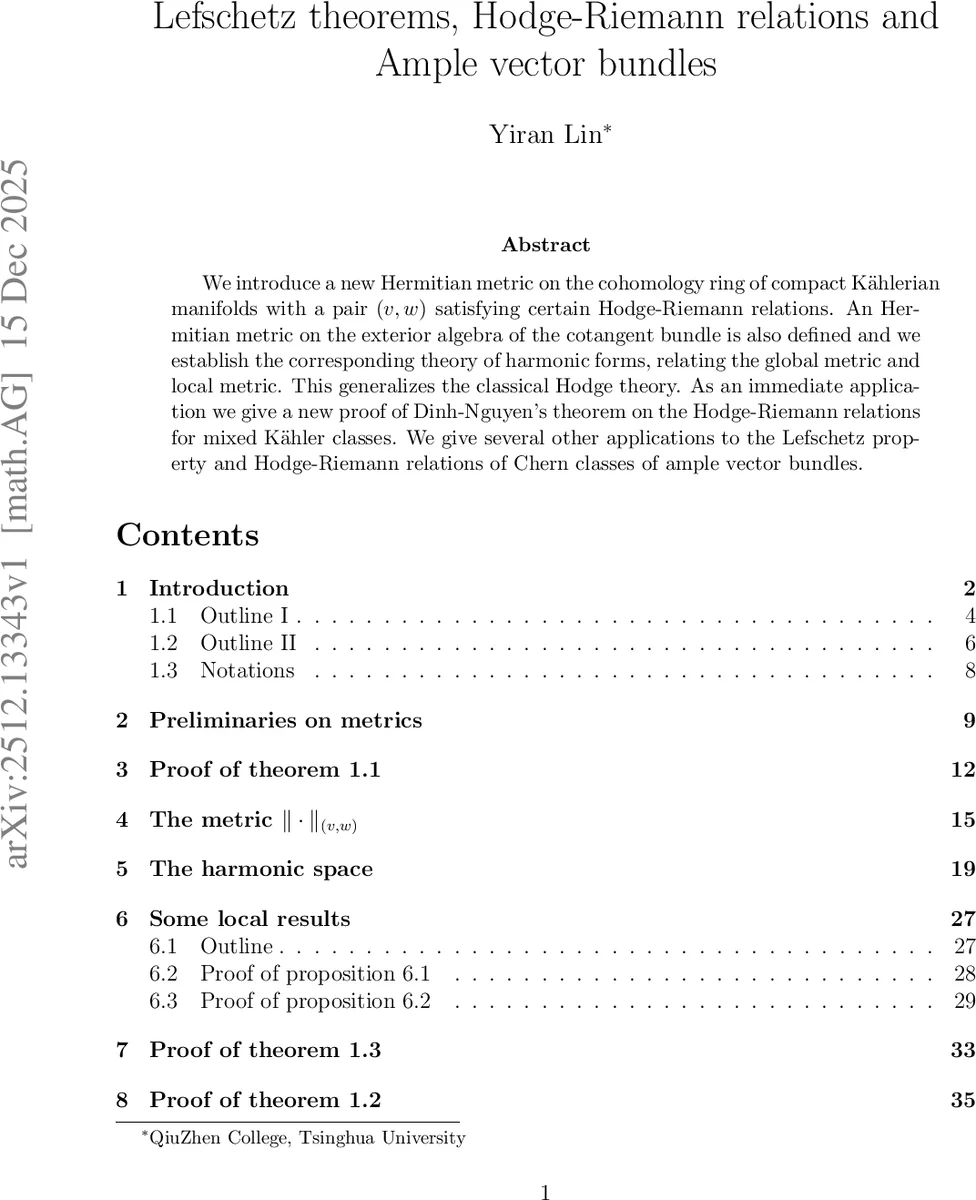
We introduce a new Hermitian metric on the cohomology ring of compact Kählerian manifolds with a pair $(v,w)$ satisfying certain Hodge-Riemann relations. An Hermitian metric on the exterior algebra of the cotangent bundle is also defined and we establish the corresponding theory of harmonic forms, relating the global metric and local metric. This generalizes the classical Hodge theory. As an immediate application we give a new proof of Dinh-Nguyen’s theorem on the Hodge-Riemann relations for mixed Kähler classes. We give several other applications to the Lefschetz property and Hodge-Riemann relations of Chern classes of ample vector bundles.
💡 Research Summary
**
The paper introduces a novel Hermitian metric ∥·∥(v,w) on the cohomology ring of compact Kähler manifolds, where v is a product of r Kähler classes and w is another Kähler class. This metric depends only on the cohomology ring and the chosen classes, not on the specific Kähler forms, and it behaves well under restriction to complete intersections representing v. The authors formulate a “quantitative principle”: instead of merely proving that a linear map is an isomorphism, one should show that it is a quasi‑isometry with respect to suitable metrics, i.e., both the map and its inverse have uniformly bounded operator norms.
Using this principle, they prove a quantitative version of the hard Lefschetz theorem for products of Chern classes of ample R‑twisted vector bundles (Theorem 1.1 and its full version Theorem 1.5). The key technical step is Proposition 1.1, which asserts the existence of a constant c>0 such that for any cohomology class a, ∥c_E·a∥_ω ≥ c ∥a∥ω, where c_E is the product of the relevant Chern classes. The proof proceeds by approximating the R‑twisted bundles by Q‑twisted ones, pulling them back via a Bloch‑Gieseker covering π:Y→X, and then “quantizing’’ the classical Bloch‑Gieseker theorem: the Lefschetz operator on O{P(E)}(1) is shown to be a quasi‑isometry (formula (6) in Section 2). This yields uniform control of norms that survives the limit Q→R.
The paper then extends these results to mixed Kähler classes and to combinations of ample bundles with Kähler classes. Theorem 1.2 treats a single ample bundle together with k Kähler classes; Theorem 1.3 and Theorem 1.4 handle more intricate situations where a holomorphic map π:Y→X makes H^(Y) a free H^(X)‑module. In these cases the authors prove inclusions of kernels of Lefschetz operators, e.g. ker(−∧u)⊂ker(−∧v), by combining a local estimate (Propositions 6.1 and 6.2) with a global-to-local argument.
Sections 4–5 develop the metric ∥·∥(v,w) in detail, showing that when the factors w_i are very ample and Y is a smooth complete intersection representing v, the metric coincides with the restriction metric on Y. Lemma 4.2 formalizes this “hyperplane trick’’ in quantitative terms. Section 5 establishes the existence of harmonic representatives for the new metric, proving an infimum formula (2) that relates the global norm to the L²‑norm of a harmonic form with respect to (ν,ω). This yields a Lefschetz decomposition and the Hodge–Riemann bilinear relations for the new setting, thereby reproducing the main theorem of Dinh‑Nguyen in a more natural way.
The local theory in Section 6 proves two key inequalities: (i) for a vector space V with positive (1,1)‑forms ω_i, the norm of να with respect to a reference form ω is controlled by the (ν,ω)‑norm of α; (ii) under a linear map π:V→W, the perturbed product ν_ε converges to ν and the corresponding norms behave continuously. These results are essential for the local‑to‑global passage in the proof of Theorem 1.3.
Overall, the paper provides a unified, metric‑based framework that not only re‑derives known Lefschetz and Hodge–Riemann results for mixed Kähler classes but also extends them to the setting of ample R‑twisted vector bundles. By emphasizing quantitative estimates, the authors overcome difficulties that arise when passing from Q‑twisted to R‑twisted bundles, and they obtain new positivity statements for Chern classes. The work thus enriches the toolbox for complex and algebraic geometers, offering a robust method to treat Lefschetz‑type phenomena in a broader, more flexible context.
Comments & Academic Discussion
Loading comments...
Leave a Comment