Spectral Entropy via Random Spanning Forests
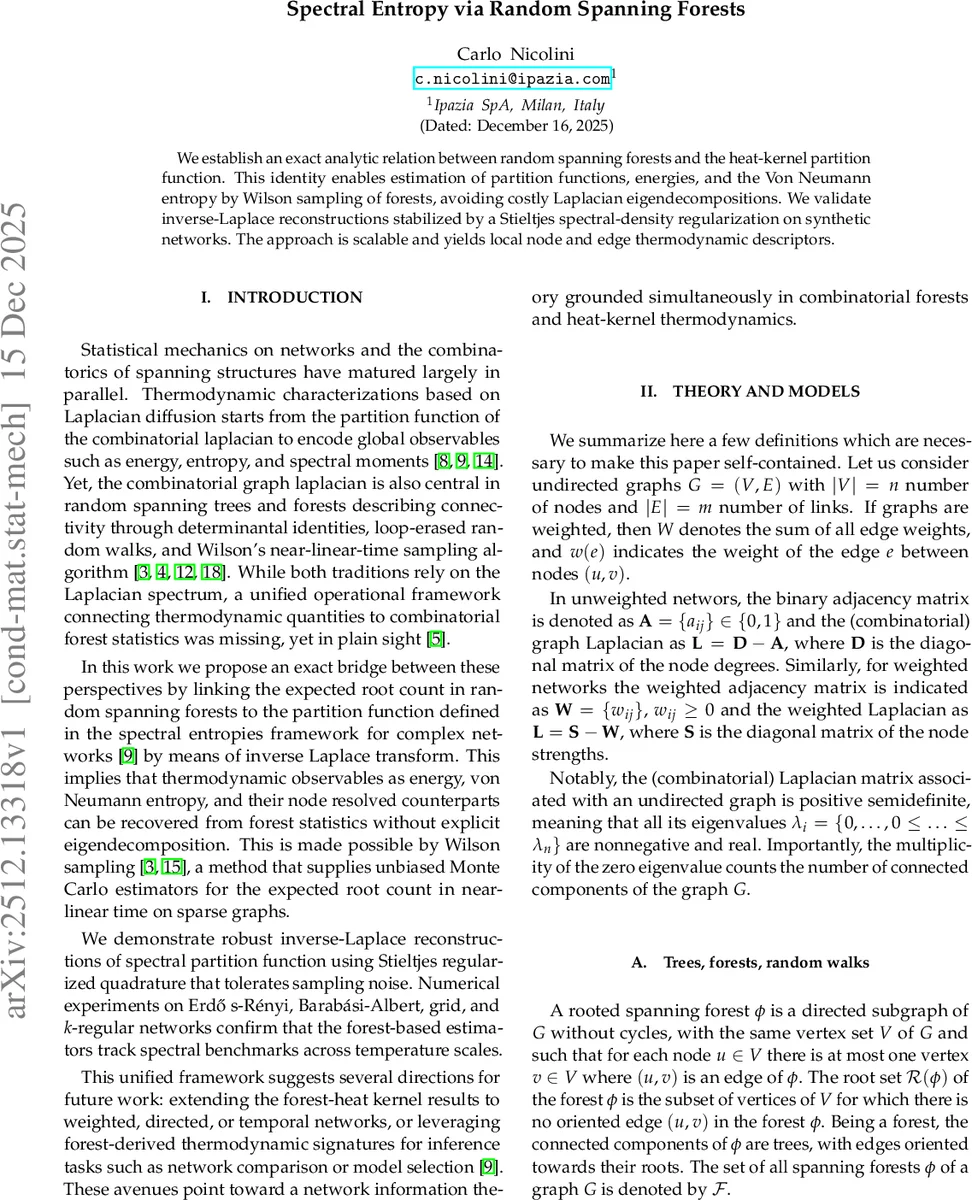
We establish an exact analytic relation between random spanning forests and the heat-kernel partition function. This identity enables estimation of partition functions, energies, and the Von Neumann entropy by Wilson sampling of forests, avoiding costly Laplacian eigendecompositions. We validate inverse-Laplace reconstructions stabilized by a Stieltjes spectral-density regularization on synthetic networks. The approach is scalable and yields local node and edge thermodynamic descriptors.
💡 Research Summary
The paper establishes a rigorous analytical bridge between random spanning forests and the thermodynamics of diffusion on graphs, showing that the expected number of roots in a random rooted forest, s(q), is directly linked to the heat‑trace (partition function) Z(β) of the combinatorial Laplacian via a Laplace transform. Starting from the matrix‑forest theorem, the authors write the forest normalizing constant as χ(q)=det(qI+L)=∏{i}(q+λ_i). Differentiating its logarithm yields s(q)=q d/dq log χ(q)=n∑{i} q/(q+λ_i), a quantity that can be estimated efficiently with Wilson’s near‑linear‑time algorithm for sampling random rooted forests. By exploiting the integral identity 1/(1+a)=∫_0^∞ e^{-(1+a)t}dt and substituting a=λ_i/q, they transform each term q/(q+λ_i) into an integral over β, arriving at the fundamental relation
s(q)=∫_0^∞ q e^{-qβ} Z(β) dβ,
or equivalently s(q)/q is the Laplace transform of Z(β). Consequently, Z(β) can be recovered by an inverse Laplace transform of s(q)/q. The authors discuss that the classic Gaver‑Stehfest inversion is highly sensitive to Monte‑Carlo noise, so they adopt a Stieltjes‑regularized least‑squares approach that incorporates prior knowledge of the Laplacian spectral density, yielding robust reconstructions of Z(β) across a wide temperature range.
Beyond global quantities, the paper derives local thermodynamic descriptors. The node‑level root probability π_v(q)=P(v∈R)=q
Comments & Academic Discussion
Loading comments...
Leave a Comment