On infinitesimal deformations of singular varieties II
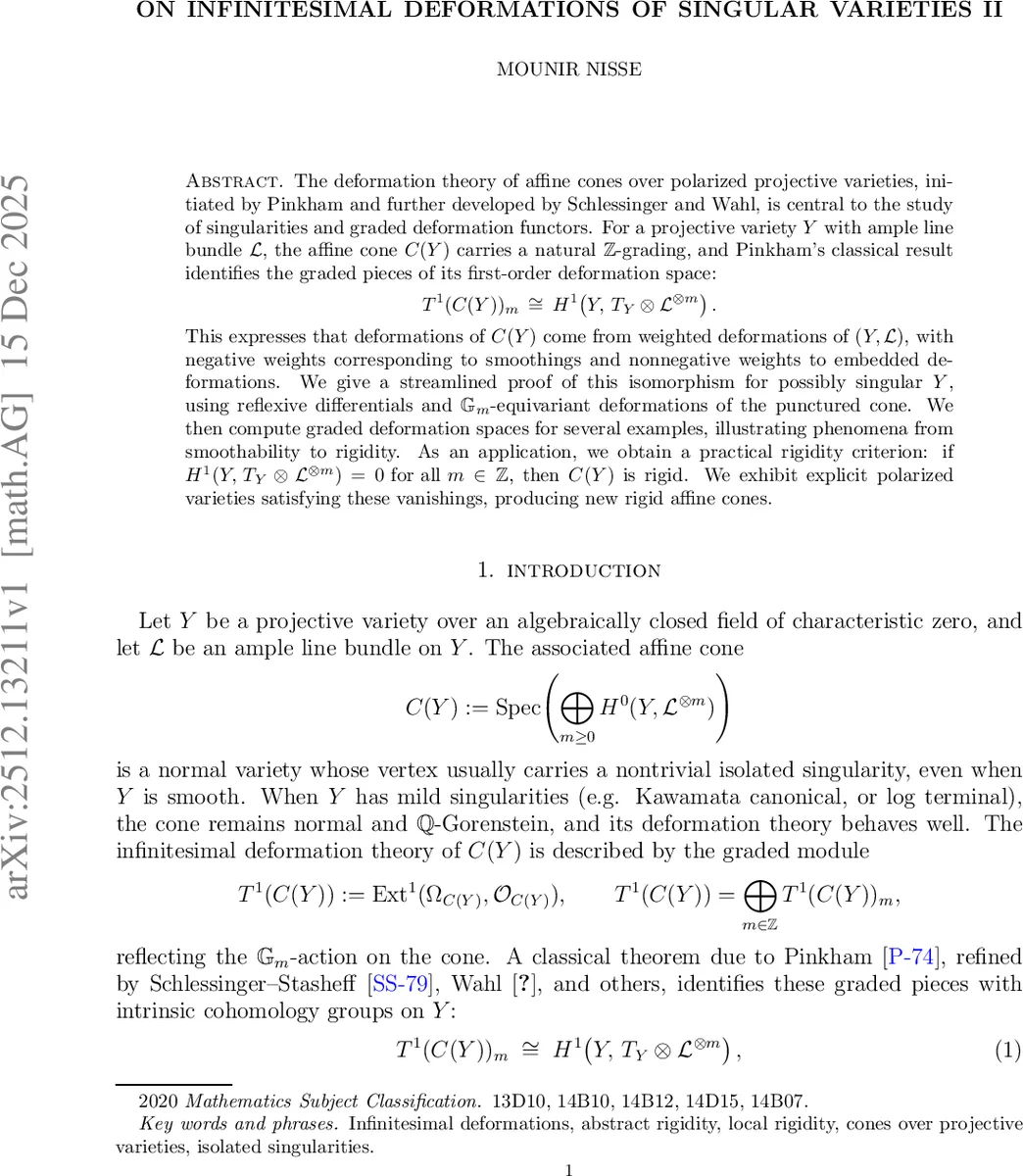
The deformation theory of affine cones over polarized projective varieties, initiated by Pinkham and further developed by Schlessinger and Wahl, is central to the study of singularities and graded deformation functors. For a projective variety (Y) with ample line bundle (\mathcal L), the affine cone (C(Y)) carries a natural (\mathbb Z)-grading, and Pinkham’s classical result identifies the graded pieces of its first-order deformation space: [ T^{1}(C(Y))_m ,\cong, H^{1}!\left(Y,,T_Y \otimes \mathcal L^{\otimes m}\right). ] This expresses that deformations of (C(Y)) come from weighted deformations of ((Y,\mathcal L)), with negative weights corresponding to smoothings and nonnegative weights to embedded deformations. % We give a streamlined proof of this isomorphism for possibly singular (Y), using reflexive differentials and (\mathbb G_m)-equivariant deformations of the punctured cone. We then compute graded deformation spaces for several examples, illustrating phenomena from smoothability to rigidity. As an application, we obtain a practical rigidity criterion: if ( H^1(Y,,T_Y \otimes \mathcal L^{\otimes m})=0 \text{ for all } m\in\mathbb Z, ) then (C(Y)) is rigid. We exhibit explicit polarized varieties satisfying these vanishings, producing new rigid affine cones.
💡 Research Summary
The paper studies infinitesimal deformations of affine cones over polarized projective varieties, extending the classical Pinkham‑Schlessinger‑Wahl theory to possibly singular bases. Let (Y) be a normal projective variety over an algebraically closed field of characteristic zero, equipped with an ample line bundle (\mathcal L). The affine cone (C(Y)=\operatorname{Spec}\bigoplus_{m\ge0} H^{0}(Y,\mathcal L^{\otimes m})) carries a natural (\mathbb Z)-grading induced by the (\mathbb G_{m})-action that scales the coordinates. The main result is a clean isomorphism for every integer (m): \
Comments & Academic Discussion
Loading comments...
Leave a Comment