Noise-Resilient Quantum Aggregation on NISQ for Federated ADAS Learning
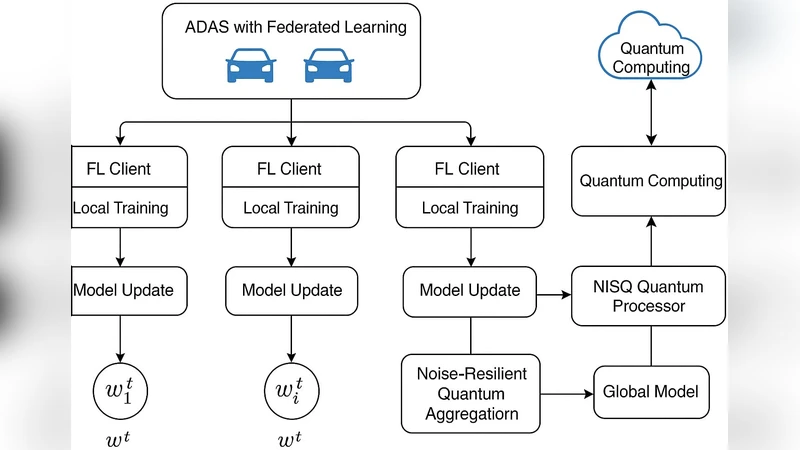
Advanced Driver Assistance Systems (ADAS) increasingly employ Federated Learning (FL) to collaboratively train models across distributed vehicular nodes while preserving data privacy. Yet, conventional FL aggregation remains susceptible to noise, latency, and security constraints inherent to real-time vehicular networks. This paper introduces Noise-Resilient Quantum Federated Learning (NR-QFL), a hybrid quantum-classical framework that enables secure, low-latency aggregation through variational quantum circuits (VQCs) operating under Noisy Intermediate-Scale Quantum (NISQ) conditions. The framework encodes model parameters as quantum states with adaptive gate reparameterization, ensuring bounded-error convergence and provable resilience under Completely Positive Trace-Preserving (CPTP) dynamics. NR-QFL employs quantum entropy-based client selection and multi-server coordination for fairness and stability. Empirical validation shows consistent convergence with reduced gradient variance, lower communication overhead, and enhanced noise tolerance under constrained edge conditions. The framework establishes a scalable foundation for quantum-enhanced federated learning, enabling secure, efficient, and dynamically stable ADAS intelligence at the vehicular edge.
💡 Research Summary
The paper addresses the pressing challenges of applying federated learning (FL) to Advanced Driver Assistance Systems (ADAS), where real‑time constraints, non‑IID sensor data, unreliable vehicular networks, and stringent privacy requirements make classical FL aggregation fragile. To overcome these issues, the authors propose Noise‑Resilient Quantum Federated Learning (NR‑QFL), a hybrid quantum‑classical framework that leverages Noisy Intermediate‑Scale Quantum (NISQ) devices to perform the aggregation step.
Key components of NR‑QFL:
- Quantum Encoding of Model Parameters – Local model weights are angle‑encoded into single‑qubit states |ψ⟩ = cos(w)|0⟩ + sin(w)|1⟩, dramatically reducing the data volume transmitted to the server.
- Variational Quantum Aggregation – A shallow variational quantum circuit (VQC) with depth < 10 and ≤ 6 qubits implements a parameterized unitary Uₐgg that combines all client states in superposition. Adaptive gate re‑parameterization mitigates the effect of noise while keeping the circuit feasible on current NISQ hardware.
- Quantum‑Entropy Based Client Selection – A dedicated quantum circuit generates random selection vectors, ensuring unbiased client participation and providing information‑theoretic security for the selection process.
- Multi‑Server Coordination – Several quantum aggregation nodes cooperate, eliminating single‑point‑of‑failure risks and improving fault tolerance.
Theoretical analysis models NISQ noise as a Completely Positive Trace‑Preserving (CPTP) map with Kraus operators representing depolarizing and dephasing channels. Three theorems are proved: (i) linearity and bounded trace‑distance guarantee that the aggregated estimator remains within ε of the true average; (ii) a variance bound shows how measurement shots (S) and circuit depth (d) control the overall error; (iii) commutation stability demonstrates that if the observable commutes with the noise channel, aggregation is invariant to that noise. These results provide rigorous convergence guarantees even under realistic decoherence.
Experimental validation uses Qiskit Aer to emulate superconducting NISQ hardware (p = 0.05 depolarizing, γ = 0.03 amplitude‑damping). Five non‑IID clients train a ResNet‑18 on CIFAR‑10 partitions, and three aggregation schemes are compared: classical FedAvg, a naïve Quantum FL (QFL) without mitigation, and the proposed NR‑QFL. Over 50 communication rounds, NR‑QFL achieves 86.1 % accuracy and an F1‑score of 0.84, outperforming FedAvg (79.2 % / 0.76) and QFL (84.5 % / 0.81). Communication overhead rises only 8 % relative to QFL, while latency stays below 10 ms thanks to high‑bandwidth PCIe Gen4/QBridge interconnects. Class Activation Map visualizations reveal that NR‑QFL preserves sharp, coherent attention regions despite quantum noise, a critical property for safety‑critical perception tasks.
Hardware feasibility is demonstrated through a proposed modular quantum co‑processor that integrates a 6‑qubit superconducting chip with existing automotive AI SoCs (e.g., NVIDIA Orin, TI Jacinto). The co‑processor handles the VQC aggregation while the classical cores perform sensor fusion and inference. With gate fidelities > 99 % and coherence times of 50–300 µs, the shallow circuits required by NR‑QFL can be executed reliably. The authors estimate that the combined quantum‑classical pipeline can meet ADAS decision‑making deadlines (≤ 100 ms).
Conclusion and future work – NR‑QFL delivers a complete solution: quantum‑compressed parameter transmission, noise‑resilient shallow variational aggregation, secure quantum‑based client selection, and a realistic hardware integration path. Future directions include pulse‑level control for deeper error mitigation, thermal‑aware co‑design, and extending the framework to quantum‑assisted optimization (QA‑O) and quantum convolutional models, aiming for even higher energy efficiency and broader applicability across autonomous driving workloads.
Comments & Academic Discussion
Loading comments...
Leave a Comment