On emerging paradigm of teaching measurement science and technology in times of ubiquitous use of AI tools
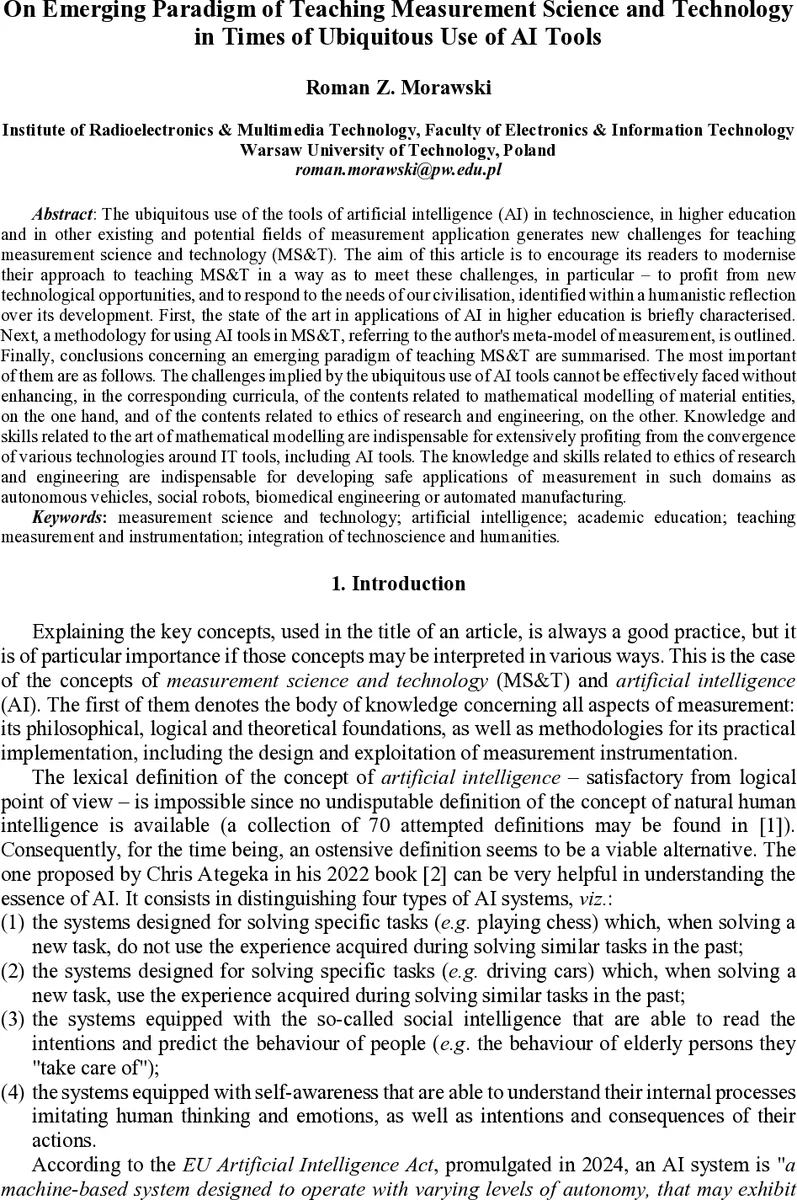
The ubiquitous use of the tools of artificial intelligence (AI) in techno-science, in higher education and in other existing and potential fields of measurement application generates new challenges for teaching measurement science and technology (MST). The aim of this article is to encourage its readers to modernize their approach to teaching MST in a way as to meet these challenges, in particular - to profit from new technological opportunities, and to respond to the needs of our civilization, identified within a humanistic reflection over its development. First, the state of the art in applications of AI in higher education is briefly characterized. Next, a methodology for using AI tools in MST, referring to the author’s meta-model of measurement, is outlined. Finally, conclusions concerning an emerging paradigm of teaching MST are summarized. The most important of them are as follows. The challenges implied by the ubiquitous use of AI tools cannot be effectively faced without enhancing, in the corresponding curricula, of the contents related to mathematical modelling of material entities, on the one hand, and of the contents related to ethics of research and engineering, on the other. Knowledge and skills related to the art of mathematical modelling are indispensable for extensively profiting from the convergence of various technologies around IT tools, including AI tools. The knowledge and skills related to ethics of research and engineering are indispensable for developing safe applications of measurement in such domains as autonomous vehicles, social robots, biomedical engineering or automated manufacturing.
💡 Research Summary
This paper presents a critical analysis of the challenges and opportunities brought about by the ubiquitous use of Artificial Intelligence (AI) tools for teaching Measurement Science and Technology (MST). It argues for a fundamental paradigm shift in MST education to effectively harness new technological capabilities while addressing the broader societal needs identified through humanistic reflection.
The author begins by defining MST as the comprehensive body of knowledge encompassing the philosophical, logical, and theoretical foundations of measurement, as well as methodologies for its practical implementation. AI is discussed through both regulatory definitions (like the EU AI Act) and a functional typology that categorizes AI systems into four types: task-specific without learning, task-specific with learning, socially intelligent, and self-aware. The paper reviews the historical integration of AI in MST, highlighting the growing importance of the “Trustworthy AI” framework, which emphasizes fairness, transparency, privacy, security, reliability, and accountability.
A significant portion of the paper is dedicated to examining the current state of AI applications in higher education, categorized into profiling/prediction, intelligent tutoring, assessment/evaluation, and adaptive personalization. It acknowledges the benefits—such as personalized learning and reduced administrative burden—but also serious concerns regarding plagiarism, privacy erosion, and the potential diminishment of human interaction and critical thinking. The author advocates for a constructive, rather than prohibitive, approach. Given the widespread student use of AI tools, education should focus on teaching their ethical and effective application, positioning AI as a “creative assistant” that aids rather than replaces genuine intellectual effort, with a strong emphasis on source citation and verification.
The core of the proposed new educational paradigm lies in two major enhancements to MST curricula. First, mathematical modelling must be elevated to a meta-concept. Moving beyond a naive view of measurement as merely a data provider for models, the author contends that the skill of constructing mathematical models of physical phenomena is essential for leveraging the convergence of technologies around IT and AI tools. This represents a shift from teaching catalogues of instruments to fostering a deep understanding of the interplay between data, models, and AI-driven analysis.
Second, the integration of ethics in research and engineering is deemed indispensable. As measurement data increasingly informs critical decisions in domains like autonomous vehicles, social robots, and biomedical engineering, MST education must produce professionals who are not only technically proficient but also ethically responsible. This involves cultivating critical thinking about the societal impact, biases, and accountability of AI systems, ensuring the development of safe and trustworthy applications.
In conclusion, the paper posits that the pervasive use of AI tools exposes the limitations of traditional MST teaching methods. To face these challenges, curricula must be modernized to strengthen both mathematical modelling skills and ethical reasoning. The emerging paradigm calls for an integrated approach that bridges technoscience and humanities, aiming to educate a new generation of measurement specialists capable of acting as responsible “architects” of complex, AI-enhanced measurement systems.
Comments & Academic Discussion
Loading comments...
Leave a Comment