Geschlechtsübergreifende Maskulina im Sprachgebrauch Eine korpusbasierte Untersuchung zu lexemspezifischen Unterschieden
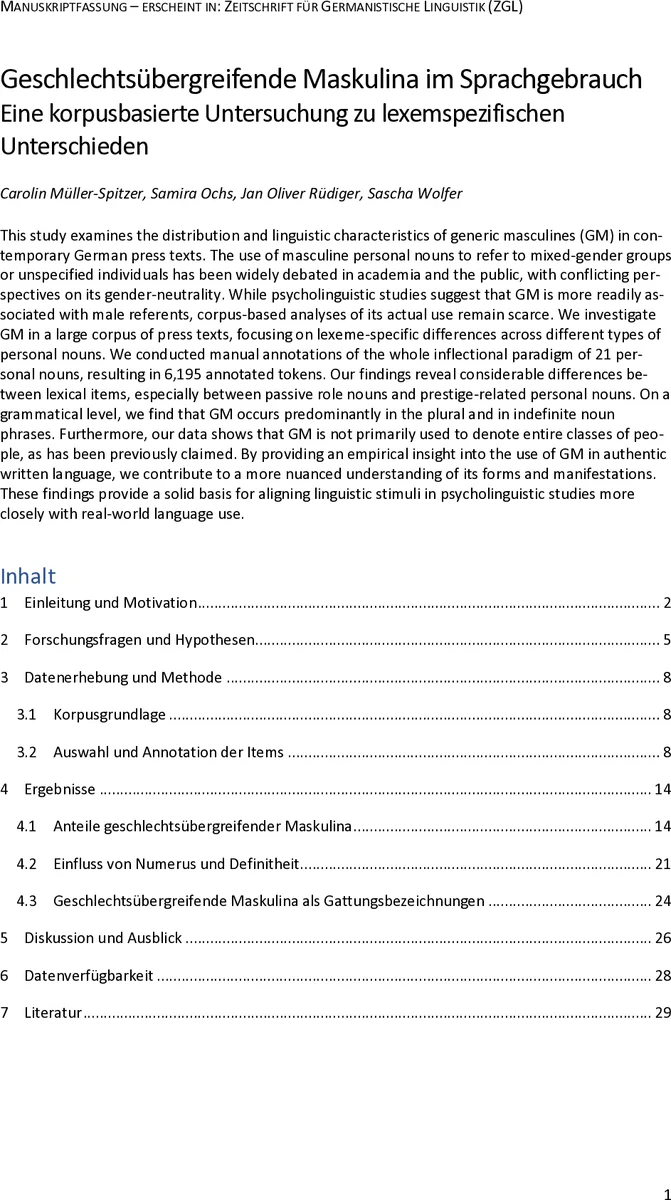
This study examines the distribution and linguistic characteristics of generic masculines (GM) in contemporary German press texts. The use of masculine personal nouns to refer to mixed-gender groups or unspecified individuals has been widely debated in academia and the public, with con-flicting perspectives on its gender-neutrality. While psycholinguistic studies suggest that GM is more readily associated with male referents, corpus-based analyses of its actual use remain scarce. We investigate GM in a large corpus of press texts, focusing on lexeme-specific differences across dif-ferent types of personal nouns. We conducted manual annotations of the whole inflectional para-digm of 21 personal nouns, resulting in 6,195 annotated tokens. Our findings reveal considerable differences between lexical items, especially between passive role nouns and prestige-related per-sonal nouns. On a grammatical level, we find that GM occurs predominantly in the plural and in indefinite noun phrases. Furthermore, our data shows that GM is not primarily used to denote entire classes of people, as has been previously claimed. By providing an empirical insight into the use of GM in authentic written language, we contribute to a more nuanced understanding of its forms and manifestations. These findings provide a solid basis for aligning linguistic stimuli in psy-cholinguistic studies more closely with real-world language use.
💡 Research Summary
The research paper titled “Geschlechtsübergreifende Maskulina im Sprachgebrauch” addresses the long-standing linguistic and social controversy surrounding the use of the “generic masculine” (GM) in the German language. The central question is whether the use of masculine personal nouns to refer to mixed-gender groups or unspecified individuals is truly gender-neutral or if it inherently carries a male-centric bias. While psycholinguistic experiments have often pointed toward a male-associated bias, there has been a significant lack of large-scale, corpus-based empirical evidence to confirm how these forms are actually utilized in real-world media.
To bridge this gap, the researchers conducted a rigorous corpus-based investigation using a large dataset of contemporary German press texts. The methodology was particularly meticulous, involving the manual annotation of the entire inflectional paradigm for 21 specific personal nouns. This resulted in a highly detailed dataset of 6,195 annotated tokens, allowing for a granular analysis of how these nouns change across different grammatical cases and numbers. The study’s primary focus was to identify lexeme-specific differences, moving beyond the idea that all masculine nouns behave identically.
The findings are multifaceted and provide significant scientific insights. First, the study reveals that the usage of GM is not uniform across all words; there are significant differences depending on the semantic nature of the noun. Specifically, a distinction was found between “passive role nouns” and “prestige-related personal nouns.” This suggests that the social and semantic weight of a noun influences its masculine usage, indicating that the “gendered” nature of language is deeply intertwined with the social status of the referent.
Second, the researchers identified clear grammatical patterns, noting that GM is most prevalent in plural forms and within indefinite noun phrases. This highlights the syntactic environments where the generic masculine is most functional. Third, the study challenges the common assumption that GM is primarily used as a linguistic tool to denote entire classes of people, providing a more nuanced view of its functional diversity.
Ultimately, this research provides a crucial empirical foundation for the linguistic community. By demonstrating that the use of the generic masculine is more nuanced and dependent on lexical and grammatical context than previously thought, the study offers a way to refine psycholinguistic stimuli. This ensures that future laboratory experiments are more closely aligned with the actual, complex patterns of real-world language use, thereby increasing the validity and ecological accuracy of studies on gendered language perception.
Comments & Academic Discussion
Loading comments...
Leave a Comment