The universal family of punctured Riemann surfaces is Stein
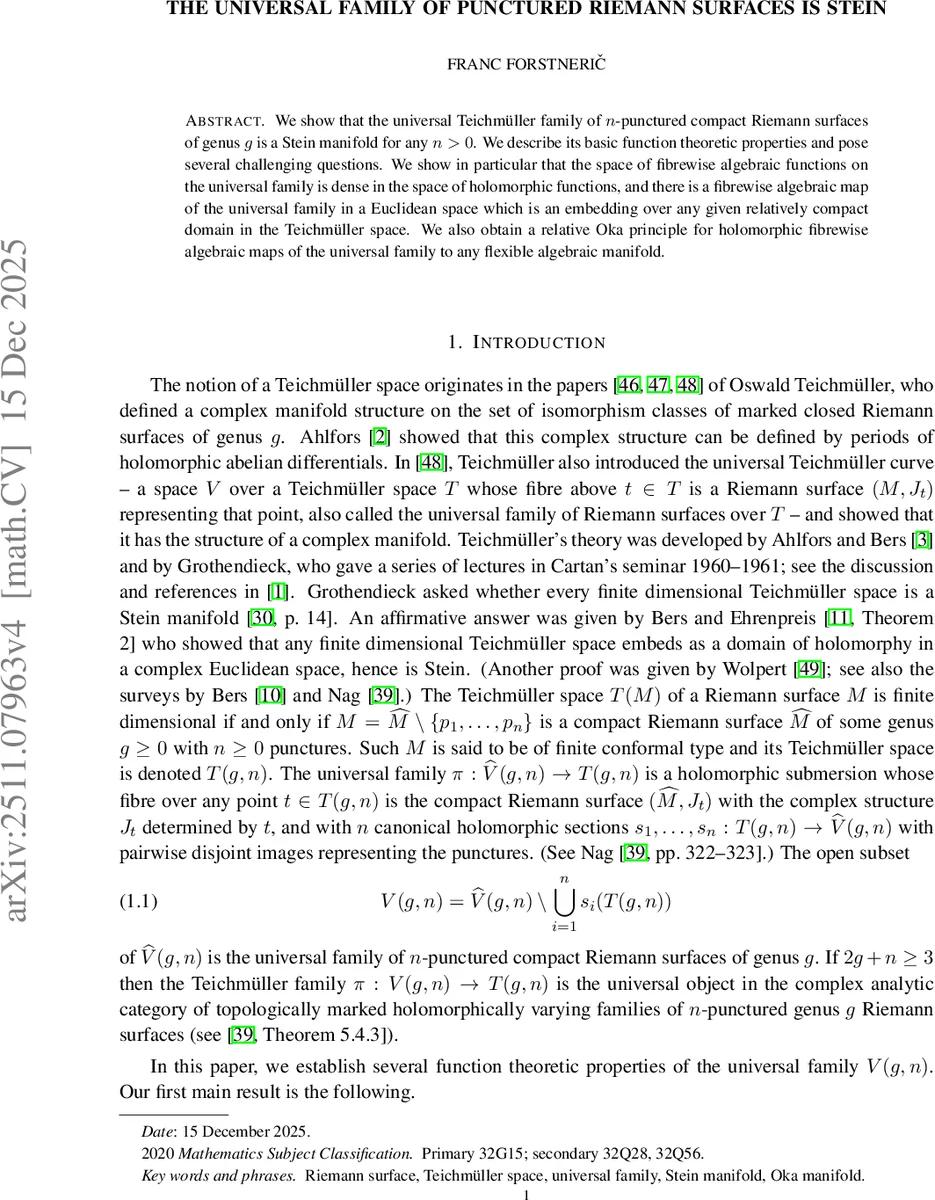
We show that the universal Teichmüller family of n-punctured compact Riemann surfaces of genus g is a Stein manifold for any n>0. We describe its basic function theoretic properties and pose several challenging questions. We show in particular that the space of fibrewise algebraic functions on the universal family is dense in the space of holomorphic functions, and there is a fibrewise algebraic map of the universal family in a Euclidean space which is an embedding over any given relatively compact domain in the Teichmüller space. We also obtain a relative Oka principle for holomorphic fibrewise algebraic maps of the universal family to any flexible algebraic manifold.
💡 Research Summary
The paper establishes that the universal Teichmüller family of n‑punctured compact Riemann surfaces of genus g, denoted V(g,n), is a Stein manifold whenever n ≥ 1. This resolves a natural question left open after the classical result that the corresponding Teichmüller space T(g,n) is Stein (Bers–Ehrenpreis, Wolpert). The authors give two independent proofs.
The first proof (Section 2) works in a more general setting: let X be any Stein manifold, Z a complex manifold of dimension dim X + 1, and π: Z → X a holomorphic submersion with connected one‑dimensional fibres. If s₁,…,sₙ: X → Z are holomorphic sections with disjoint images, then the complement Ω = Z \ ⋃ sᵢ(X) is Stein. The argument proceeds by constructing a global strongly plurisubharmonic exhaustion function on Ω. Near each section the authors use Siu’s theorem to obtain a Stein neighbourhood and a strongly plurisubharmonic function φ that blows up along the section. By choosing a small disc D in each fibre and a strongly subharmonic function u on the complementary bordered surface, they glue φ and u via a regularised maximum to obtain a fibrewise strongly subharmonic function ρ. Adding a strongly plurisubharmonic exhaustion τ on the base yields ρ + τ∘π, a global exhaustion on Ω. Grauert’s theorem then implies that Ω is Stein. Applying this to Z = the compactified universal family (\overline{V}(g,n)) and the n canonical sections gives Steinness of V(g,n).
The second proof (Section 3) is more algebraic. The authors define A(V(g,n)) as the algebra of fibrewise algebraic functions—functions that restrict on each fibre to a regular function on the corresponding punctured algebraic curve. They prove that A(V(g,n)) is dense in the full holomorphic function algebra O(V(g,n)) with respect to the compact‑open topology. The key is that fibrewise algebraic functions separate points and, by Grauert–Remmert’s coherence theorem, generate enough holomorphic functions to make V(g,n) holomorphically convex. Consequently V(g,n) is Stein.
From Steinness the paper derives several important consequences. By classical embedding theorems (Remmert–Bishop–Narasimhan) V(g,n) admits a proper holomorphic embedding into (\mathbb{C}^{N}) with (N=2\dim V+1 = 6g-6+2n+1) (or even a smaller N using Eliashberg–Gromov). Because the base T(g,n) is contractible, the submersion π is smoothly trivial, and the inclusion of any fibre is a homotopy equivalence. Combining this with Oka theory, the authors obtain Corollary 1.2: for any Oka manifold Y, every continuous map V(g,n)→Y is homotopic to a holomorphic map, and any holomorphic map defined on a fibre extends holomorphically over the whole family. Moreover, if Y is not simply connected, there exist holomorphic maps V(g,n)→Y that are non‑constant on every fibre (Corollary 1.3).
The paper also shows that every holomorphic vector bundle over V(g,n) is holomorphically trivial (Proposition 1.5), which yields a nowhere‑vanishing holomorphic vector field tangent to the fibres and a dual holomorphic 1‑form that never vanishes on any fibre (Corollary 1.6).
Several open problems are posed. Problem 1.4 asks whether V(g,n) admits a proper holomorphic embedding into some (\mathbb{C}^{N}) that is algebraic on each fibre. Problem 1.7 asks for a holomorphic function f: V(g,n)→(\mathbb{C}) whose restriction to every fibre is an immersion (i.e., whose differential never aligns with the vertical direction). The authors note that a holomorphic function without critical points exists (by a result of Forstnerič), but achieving transversality to the fibres remains open.
Finally, the authors discuss possible extensions to infinite‑dimensional Teichmüller families, referencing recent work on Runge approximation and Oka principles for families of open Riemann surfaces with varying complex structures.
In summary, the paper provides a thorough analysis of the universal punctured Teichmüller family, proving its Stein property via both analytic and algebraic methods, and explores a rich array of geometric, function‑theoretic, and homotopical consequences, while highlighting intriguing directions for future research.
Comments & Academic Discussion
Loading comments...
Leave a Comment