A general comparison principle for the pluripotential complex Monge-Ampère flow
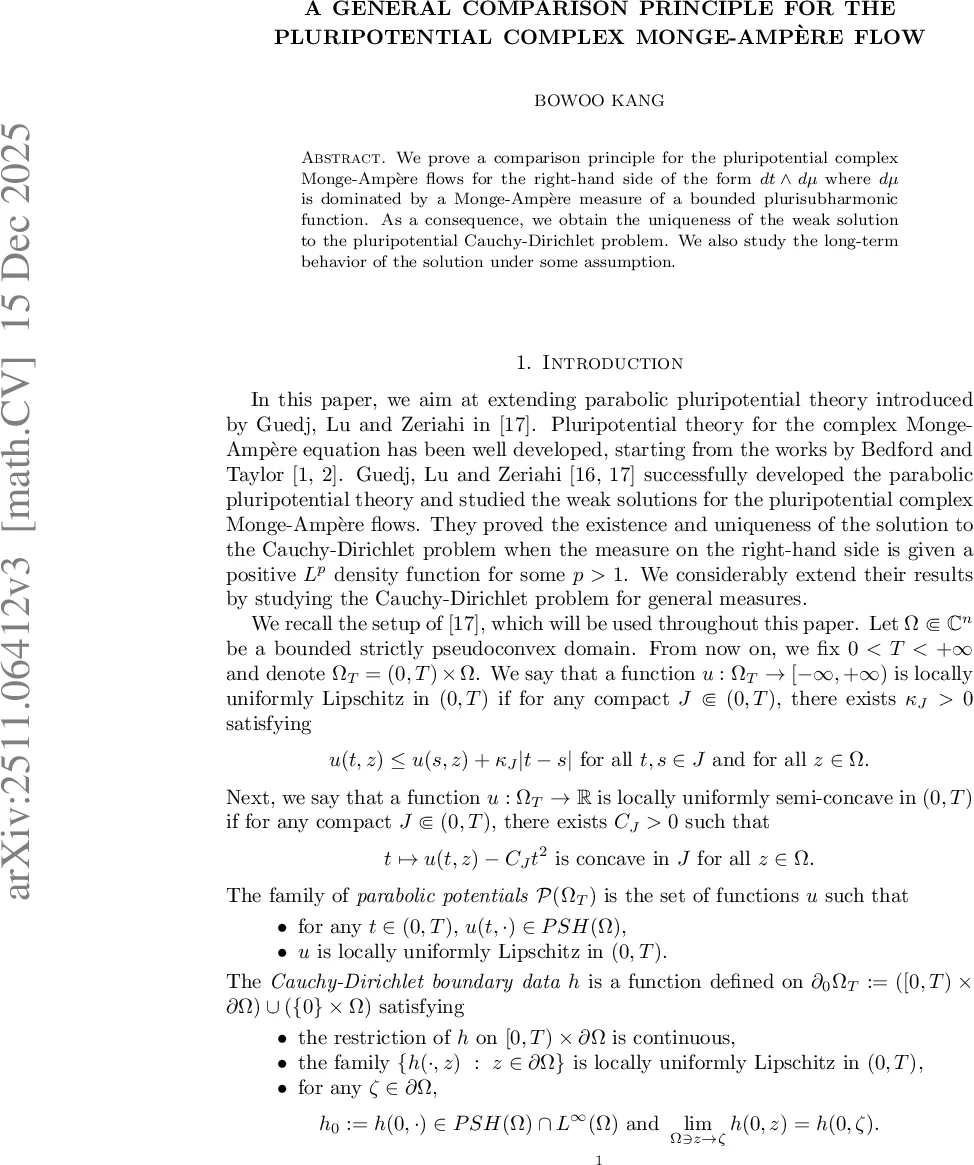
We prove a comparison principle for the pluripotential complex Monge-Ampère flows for the right-hand side of the form $dt \wedge dμ$ where $dμ$ is dominated by a Monge-Ampère measure of a bounded plurisubharmonic function. As a consequence, we obtain the uniqueness of the weak solution to the pluripotential Cauchy-Dirichlet problem. We also study the long-term behavior of the solution under some assumption.
💡 Research Summary
The paper develops a new comparison principle for pluripotential solutions of the complex Monge‑Ampère flow (CMAF) when the right‑hand side involves a general measure µ rather than a density in L^p. The setting is a bounded strictly pseudo‑convex domain Ω⊂ℂⁿ and a time interval (0,T). A “parabolic potential” is a function u(t,·) that is plurisubharmonic (psh) for each t and locally uniformly Lipschitz in time. The Cauchy‑Dirichlet problem asks for u∈P(Ω_T)∩L^∞(Ω_T) satisfying
dt∧(dd^c u)^n = e ∂_t u + F(t,z,u) dt∧dµ
in the pluripotential sense, together with prescribed boundary data h on ∂Ω_T and initial data h₀ on Ω.
The crucial assumption on µ is that there exists a bounded psh function φ with (dd^c φ)^n ≥ µ and φ|_{∂Ω}=0 (equivalently, a bounded ψ with (dd^c ψ)^n=µ). This is guaranteed by Kolodziej’s subsolution theorem. The function F(t,z,r) is continuous, increasing in r, locally uniformly Lipschitz in (t,z), and locally semi‑convex in t.
The main result (Theorem 1.2) states: if u and v are bounded parabolic potentials that are locally uniformly semi‑concave in time, u satisfies the subsolution inequality and v the supersolution inequality, and the boundary data satisfy h₁≤h₂, then u≤v on Ω_T. Compared with the earlier theorem of Guedj‑Lu‑Zeriahi (which required the supersolution to be semi‑concave and an additional distributional condition (1.4) on the boundary data), the new principle removes those extra hypotheses. The proof avoids the use of upper envelopes and instead directly compares the two semi‑concave functions, relying on several technical lemmas:
- Lemma 2.2 establishes Borel measurability of the map t↦∫_{E_t}(dd^c u(t,·))^n for any Borel set E⊂Ω_T.
- Lemma 2.3 shows that the Radon measure dt∧(dd^c u)^n coincides with the iterated integral ∫0^T dt∫{E_t}(dd^c u)^n.
- Lemma 2.4 provides a parabolic version of the classical comparison principle for the Monge‑Ampère operator, yielding an inequality between the measures of the sublevel set {v<u}.
- Lemmas 2.5 and 2.6 are global maximum and domination principles adapted to the parabolic setting.
These tools allow the authors to prove that if dt∧(dd^c v)^n ≤ dt∧(dd^c u)^n then u≤v, which is the core of the comparison argument.
Using the comparison principle together with an existence result from the authors’ earlier work, Corollary 1.4 establishes existence and uniqueness of a bounded pluripotential solution to the Cauchy‑Dirichlet problem under the usual regularity assumptions (1.3) and (1.4) on the boundary data. The solution is locally uniformly semi‑concave in time.
The paper further investigates the long‑time behavior. In Theorem 1.5, assuming the time interval is infinite (T=+∞) and that F satisfies a strong monotonicity condition |F(z,r₁)−F(z,r₂)|≥L_F|r₁−r₂| for all r₁,r₂ in a bounded interval, the unique solution u(t,·) converges uniformly as t→∞ to a stationary bounded psh function ψ^∞ solving
(dd^c ψ^∞)^n = e F(z,ψ^∞) µ, ψ^∞|_{∂Ω}=0.
Thus the flow stabilizes to a steady state determined by the measure µ and the nonlinearity F.
Overall, the paper significantly broadens the applicability of pluripotential methods for complex Monge‑Ampère flows. By allowing general measures dominated by Monge‑Ampère measures of bounded psh functions, it removes the restrictive L^p‑density condition and provides a robust comparison principle, uniqueness, and convergence results. These advances have potential implications for complex geometric flows, the analytic minimal model program, and other areas where degenerate complex Monge‑Ampère equations arise.
Comments & Academic Discussion
Loading comments...
Leave a Comment