Graded chain conditions and graded Jacobson radical of groupoid graded modules
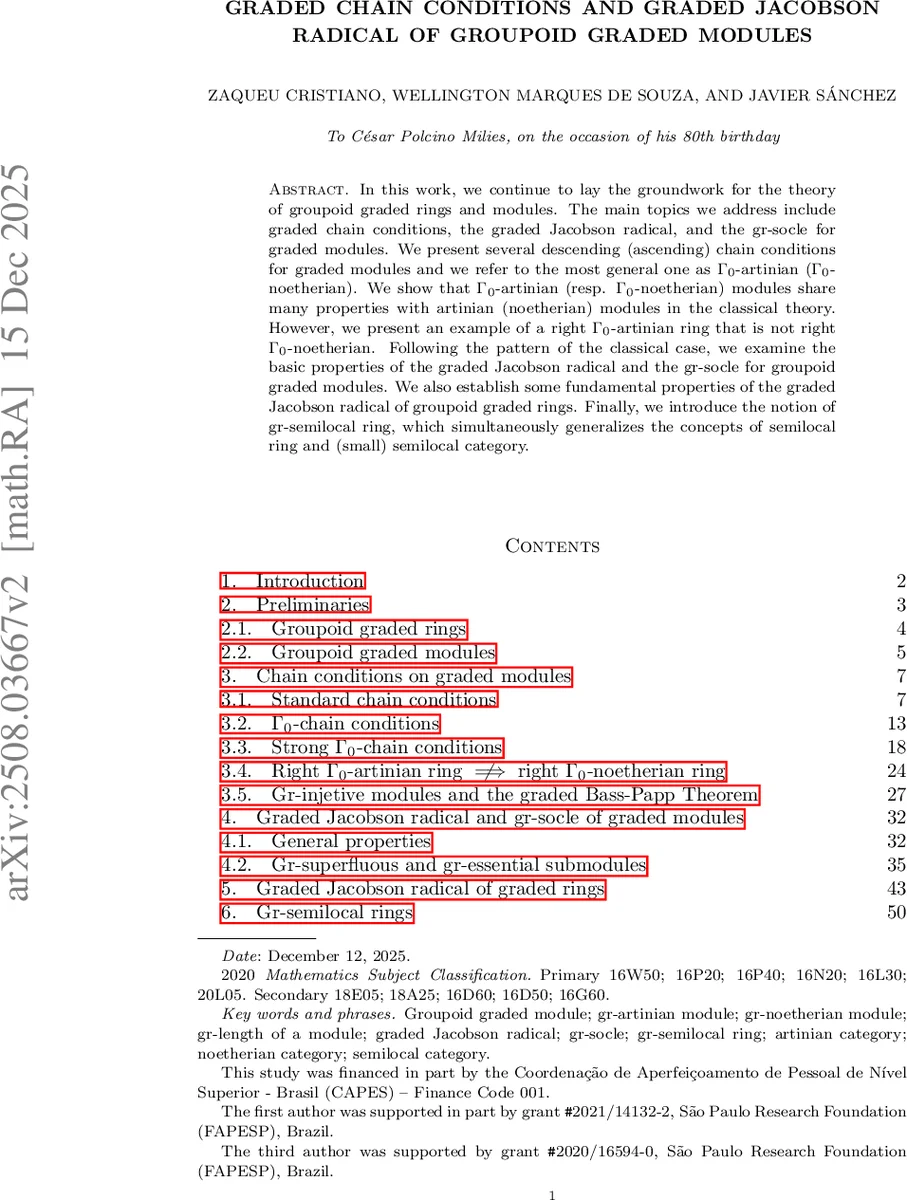
In this work, we continue to lay the groundwork for the theory of groupoid graded rings and modules. The main topics we address include graded chain conditions, the graded Jacobson radical, and the gr-socle for graded modules. We present several descending (ascending) chain conditions for graded modules and we refer to the most general one as $Γ_0$-artinian ($Γ_0$-noetherian). We show that $Γ_0$-artinian (resp. $Γ_0$-noetherian) modules share many properties with artinian (noetherian) modules in the classical theory. However, we present an example of a right $Γ_0$-artinian ring that is not right $Γ_0$-noetherian. Following the pattern of the classical case, we examine the basic properties of the graded Jacobson radical and the gr-socle for groupoid graded modules. We also establish some fundamental properties of the graded Jacobson radical of groupoid graded rings. Finally, we introduce the notion of gr-semilocal ring, which simultaneously generalizes the concepts of semilocal ring and (small) semilocal category.
💡 Research Summary
This paper makes significant contributions to the foundational theory of groupoid-graded rings and modules, with a focused investigation on graded chain conditions, the graded Jacobson radical, and related concepts. The work systematically generalizes classical module theory to the setting of object-unital groupoid-graded structures.
The authors begin by establishing necessary preliminaries on groupoids, graded rings, and graded modules, emphasizing the decomposition of any graded module M as a direct sum over objects: M = ⊕_{e∈Γ₀} M(e).
The first major part of the paper is dedicated to graded chain conditions. The authors identify that the most natural “standard” chain conditions are too restrictive, as they essentially force the ring to be unital. To overcome this, they introduce the more flexible Γ₀-chain conditions (Γ₀-artinian and Γ₀-noetherian). These conditions only require chains of graded submodules contained within the finite-support submodules ⊕_{e∈F} M(e) (for finite sets F ⊂ Γ₀) to stabilize. Modules satisfying these conditions retain many key properties of classical artinian/noetherian modules, such as the existence of a composition series (gr-length) and the fact that finitely generated modules over a Γ₀-noetherian ring are themselves Γ₀-noetherian. A deep connection is made to the concepts of artinian and noetherian categories from category theory. The authors also define even stronger “strong Γ₀-chain conditions,” which are noted to be relevant for studying the nilpotency of the graded Jacobson radical in subsequent work. A crucial and surprising result is the construction of an example of a right Γ₀-artinian ring that is not right Γ₀-noetherian, highlighting a fundamental divergence from the group-graded case and classical ring theory. Furthermore, the authors prove a graded version of the Bass-Papp Theorem, characterizing right Γ₀-noetherian rings via the preservation of gr-injectivity under taking graded direct products.
The second core contribution is the development of a theory for the graded Jacobson radical, J^gr(M), and the graded socle, Soc^gr(M), of a graded module. The graded Jacobson radical is defined equivalently as the intersection of all gr-maximal submodules or as the sum of all gr-superfluous submodules. Dually, the graded socle is defined as the sum of all gr-simple submodules or as the intersection of all gr-essential submodules. A comprehensive set of properties analogous to the ungraded theory is established for these constructs.
The third focus is on the graded Jacobson radical J^gr(R) of the graded ring itself. Fundamental properties are proven, including a graded Nakayama’s Lemma and the fact that J^gr(R) contains all homogeneous elements that are not gr-invertible. A key characterization shows that a ring is gr-semisimple if and only if it is right Γ₀-artinian and has zero graded Jacobson radical.
Synthesizing these ideas, the paper culminates in the introduction of “gr-semilocal rings.” A Γ-graded ring R is defined to be gr-semilocal if the quotient R/J^gr(R) is a gr-semisimple ring (equivalently, a right Γ₀-artinian ring with zero radical). This concept simultaneously generalizes classical semilocal rings and the notion of (small) semilocal categories. One of the main theorems provides a powerful characterization: R is gr-semilocal if and only if for every object e in the groupoid, the component ring R_e is a classical semilocal ring. This theorem immediately implies that groupoid-graded rings arising from semilocal categories are automatically gr-semilocal, providing a vast source of examples and firmly embedding the new theory within broader mathematical frameworks.
Overall, this paper provides a rigorous and extensive groundwork for the study of chain conditions and radical theory in the context of groupoid-graded algebras, revealing both expected generalizations and novel phenomena distinct from the group-graded case.
Comments & Academic Discussion
Loading comments...
Leave a Comment