A derived category analogue of the Nakai--Moishezon criterion
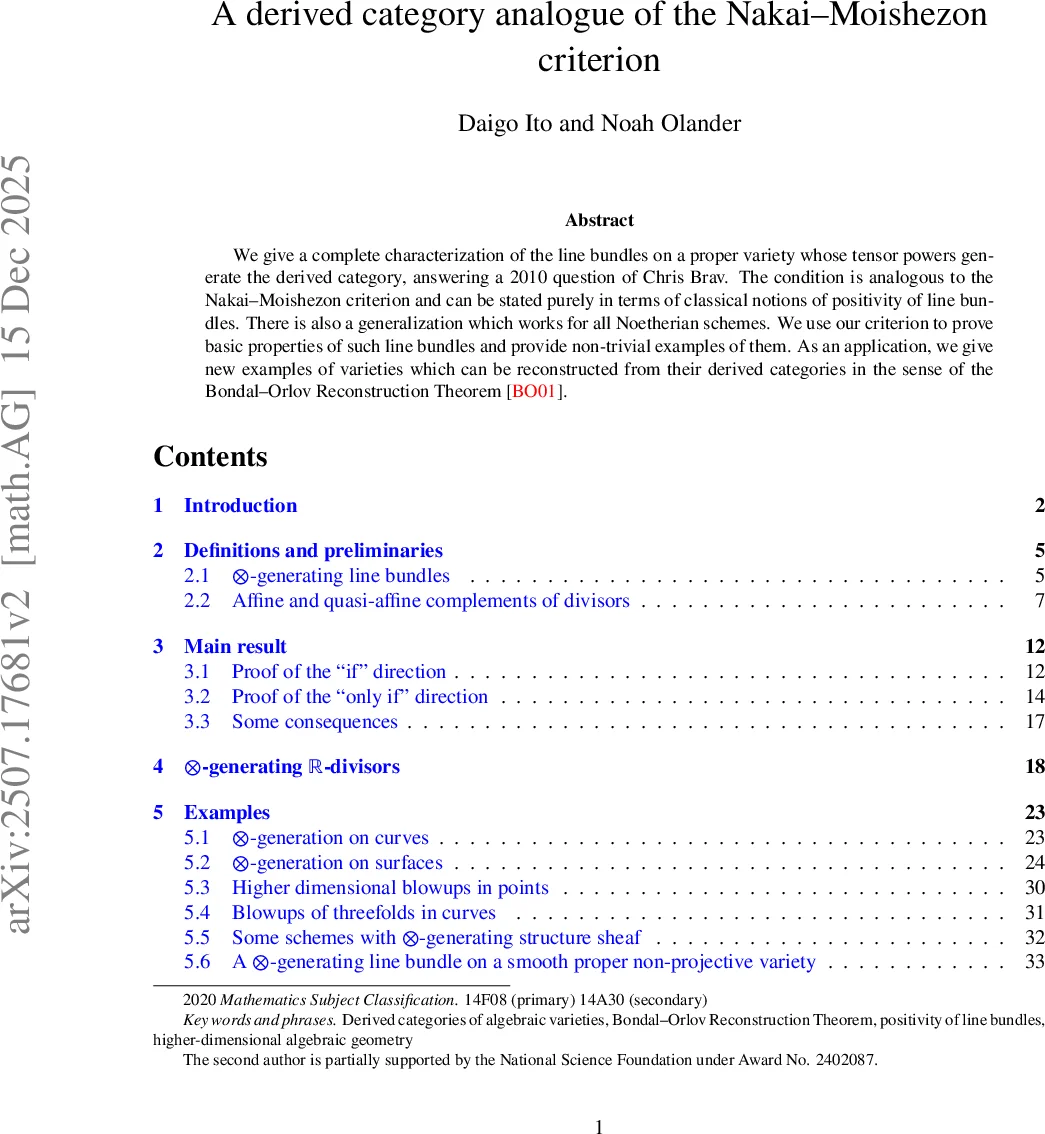
We give a complete characterization of the line bundles on a proper variety whose tensor powers generate the derived category, answering a 2010 question of Chris Brav. The condition is analogous to the Nakai–Moishezon criterion and can be stated purely in terms of classical notions of positivity of line bundles. There is also a generalization which works for all Noetherian schemes. We use our criterion to prove basic properties of such line bundles and provide non-trivial examples of them. As an application, we give new examples of varieties which can be reconstructed from their derived categories in the sense of the Bondal–Orlov Reconstruction Theorem.
💡 Research Summary
The paper addresses a fundamental question in derived algebraic geometry: which line bundles on a scheme generate its derived category of quasi‑coherent sheaves via tensor powers? This problem, posed by Chris Brav in 2010, is answered completely by Daigo Ito and Noah Olander. Their main result is a criterion that mirrors the classical Nakai–Moishezon ampleness test, but it applies to the derived‑category generation property rather than to ampleness.
Definitions and background.
For a quasi‑compact, quasi‑separated scheme X, a line bundle L is called ⊗‑generating if the set {Lⁿ | n∈ℤ} classically generates the subcategory of perfect complexes Perf(X). Equivalently, there exists an integer N>0 such that Perf(X) = ⟨𝒪_X, L, …, Lⁿ⟩. This notion generalizes the well‑known fact that if L or L⁻¹ is ample then L is ⊗‑generating (Orlov’s theorem). Lemmas 2.2–2.5 establish basic stability properties: ⊗‑generation is preserved under finite tensor powers, restriction to irreducible components, pull‑back by finite surjective morphisms, and base‑change to field extensions.
A generalized notion of bigness.
The authors introduce a scheme‑theoretic analogue of “big” line bundles: a line bundle L on an integral, quasi‑compact, quasi‑separated scheme X is big if there exists n>0 and a global section s∈Γ(X, Lⁿ) such that the open complement X_s = {s≠0} is non‑empty and affine. Lemma 2.6 (Deligne’s formula) and Lemma 2.17 show that for proper varieties over a field this definition coincides with the classical one.
Main theorems.
Theorem 1.1 (Theorem 3.1 (i)) states that for a proper scheme X over a field, a line bundle L is ⊗‑generating iff for every closed subvariety Z⊂X either L|_Z or L⁻¹|_Z is big. This is precisely the Nakai–Moishezon style condition: ampleness requires L|_Z to be big for all Z, while ⊗‑generation only needs one of the two twists to be big.
Theorem 1.2 (Theorem 3.1 (ii)) gives a scheme‑wide version: for any Noetherian scheme X, L is ⊗‑generating iff for every integral closed subscheme Z there exist an integer n and a global section s∈Γ(Z, Lⁿ|_Z) such that Z_s is non‑empty and affine. Thus the existence of a “big” tensor power on every closed piece is both necessary and sufficient.
These theorems are proved by a careful analysis of affine complements, the use of Deligne’s formula, and a reduction to the case of integral subschemes. The “if” direction constructs enough morphisms from tensor powers to any non‑zero object in D(QCoh X); the “only‑if” direction shows that failure of the affine‑open condition would prevent generation.
Consequences and corollaries.
Corollary 1.3 shows that ⊗‑generation is invariant under tensor powers, restriction to irreducible components, and pull‑back by finite surjective morphisms. The authors also exhibit examples where analogous statements fail for compact generators, highlighting the special nature of ⊗‑generation.
In Section 4 they introduce the ⊗‑generating cone inside the real Néron–Severi space N¹(X). Proposition 4.12 proves that ⊗‑generation is a numerical property: it depends only on the numerical class of the divisor. Lemmas 5.3 and 5.4 give intersection‑theoretic criteria on surfaces, allowing explicit computation of the cone for ruled surfaces and blow‑ups of ℙ².
Examples.
Section 5 provides a rich collection of non‑ample, non‑anti‑ample ⊗‑generating line bundles:
- Nodal unions of two ℙ¹,
- Smooth projective surfaces containing a curve of negative self‑intersection,
- Blow‑ups of quasi‑projective varieties at points,
- Affine space with doubled origin (structure sheaf ⊗‑generating but not ample),
- The affine plane blown up at the origin with a point removed from the exceptional divisor,
- Hirzebruch’s smooth proper non‑projective threefold.
These illustrate that ⊗‑generation does not imply separatedness or the resolution property.
Applications to reconstruction.
Theorem 1.5 applies the criterion to the canonical bundle ω_X. If ω_X (or its inverse) is big and X satisfies mild additional hypotheses (e.g., no (‑2)‑curves on a surface, certain configurations of points in blow‑ups of ℙ², unstable rank‑2 bundles over an elliptic curve, or blow‑ups of a general‑type threefold along a moving line), then ω_X is ⊗‑generating. Consequently, by the Bondal–Orlov reconstruction theorem, such varieties can be uniquely recovered from their derived categories; they have no non‑isomorphic Fourier–Mukai partners and every autoequivalence is standard.
Generalization to several line bundles.
Theorem 1.6 extends the criterion to a finite collection {L₁,…,Lₙ}. The set of all tensor products L₁^{e₁}⊗…⊗Lₙ^{eₙ} (e_i∈ℤ) generates D(QCoh X) iff for every integral closed subscheme Z there exist integers (e₁,…,eₙ) and a global section of the corresponding tensor power whose non‑vanishing locus is non‑empty and affine. This unifies the single‑bundle case and shows the method is robust under taking multiple generators.
Overall impact.
The paper provides a clean, purely algebro‑geometric characterization of when a line bundle (or a finite set of them) generates the derived category via tensor powers. By translating the derived‑category condition into the existence of affine open subsets cut out by sections, the authors bridge homological algebra and classical positivity theory. The results open new avenues for constructing examples of derived‑equivalent but non‑isomorphic varieties, for studying semi‑orthogonal decompositions, and for understanding the numerical geometry of generators in the Néron–Severi space.
Comments & Academic Discussion
Loading comments...
Leave a Comment