Engineering frustrated Rydberg spin models by graphical Floquet modulation
Arrays of Rydberg atoms interacting via dipole-dipole interactions offer a powerful platform for probing quantum many-body physics. However, these intrinsic interactions also determine and constrain the models – and parameter regimes thereof – for quantum simulation. Here, we propose a systematic framework to engineer arbitrary desired long-range interactions in Rydberg-atom lattices, enabling the realization of fully tunable $J_1$-$J_2$-$J_3$ Heisenberg models. Using site-resolved periodic modulation of Rydberg states, we develop an experimentally feasible protocol to precisely control the interaction ratios $J_2/J_1$ and $J_3/J_1$ in a kagome lattice. This control can increase the effective range of interactions and drive transitions between competing spin-ordered and spin liquid phases. To generalize this approach beyond the kagome lattice, we reformulate the design of modulation patterns through a graph-theoretic approach, demonstrating the universality of our method across all 11 planar Archimedean lattices. Our strategy overcomes the inherent constraints of power-law-decaying dipolar interactions, providing a versatile toolbox for exploring frustrated magnetism, emergent topological phases, and quantum correlations in systems with long-range interactions.
💡 Research Summary
This paper presents a groundbreaking methodological framework to overcome a fundamental limitation in programmable quantum simulators based on Rydberg atom arrays. While these platforms offer strong, tunable dipole-dipole interactions, the intrinsic power-law decay (∝ 1/R^3) of these interactions constrains the range and relative strengths of spin couplings that can be simulated, limiting access to rich phases in frustrated quantum magnetism.
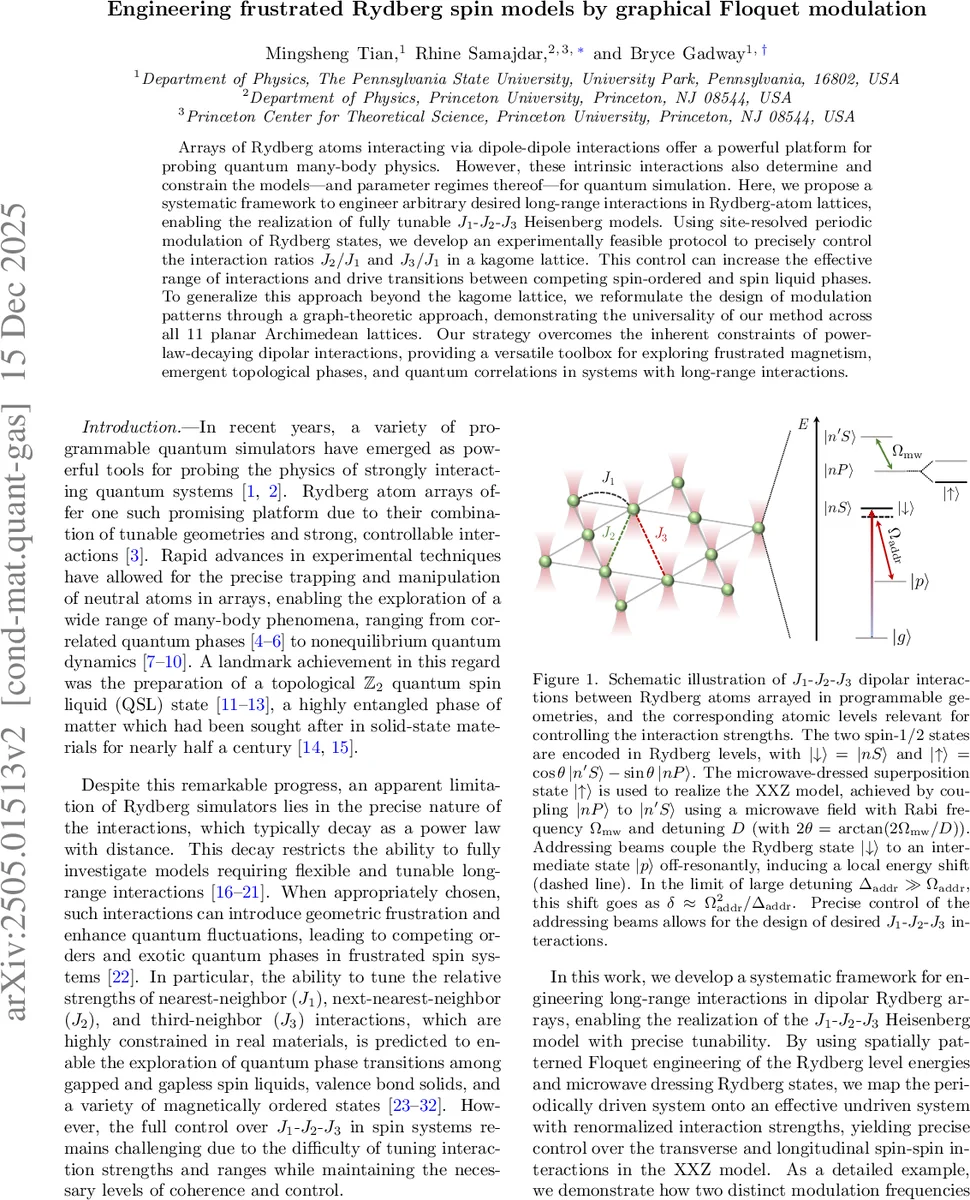
The authors propose a systematic approach dubbed “graphical Floquet modulation.” The core idea is to apply site-resolved, periodic energy modulations to the Rydberg atoms. Experimentally, this is achieved by using addressing beams to induce an AC Stark shift on a specific Rydberg state (|nS⟩) and then modulating the intensity of this beam at desired frequencies (ω_q) with precise, site-dependent phases (φ_mq). Under such periodic driving, the system’s effective dynamics are described by Floquet theory, leading to a renormalization of the spin-exchange interaction between atoms at sites m and n. The effective coupling becomes J_eff = J_original * Π J₀( (2δ_q/ω_q) * sin((φ_mq - φ_nq)/2) ), where J₀ is the zeroth-order Bessel function.
The key innovation lies in designing the spatial pattern of the phases (φ_m). To selectively suppress or preserve interactions at specific distances, the authors recast this design problem into a graph-theoretic challenge. For a target interaction type (e.g., nearest-neighbor J1), a graph is constructed where vertices represent atoms and edges connect atom pairs between which that interaction exists. The goal is to assign phases (or “colors”) to vertices such that connected vertices (i.e., atoms linked by the target interaction) always have different phases. This is a classic graph coloring problem. Applying a modulation pattern based on such a coloring selectively renormalizes the targeted interaction while leaving other interactions (e.g., next-nearest-neighbor J2 between atoms of the same color) unchanged.
The paper provides a detailed recipe for the kagome lattice. Using two independent modulation frequencies (ω1, ω2), each with its own coloring scheme, they demonstrate independent control over the ratios J2/J1 and J3/J1. One frequency/coloring pattern targets J1 and J3 interactions, while the other targets J1 and J2. This enables exploration of parameter regimes crucial for frustrated magnetism, such as where J3 > J2, which is predicted to host a chiral spin liquid phase.
To demonstrate the universality of their method, the authors extend the graph-theoretic formulation to all 11 planar Archimedean lattices. For each lattice, they determine the required coloring schemes to engineer desired long-range interaction profiles, proving the method is a general-purpose toolbox.
In summary, this work transcends the inherent constraints of native dipolar interactions in Rydberg arrays. By leveraging Floquet engineering guided by graph theory, it provides a powerful and universal protocol for designing arbitrary long-range spin models. This opens the door to the experimental simulation of a vast landscape of quantum phases—including various spin liquids, valence bond solids, and topological states—that were previously inaccessible in this platform, thereby significantly expanding the frontier of quantum simulation with programmable atomic systems.
Comments & Academic Discussion
Loading comments...
Leave a Comment