Can Non-Signaling Assistance Increase the Degrees of Freedom of a Wireless Network?
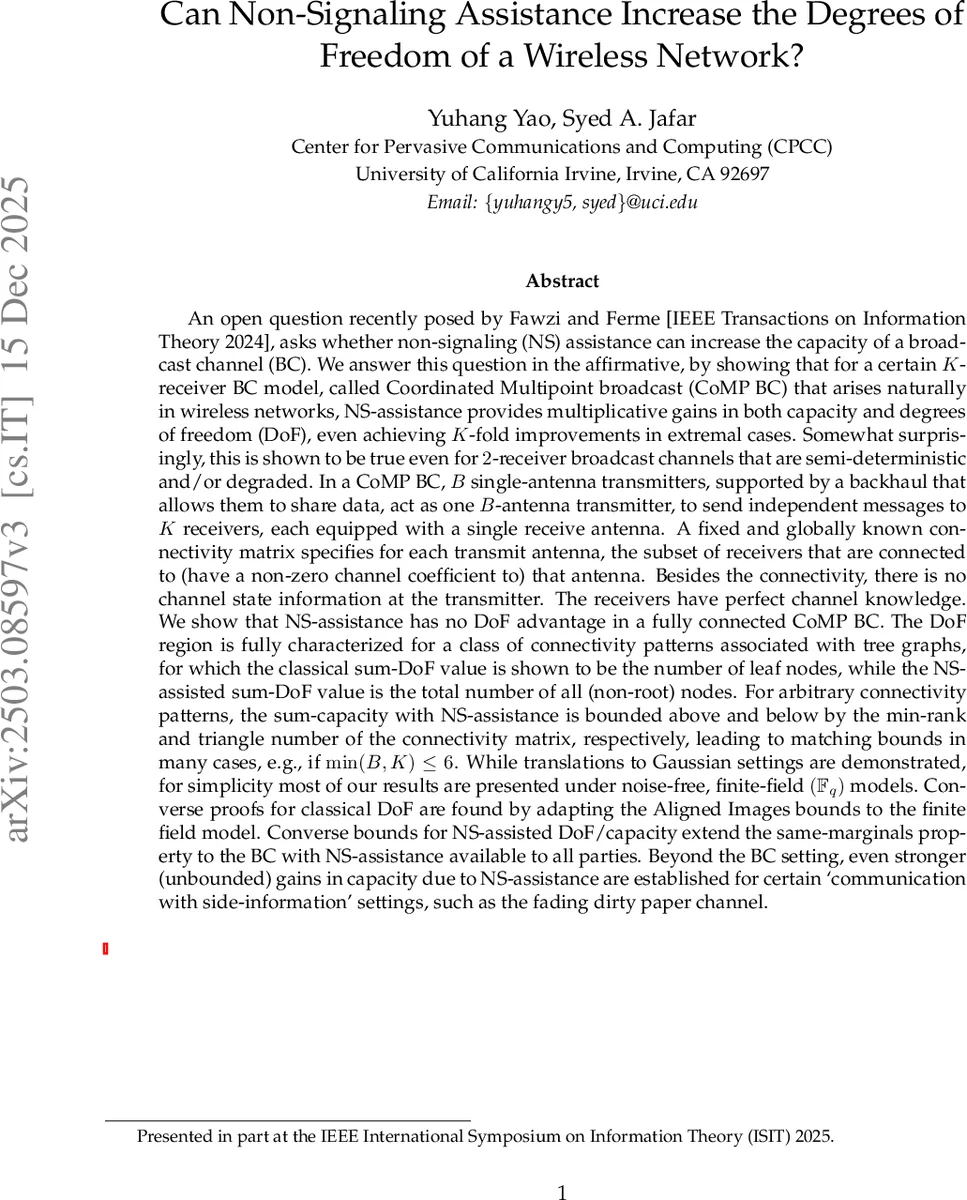
An open question posed by Fawzi and Ferme [Transactions on Information Theory 2024], asks whether non-signaling (NS) assistance can increase the capacity of a broadcast channel (BC). We answer this question in the affirmative, by showing that for a certain K-receiver BC setting, called Coordinated Multipoint (CoMP) that arises naturally in wireless networks, NS-assistance provides multiplicative gains in capacity and degrees of freedom (DoF), even achieving K-fold improvements in some cases. Somewhat surprisingly, this is shown to be true even for 2-receiver broadcast channels that are semi-deterministic and/or degraded. In a CoMP BC, B single-antenna transmitters, supported by a backhaul that allows them to share data, act as one B-antenna transmitter, to send independent messages to K receivers, each equipped with a single receive antenna. A fixed and globally known connectivity matrix M, specifies for each transmit antenna, the subset of receivers that are connected to (have a non-zero channel coefficient to) that antenna. Besides the connectivity, there is no channel state information at the transmitter. The DoF region is fully characterized for a class of connectivity patterns associated with tree graphs. Sum-capacity with NS-assistance for arbitrary connectivity patterns is bounded below and above by the triangle number and the min-rank of the connectivity matrix, respectively. While translations to Gaussian settings are demonstrated, most of our results are presented under noise-free, finite-field (Fq) models. Converse proofs for classical DoF adapt the Aligned Images bounds to the finite field model. Converse bounds for NS-assisted capacity extend the same-marginals property to the BC with NS-assistance available to all parties. Even stronger (unbounded) gains are established for certain ‘communication with side-information’ settings, such as the fading dirty paper channel.
💡 Research Summary
The paper addresses a central open problem posed by Fawzi and Ferme (2024): can non‑signaling (NS) assistance increase the capacity and degrees of freedom (DoF) of a broadcast channel (BC) that models realistic wireless networks? The authors focus on a coordinated multipoint (CoMP) broadcast setting, where B single‑antenna base stations are linked by a high‑speed backhaul and jointly act as a B‑antenna transmitter serving K single‑antenna receivers. The connectivity between each transmit antenna and the receivers is captured by a fixed, globally known binary matrix M; there is no CSIT beyond this connectivity pattern, while receivers have perfect CSIR.
The main contributions are as follows:
-
No DoF gain in fully‑connected networks. By adapting the Aligned Images technique to finite‑field (F_q) models, the authors prove that when M is all‑ones (every transmitter reaches every receiver), NS assistance does not improve the DoF compared with classical coding. This negative result mirrors earlier impossibility results for deterministic BCs.
-
Multiplicative DoF gains for hierarchical (tree) connectivity. For connectivity patterns that correspond to trees (e.g., macro‑pico‑femto hierarchies), the classical sum‑DoF equals the number of leaf nodes, whereas the NS‑assisted sum‑DoF equals the total number of non‑root nodes. In the extreme case of a path graph (a single leaf), NS assistance yields a K‑fold increase in DoF. Theorem 7 formalizes this multiplicative gain and shows that even semi‑deterministic or degraded 2‑receiver BCs can achieve up to a factor‑2 improvement.
-
General upper and lower bounds via matrix invariants. For arbitrary connectivity matrices, the authors bound the NS‑assisted sum‑capacity (and thus sum‑DoF) between the min‑rank of M (upper bound, Theorem 8) and the triangle number of M (lower bound, Theorem 9). When min(B, K) ≤ 6 these bounds coincide, yielding exact capacity values (Corollary 4). The min‑rank captures the linear independence of rows/columns, while the triangle number reflects the minimal number of non‑zero entries needed to make M upper‑triangular.
-
Extension to Gaussian channels. Although most proofs are presented for noise‑free finite‑field models, Theorem 6 translates the DoF results to the high‑SNR regime of Gaussian CoMP BCs, showing that the same multiplicative gains persist when power P → ∞.
-
Unbounded gains in side‑information channels. Beyond the BC, the paper demonstrates that NS assistance can provide arbitrarily large capacity improvements for channels with transmitter side information, exemplified by the fading dirty‑paper channel (Theorem 10). Here the NS resource effectively neutralizes the interference known at the transmitter, leading to capacity that grows without bound relative to the classical case.
-
Converse techniques. The classical converse uses an adapted Aligned Images argument for finite fields. For NS‑assisted converse, the authors extend the “same‑marginals” property to the broadcast setting with NS resources shared among all parties (Theorem 2), establishing tight outer bounds that match the achievable schemes in many regimes.
Overall, the paper establishes that NS assistance can dramatically enlarge the DoF and capacity of natural wireless network models, but only when the network topology exhibits certain sparsity or hierarchy. Fully connected networks remain unaffected, while tree‑like structures reap the full benefit of NS correlations. These findings answer the four questions raised by Fawzi and Ferme affirmatively, providing both constructive coding strategies (based on pseudo‑telepathy games mapped to coding) and tight converse bounds. The work opens a new line of inquiry into practical implementations of NS resources—whether via quantum entanglement, PR‑boxes, or other post‑quantum correlations—and their integration into future 5G/6G coordinated multipoint systems.
Comments & Academic Discussion
Loading comments...
Leave a Comment