Blowing up Dirac's theorem
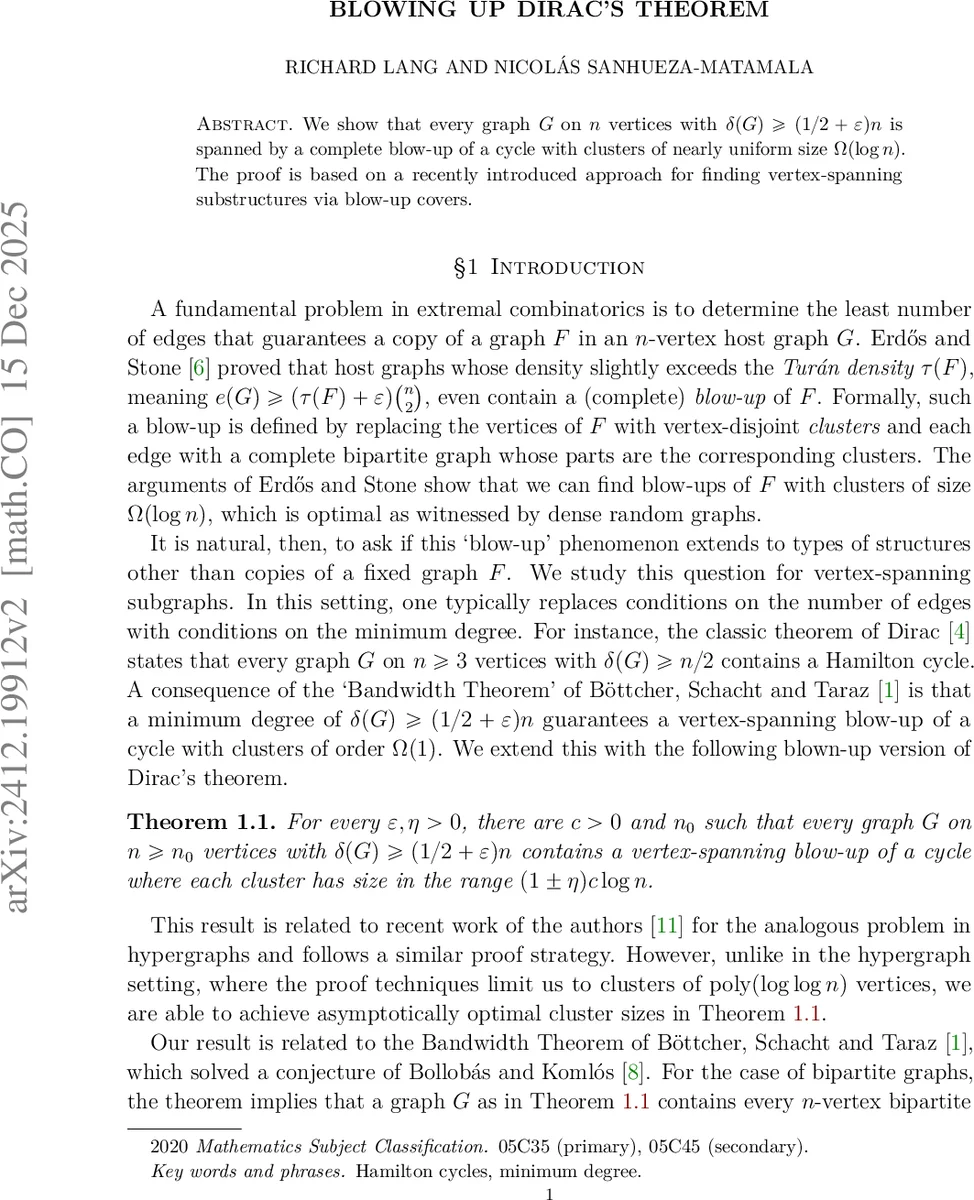
We show that every graph $G$ on $n$ vertices with $δ(G) \geq (1/2+\varepsilon)n$ is spanned by a complete blow-up of a cycle with clusters of nearly uniform size $Ω(\log n)$. The proof is based on a recently introduced approach for finding vertex-spanning substructures via blow-up covers.
💡 Research Summary
The paper “Blowing up Dirac’s theorem” establishes that any graph (G) on (n) vertices with minimum degree (\delta(G)\ge (\frac12+\varepsilon)n) contains a spanning subgraph that is a complete blow‑up of a cycle whose clusters have size (\Theta(\log n)). This result can be viewed as a blow‑up version of Dirac’s classical theorem (which guarantees a Hamilton cycle under the same degree condition) and improves upon earlier blow‑up results that required clusters of linear or poly‑logarithmic size.
The authors’ approach hinges on two auxiliary lemmas. Lemma 2.1 (Simple blow‑up cover) shows that the vertex set of a Dirac‑type graph can be partitioned into vertex‑disjoint quasi‑(\eta)-balanced blow‑ups (R_i(V_i)). Each reduced graph (R_i) inherits a minimum‑degree condition (\delta(R_i)\ge (\frac12+\varepsilon/4)|R_i|) and has only one exceptional singleton cluster; all other clusters have size ((1\pm\eta)m) with (m = c\log n). Lemma 2.2 (Connecting blow‑ups) provides a method to link two such blow‑ups: given a partition (U,V,W) of the vertex set with (|U|=|V|=m), one can find subsets (U_1\subseteq U), (V_1\subseteq V) and a set (W_1) of size (m) such that the complete bipartite graphs (K_{U_1,W_1}) and (K_{V_1,W_1}) are present in (G). This creates a “bridge” between the two blow‑ups.
The proof of the main theorem proceeds as follows. First, Lemma 2.1 is applied to obtain a family of blow‑ups whose reduced graphs each contain a Hamilton cycle (by Dirac’s theorem). The exceptional singleton clusters are merged into neighboring clusters, preserving the quasi‑balanced property. Next, Lemma 2.2 is used iteratively to connect the cycles (C_i) of the reduced graphs (R_i) into a single long cycle. For each pair of consecutive cycles, suitable subsets (U_i, V_{i+1}) are chosen from clusters that are consecutive on the respective cycles, and a common set (W_i) is found to realize the two required complete bipartite graphs. Care is taken to keep the number of vertices taken from any cluster small (at most (2\eta m)), ensuring that after all connections the family of clusters remains balanced.
After all connections are made, the resulting structure is a spanning blow‑up of a cycle where the “internal” clusters have size roughly (c_1\log n) and the “connecting” clusters have size (c_2\log n). Finally, each internal cluster is subdivided into (\ell) subclusters of almost equal size, where (\ell) is chosen so that the final cluster size lies in the interval ((1\pm5\eta)c\log n). This yields a spanning blow‑up of a cycle with uniformly logarithmic clusters, completing the proof of Theorem 1.1.
The paper also includes a toolbox of auxiliary results. Lemma 3.1 (Degree inheritance) shows that sampling a random (s)-vertex subset of a Dirac‑type graph preserves the minimum‑degree condition up to a small additive error. Lemma 3.2 (Graph blow‑ups) is a refined version of Erdős’ result, based on work of Nikiforov, guaranteeing the existence of blow‑ups with logarithmic cluster size in dense graphs. Lemmas 4.1 and 4.2 provide, respectively, an almost‑cover of the vertex set by balanced blow‑ups and a method to cover the remaining vertices with rooted blow‑ups while keeping the balance.
In the concluding discussion the authors propose Conjecture 1.2, which predicts that the same logarithmic‑cluster blow‑up phenomenon holds for the (r)-th power of a cycle, with the natural minimum‑degree threshold (1-\frac{1}{r+1}). This would extend the result of Komlós, Sárközy and Szemerédi on powers of Hamilton cycles. The authors note that achieving sub‑logarithmic cluster sizes would require new ideas, and they suggest exploring more complex spanning structures such as powers of cycles or other dense configurations.
Overall, the paper introduces a novel “blow‑up cover” technique that avoids the heavy machinery of the regularity lemma while still achieving asymptotically optimal cluster sizes. It bridges extremal graph theory (minimum‑degree conditions) with probabilistic methods (subsampling, Erdős–Stone type arguments) and provides a fresh perspective on constructing vertex‑spanning substructures in dense graphs.
Comments & Academic Discussion
Loading comments...
Leave a Comment