Groupoid Graded Semisimple Rings
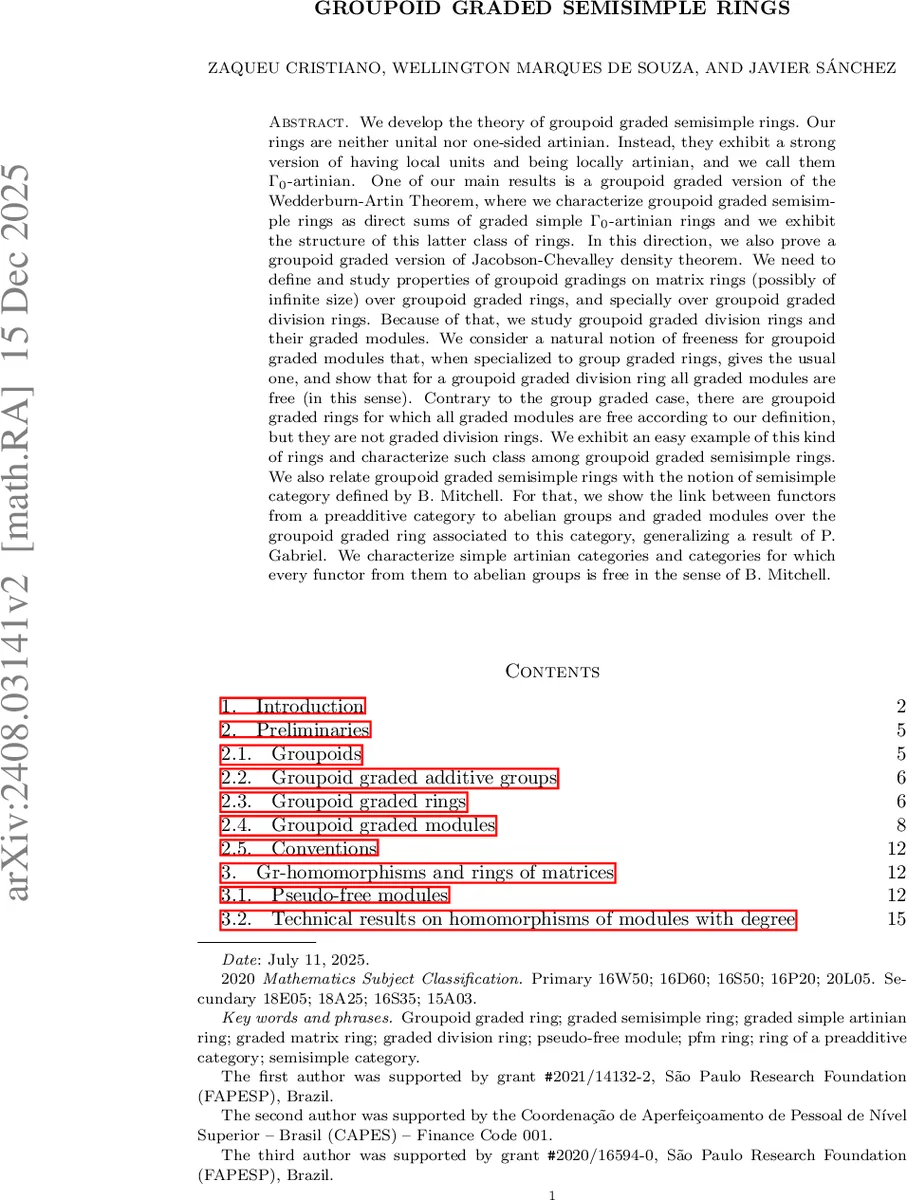
We develop the theory of groupoid graded semisimple rings. Our rings are neither unital nor one-sided artinian. Instead, they exhibit a strong version of having local units and being locally artinian, and we call them $Γ_0$-artinian. One of our main results is a groupoid graded version of the Wedderburn-Artin Theorem, where we characterize groupoid graded semisimple rings as direct sums of graded simple $Γ_0$-artinian rings and we exhibit the structure of this latter class of rings. In this direction, we also prove a groupoid graded version of Jacobson-Chevalley density theorem. We need to define and study properties of groupoid gradings on matrix rings (possibly of infinite size) over groupoid graded rings, and specially over groupoid graded division rings. Because of that, we study groupoid graded division rings and their graded modules. We consider a natural notion of freeness for groupoid graded modules that, when specialized to group graded rings, gives the usual one, and show that for a groupoid graded division ring all graded modules are free (in this sense). Contrary to the group graded case, there are groupoid graded rings for which all graded modules are free according to our definition, but they are not graded division rings. We exhibit an easy example of this kind of rings and characterize such class among groupoid graded semisimple rings. We also relate groupoid graded semisimple rings with the notion of semisimple category defined by B. Mitchell. For that, we show the link between functors from a preadditive category to abelian groups and graded modules over the groupoid graded ring associated to this category, generalizing a result of P. Gabriel. We characterize simple artinian categories and categories for which every functor from them to abelian groups is free in the sense of B. Mitchell.
💡 Research Summary
This paper systematically develops the theory of semisimple rings graded by a groupoid, moving beyond the classical setting of group-graded or unital Artinian rings. The authors consider object-unital rings (having local units at each object/idempotent) that satisfy a localized Artinian condition termed “Γ0-artinian,” which is crucial for handling groupoids with potentially infinite object sets.
The core technical work begins by addressing foundational challenges. Since traditional free modules are ill-defined in the groupoid-graded context, the authors introduce the concept of “pseudo-free modules,” which coincides with ordinary free modules in the group-graded case. They then develop a comprehensive theory for inducing groupoid gradings on matrix rings (including infinite matrices) over a graded ring, which is more complex than the group-graded analogue and requires careful selection of sequences of subsets of the groupoid.
One of the central achievements is a complete groupoid-graded generalization of the Wedderburn-Artin Theorem. The authors prove that a groupoid-graded semisimple ring is isomorphic to a direct sum of gr-simple Γ0-artinian rings. They further characterize these gr-simple components as graded matrix rings (of possibly infinite size) over graded prime division rings. This structural decomposition is supported by a graded version of the Jacobson-Chevalley density theorem, providing an alternative proof.
A surprising discovery is that, contrary to the group-graded or unital ring case, there exist groupoid-graded rings over which all graded modules are pseudo-free, yet which are not graded division rings. The authors provide an explicit example and then fully characterize such “pseudo-free module (pfm) rings” within the class of gr-semisimple rings.
The final major contribution establishes a profound connection with category theory. For a small preadditive category, its associated ring has a natural groupoid grading. The authors generalize a result of Gabriel, showing that additive functors from such a category to abelian groups correspond precisely to graded modules over this graded ring. Leveraging their algebraic structure theorems, they obtain novel characterizations of semisimple categories, simple Artinian categories, and categories for which every functor to abelian groups is free in the sense of B. Mitchell.
In summary, this work provides a unified and powerful framework for studying semisimplicity in the context of groupoid gradings, resolving inherent technical difficulties, establishing fundamental structure theorems, and revealing significant applications to the structure of preadditive categories.
Comments & Academic Discussion
Loading comments...
Leave a Comment