Gyrokinetic limit of the 2D Hartree equation in a large magnetic field
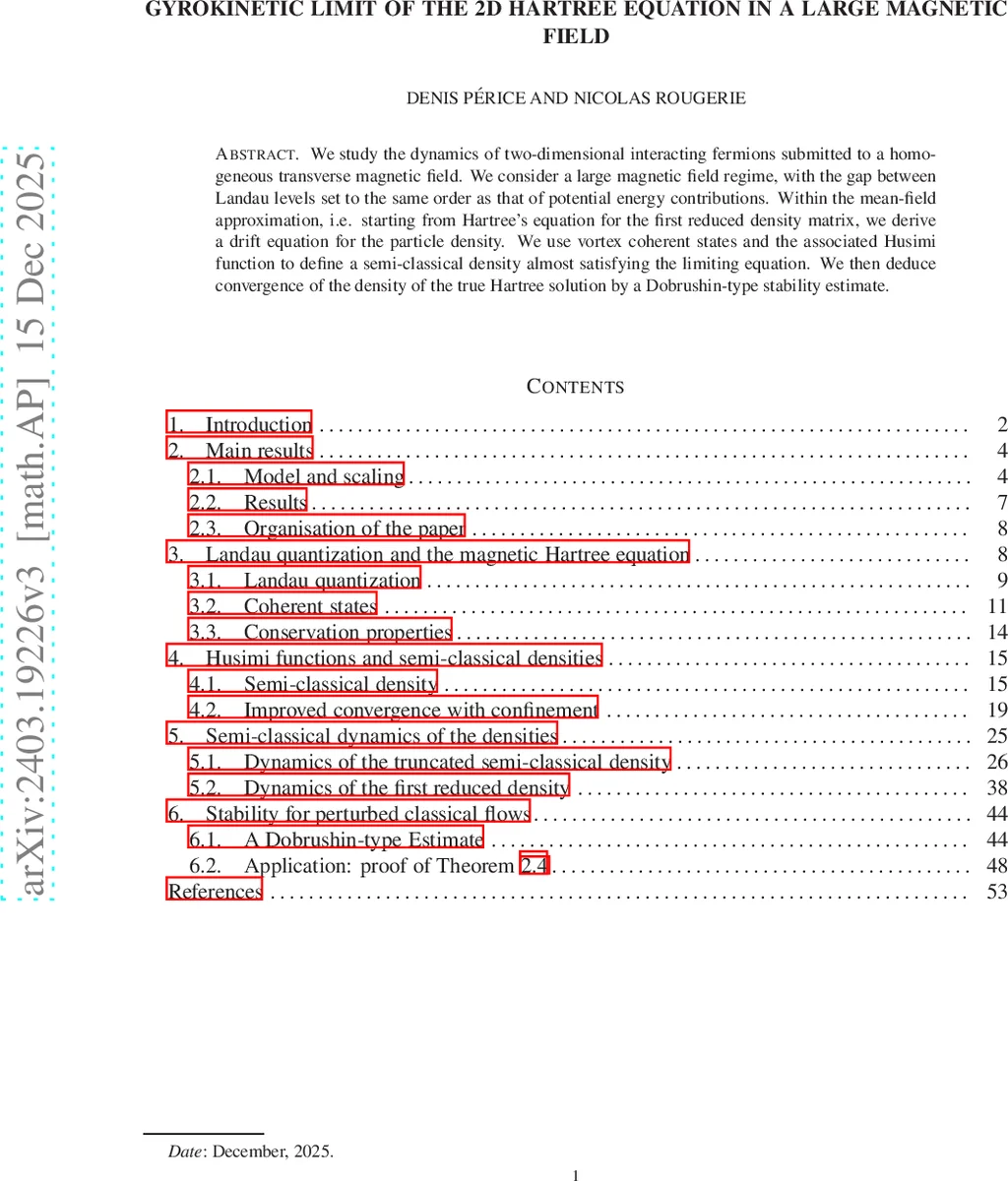
We study the dynamics of two-dimensional interacting fermions submitted to a homogeneous transverse magnetic field. We consider a large magnetic field regime, with the gap between Landau levels set to the same order as that of potential energy contributions. Within the mean-field approximation, i.e. starting from Hartree’s equation for the first reduced density matrix, we derive a drift equation for the particle density. We use vortex coherent states and the associated Husimi function to define a semi-classical density almost satisfying the limiting equation. We then deduce convergence of the density of the true Hartree solution by a Dobrushin-type stability estimate.
💡 Research Summary
This paper rigorously derives a classical drift equation for the particle density from the quantum mean-field dynamics of two-dimensional interacting fermions in a very strong, homogeneous magnetic field. The study focuses on a scaling regime where the magnetic field strength (B) is proportional to the number of particles (N), causing the Landau level spacing (ħB/m) to be of the same order of magnitude as the potential energy contributions. This is the relevant regime for phenomena like the quantum Hall effect.
The starting point is the Hartree equation, which is the mean-field approximation of the many-body Schrödinger equation. Under an appropriate scaling where time is measured in units of B, the authors analyze the time evolution of the one-body density matrix. The core challenge is that the conventional semi-classical phase space of position and momentum (x, p) is inadequate in this strong-field limit. Instead, the correct classical phase space is parametrized by the guiding center coordinate (z ∈ ℝ²) of the cyclotron orbits and the discrete Landau level index (n ∈ ℕ).
The key technical tool is the use of “vortex coherent states.” These are quantum states, denoted φ_{z,n}, that are precisely localized in the n-th Landau level and approximately localized around the guiding center position z. Using these states, the authors define a Husimi function (a semi-classical distribution) for the quantum density matrix. By summing this Husimi function over Landau levels up to a large cutoff L, they construct a “truncated semi-classical density” that accurately approximates the true quantum particle density.
The first main result (Theorem 2.3) shows that this truncated semi-classical density, and by close proximity the density of the true Hartree solution, approximately satisfies (in a weak sense) the target drift equation: ∂_t ρ + ∇^⊥(V_ext + w ∗ ρ) · ∇ρ = 0. Here, ∇^⊥ denotes the perpendicular gradient, and the equation describes the drift of guiding centers driven by the effective force from external and mean-field potentials. The error in this approximation is controlled by a positive power of the magnetic length ℓ_B ∝ 1/√B.
The second and culminating result (Theorem 2.4) establishes the full convergence of the quantum density to the solution of the classical drift equation. This is achieved by proving and applying a Dobrushin-type stability estimate for the drift equation in the Monge-Kantorovich-Wasserstein (W_1) distance. This estimate bounds the distance between two solutions by the initial distance multiplied by a time-dependent factor. Combining this stability with the approximate-solution result from Theorem 2.3 allows the authors to bound the distance between the Hartree density and the classical solution. The convergence rate is given as a power of ℓ_B, under assumptions of high regularity (C^{9,∞}) for the external and interaction potentials (V_ext, w), and bounded initial kinetic energy and spatial moments for the density matrix.
The work provides a mathematically rigorous bridge between quantum dynamics in strong magnetic fields and classical gyrokinetic transport, introducing a novel phase space and coherent state technique suited to the magnetic Thomas-Fermi regime. The authors note that the high regularity requirements on potentials and the control of long-time asymptotics remain challenges for future research.
Comments & Academic Discussion
Loading comments...
Leave a Comment