The scaling limit of the volume of loop O(n) quadrangulations
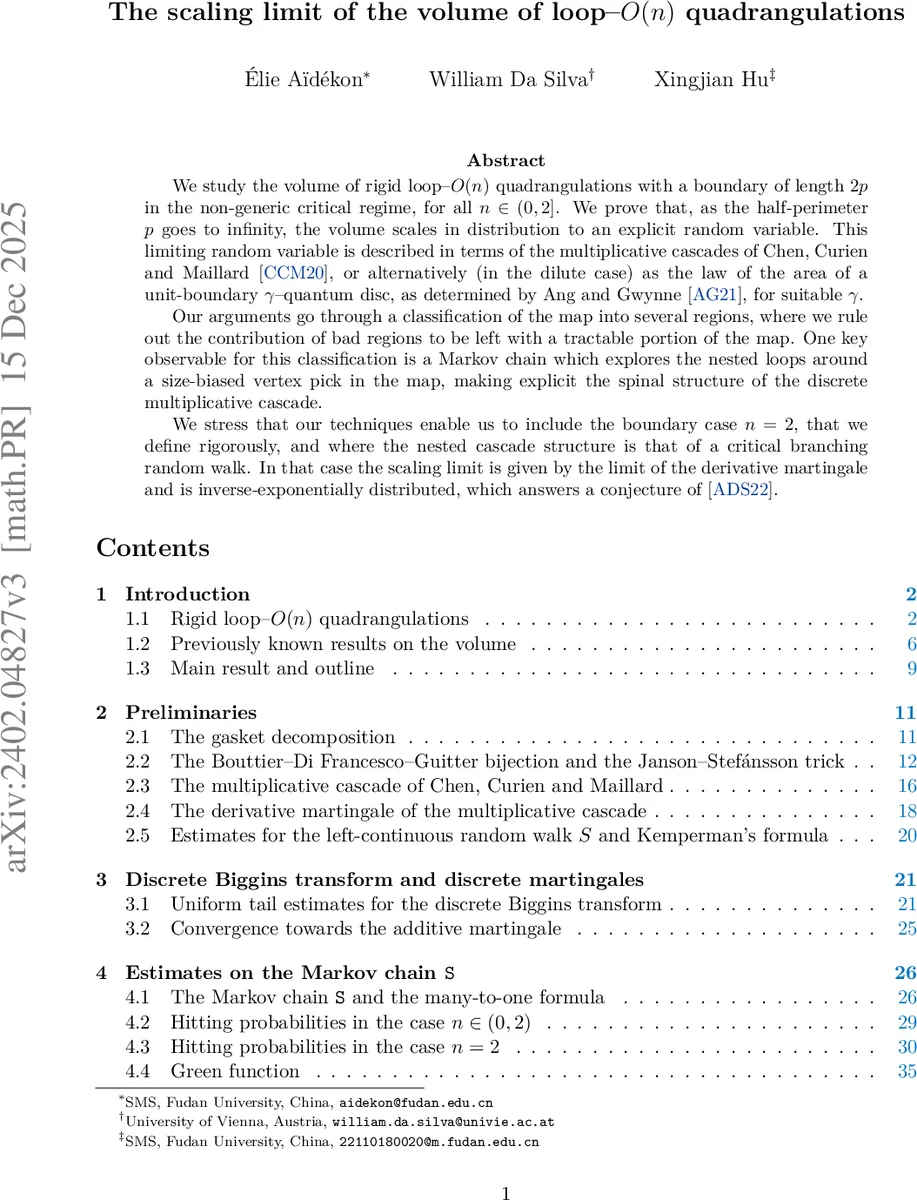
We study the volume of rigid loop-$O(n)$ quadrangulations with a boundary of length $2p$ in the non-generic critical regime. We prove that, as the half-perimeter $p$ goes to infinity, the volume scales in distribution to an explicit random variable. This limiting random variable is described in terms of the multiplicative cascades of Chen, Curien and Maillard arXiv:1702.06916, or alternatively (in the dilute case) as the law of the area of a unit-boundary $γ$-quantum disc, as determined by Ang and Gwynne arXiv:1903.09120, for suitable $γ$. Our arguments go through a classification of the map into several regions, where we rule out the contribution of bad regions to be left with a tractable portion of the map. One key observable for this classification is a Markov chain which explores the nested loops around a size-biased vertex pick in the map, making explicit the spinal structure of the discrete multiplicative cascade. We stress that our techniques enable us to include the boundary case $n=2$, that we define rigorously, and where the nested cascade structure is that of a critical branching random walk. In that case the scaling limit is given by the limit of the derivative martingale and is inverse-exponentially distributed, which answers a conjecture of arXiv:2005.06372v2.
💡 Research Summary
The paper studies the volume (i.e., number of vertices) of rigid loop‑O(n) quadrangulations with a boundary of length 2p in the non‑generic critical regime, for all n∈(0, 2] . The authors prove that, as the half‑perimeter p tends to infinity, the properly rescaled volume converges in distribution to an explicit random variable. This limit is described in two equivalent ways: (i) as the limit of the Malthusian martingale of the multiplicative cascade introduced by Chen, Curien and Maillard (CCM20), and (ii) in the dilute phase (α>3/2) as the law of the area of a unit‑boundary γ‑quantum disc, as identified by Ang and Gwynne (AG21) for a suitable γ.
The model is defined by assigning local weights g or h to internal faces depending on whether they are empty or crossed by a loop, and a global weight n to each loop. The admissible parameters (n; g, h) lie on the critical line given by equations (1.3) for n∈(0, 2) or (1.6) for n=2. On this line the partition function behaves like F_p∼C h^{−p} p^{−α−1/2} with α∈(1, 2) determined by (1.5).
The proof proceeds by a detailed decomposition of the map into “good” and “bad” regions using the gasket decomposition of Borot, Bouttier and Guitter. A key observable is a Markov chain S that explores the nested loops around a size‑biased vertex. This chain encodes the spinal structure of the discrete multiplicative cascade (χ(p)(u))_{u∈U} indexed by the Ulam tree. By establishing many‑to‑one formulas, hitting probabilities, and Green function estimates for S, the authors show that the contribution of bad regions to the total volume is negligible (of order p^{−ε}).
For the good region they obtain first‑ and second‑moment bounds that allow them to compare the volume V(p) with the additive martingale W_ℓ:=∑{|u|=ℓ} Z_α(u)^{θ_α}, where Z_α(u) are the limiting continuous cascade variables and θ_α= min(2, 2α−1). The discrete cascade χ(p) is proved to converge after scaling to the continuous cascade Z_α, and consequently p^{−θ_α} V(p) converges to the limit W∞:=lim_{ℓ→∞}W_ℓ.
The law of W_∞ is completely explicit. In the dilute case (α>3/2) its Laplace transform is ψ_{α,θ_α}((α−3/2)q), which corresponds to an inverse‑Gamma distribution with parameters (α−1/2, α−3/2). In the dense case (α<3/2) the Laplace transform is ψ_{α,θ_α}(Γ(α+1/2)Γ(3/2−α) q), giving a different, non‑standard distribution. For the boundary case n=2 the cascade reduces to a critical branching random walk; the derivative martingale converges to an inverse‑exponential law, confirming the conjecture of ADS22.
The paper also provides detailed asymptotics for the partition function and the mean volume in the n=2 case (Appendix B), showing logarithmic corrections when g<h/2. Appendix A establishes the existence of a well‑defined non‑generic critical O(2) model by taking limits of the (1.3) equations. Appendix C gives the tail distribution of the Markov chain S for n=2, confirming that bad regions are essentially absent.
Overall, the work delivers a rigorous probabilistic description of the volume scaling limit for loop‑O(n) quadrangulations in the most intricate non‑generic critical regime, linking discrete random map models to continuous objects from Liouville quantum gravity. The techniques—particularly the Markov chain classification and the use of the discrete Biggins transform—are likely to be applicable to a broader class of random planar maps and to further deepen the connection between combinatorial map models and quantum geometry.
Comments & Academic Discussion
Loading comments...
Leave a Comment