📝 Original Info
- Title: Towards Unified Co-Speech Gesture Generation via Hierarchical Implicit Periodicity Learning
- ArXiv ID: 2512.13131
- Date: 2025-12-15
- Authors: Researchers from original ArXiv paper
📝 Abstract
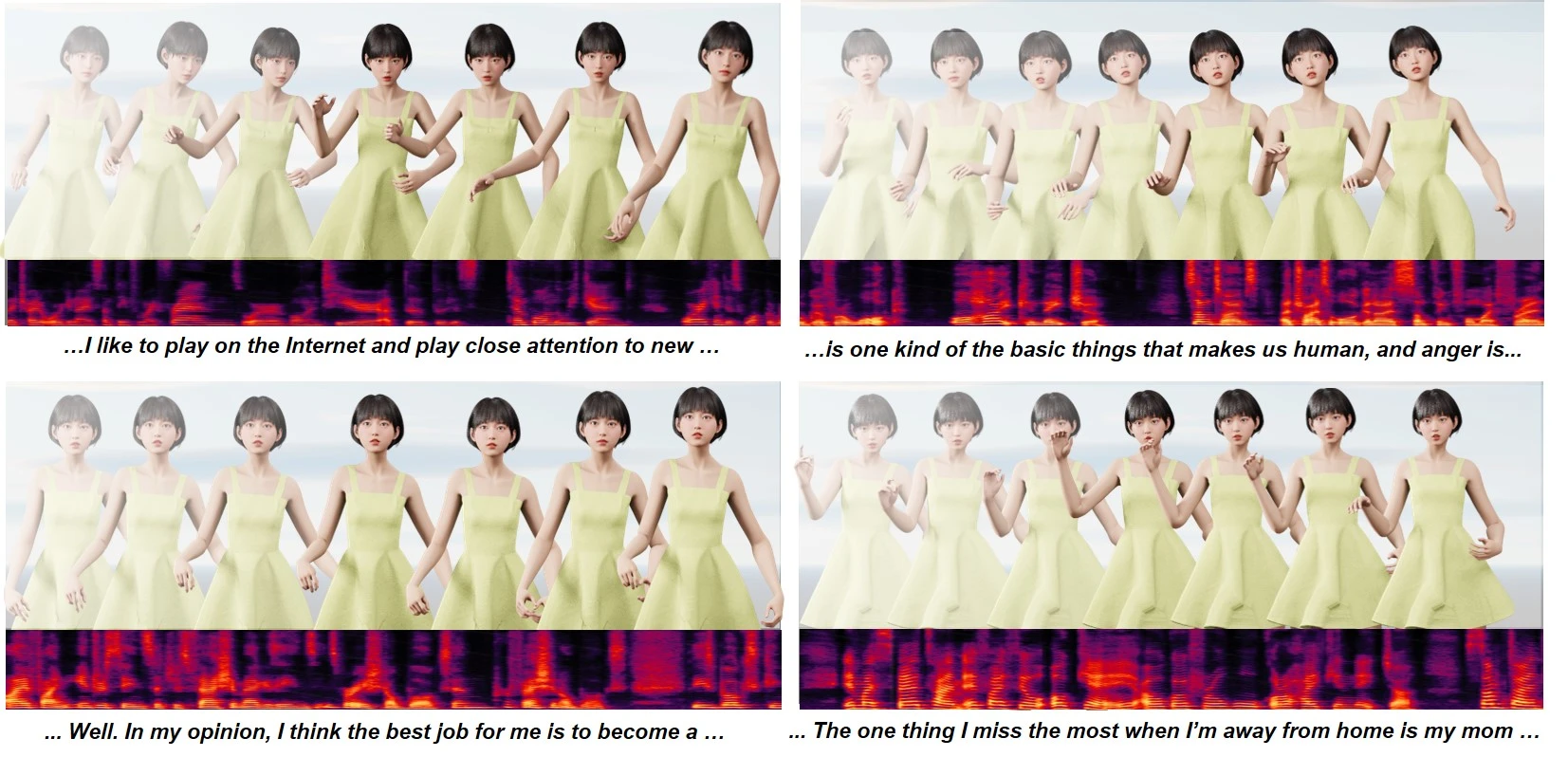
Generating 3D-based body movements from speech shows great potential in extensive downstream applications, while it still suffers challenges in imitating realistic human movements. Predominant research efforts focus on end-to-end generation schemes to generate co-speech gestures, spanning GANs, VQ-VAE, and recent diffusion models. As an ill-posed problem, in this paper, we argue that these prevailing learning schemes fail to model crucial inter-and intra-correlations across different motion units, i.e.head, body, and hands, thus leading to unnatural movements and poor coordination. To delve into these intrinsic correlations, we propose a unified Hierarchical Implicit Periodicity (HIP) learning approach for audio-inspired 3D gesture generation. Different from predominant research, our approach models this multi-modal implicit relationship by two explicit technique insights: i) To disentangle the complicated gesture movements, we first explore the gesture motion phase manifolds with periodic autoencoders to imitate human natures from realistic distributions while incorporating non-period ones from current latent states for instance-level diversities. ii) To model the hierarchical relationship of face motions, body gestures, and hand movements, driving the animation with cascaded guidance during learning. We exhibit our proposed approach on 3D avatars and extensive experiments show our method outperforms the state-of-the-art co-speech gesture generation methods by both quantitative and qualitative evaluations. Code and models will be publicly available.
💡 Deep Analysis
Deep Dive into Towards Unified Co-Speech Gesture Generation via Hierarchical Implicit Periodicity Learning.
Generating 3D-based body movements from speech shows great potential in extensive downstream applications, while it still suffers challenges in imitating realistic human movements. Predominant research efforts focus on end-to-end generation schemes to generate co-speech gestures, spanning GANs, VQ-VAE, and recent diffusion models. As an ill-posed problem, in this paper, we argue that these prevailing learning schemes fail to model crucial inter-and intra-correlations across different motion units, i.e.head, body, and hands, thus leading to unnatural movements and poor coordination. To delve into these intrinsic correlations, we propose a unified Hierarchical Implicit Periodicity (HIP) learning approach for audio-inspired 3D gesture generation. Different from predominant research, our approach models this multi-modal implicit relationship by two explicit technique insights: i) To disentangle the complicated gesture movements, we first explore the gesture motion phase manifolds with peri
📄 Full Content
1
Towards Unified Co-Speech Gesture Generation via
Hierarchical Implicit Periodicity Learning
Xin Guo, Yifan Zhao, Member, IEEE, Jia Li, Senior Member, IEEE
Abstract—Generating 3D-based body movements from speech
shows great potential in extensive downstream applications, while
it still suffers challenges in imitating realistic human movements.
Predominant research efforts focus on end-to-end generation
schemes to generate co-speech gestures, spanning GANs, VQ-
VAE, and recent diffusion models. As an ill-posed problem, in
this paper, we argue that these prevailing learning schemes fail
to model crucial inter- and intra-correlations across different
motion units, i.e.head, body, and hands, thus leading to unnatural
movements and poor coordination. To delve into these intrinsic
correlations, we propose a unified Hierarchical Implicit Periodicity
(HIP) learning approach for audio-inspired 3D gesture generation.
Different from predominant research, our approach models
this multi-modal implicit relationship by two explicit technique
insights: i) To disentangle the complicated gesture movements,
we first explore the gesture motion phase manifolds with periodic
autoencoders to imitate human natures from realistic distributions
while incorporating non-period ones from current latent states for
instance-level diversities. ii) To model the hierarchical relationship
of face motions, body gestures, and hand movements, driving the
animation with cascaded guidance during learning. We exhibit
our proposed approach on 3D avatars and extensive experiments
show our method outperforms the state-of-the-art co-speech
gesture generation methods by both quantitative and qualitative
evaluations. Code and models will be publicly available.
Index Terms—3D-based body movements, Hierarchical implicit
periodicity, Phase manifolds, Multi-modal implicit relationship
I. INTRODUCTION
When a person attempts to articulate his thoughts, two
distinct modalities are employed: speech and physical gestures.
Verbal communication serves as the principal means for
expressing one’s ideas, while gestures offer a complementary
way to concretize content and emotional expressions, thereby
enhancing the comprehensibility of the conveyed message
to others. For instance, during greetings or interpersonal
interactions, people employ a repertoire of gestures alongside
their verbal communication, with these gestures indirectly
revealing their emotional disposition towards the interlocutor.
Facial expressions and body gestures also exhibit a degree of
coordination, such as the discernible divergence in gestures
when individuals experience varying degrees of happiness.
Consequently, the exploration of speech-driven human body
gesture generation has emerged as a promising research avenue.
Co-speech gesture generation, an ill-posed one-to-many
mapping problem, requires modeling both intra-unit (within
face, body, hands) and inter-unit correlations for coherent
X. Guo, Y. Zhao, and J. Li are with the State Key Laboratory of Virtual
Reality Technology and Systems, School of Computer Science and Engineering
&Qingdao Research Institute, Beihang University, Beijing, 100191, China.
Y.
Zhao
and
J.
Li
are
the
corresponding
authors.
(E-mail:
zhaoyf@buaa.edu.cn, jiali@buaa.edu.cn).
gesture production. The methods include: retrieval-based [1],
[2], [3], [4] which decomposes gestures into action units,
extracts conditional features, and retrieves similar motions from
databases, achieving high controllability but limited to database
content. End-to-end models [5], [6], [7], [8] use architectures
like RNNs and Transformers to directly map audio to gestures,
supporting complex cross-modal mappings and generating
diverse gestures. Two-stage methods [9], [10] map audio to
intermediate latent codes before decoding them into motion
sequences. Although they enhance gesture diversity, both end-
to-end and two-stage approaches often treat body movements
as a single aggregated signal, overlooking structured inter
and intra-correlations, leading to unstable and semantically
misaligned gesture generation. Hierarchical methods [10],
[11], [12], [13], [14] attempt to model different body parts
separately. However, they still lack a clear correlation hierarchy:
Habibie [11] and TALKSHOW [10] independently generate
facial and body motions without cross-part coordination;
EMAGE [12] predicts masked body parts simultaneously to
allow mutual influence but lacks a dependency order; DiffSHEG
[13] first generates facial motions and then predicts the entire
body as a single signal, ignoring structured relationships within
the body itself; and HA2G [14] generates body parts in a
stepwise manner but omits facial information entirely.
While existing methods have advanced co-speech gesture
generation, they often neglect the dependencies among different
body parts. Human motions follow certain morphological
and physical rules, and the movement of one human part
often influences the motion of other parts.
…(Full text truncated)…
📸 Image Gallery
Reference
This content is AI-processed based on ArXiv data.