Evolving the Loeb Scale
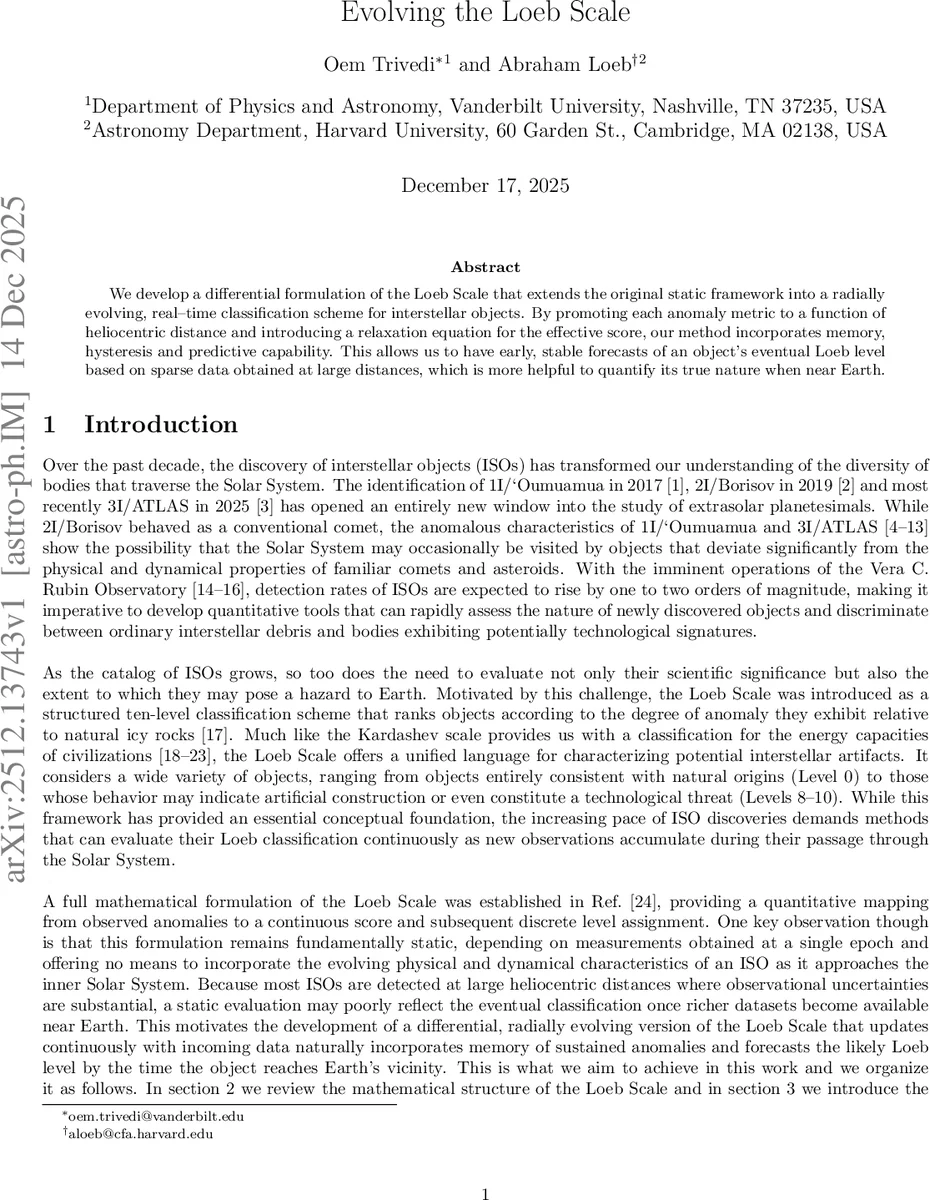
We develop a differential formulation of the Loeb Scale that extends the original static framework into a radially evolving, real time classification scheme for interstellar objects. By promoting each anomaly metric to a function of heliocentric distance and introducing a relaxation equation for the effective score, our method incorporates memory, hysteresis and predictive capability. This allows us to have early, stable forecasts of an object’s eventual Loeb level based on sparse data obtained at large distances, which is more helpful to quantify its true nature when near Earth.
💡 Research Summary
The paper “Evolving the Loeb Scale” presents a substantial extension of the original Loeb Scale—a ten‑level classification system for interstellar objects (ISOs) that gauges how anomalous an object is relative to natural icy bodies—by turning it from a static, single‑epoch metric into a continuous, distance‑dependent, real‑time scoring framework.
Motivation and Background
The authors begin by reviewing the discovery of ISOs such as 1I/‘Oumuamua, 2I/Borisov, and the newly reported 3I/ATLAS, emphasizing that many of these bodies display properties that deviate markedly from typical comets or asteroids. With upcoming facilities like the Vera C. Rubin Observatory expected to increase ISO detection rates by one to two orders of magnitude, a rapid, quantitative tool is needed to distinguish ordinary interstellar debris from objects that might bear technological signatures or pose a hazard. The original Loeb Scale, introduced in earlier work (Ref.
Comments & Academic Discussion
Loading comments...
Leave a Comment