Enhancing GHSL Population Grids Using Hexagon KH-9 Built-up Data: Refining 1970s Rural and Peri-Urban Distributions in Istanbul
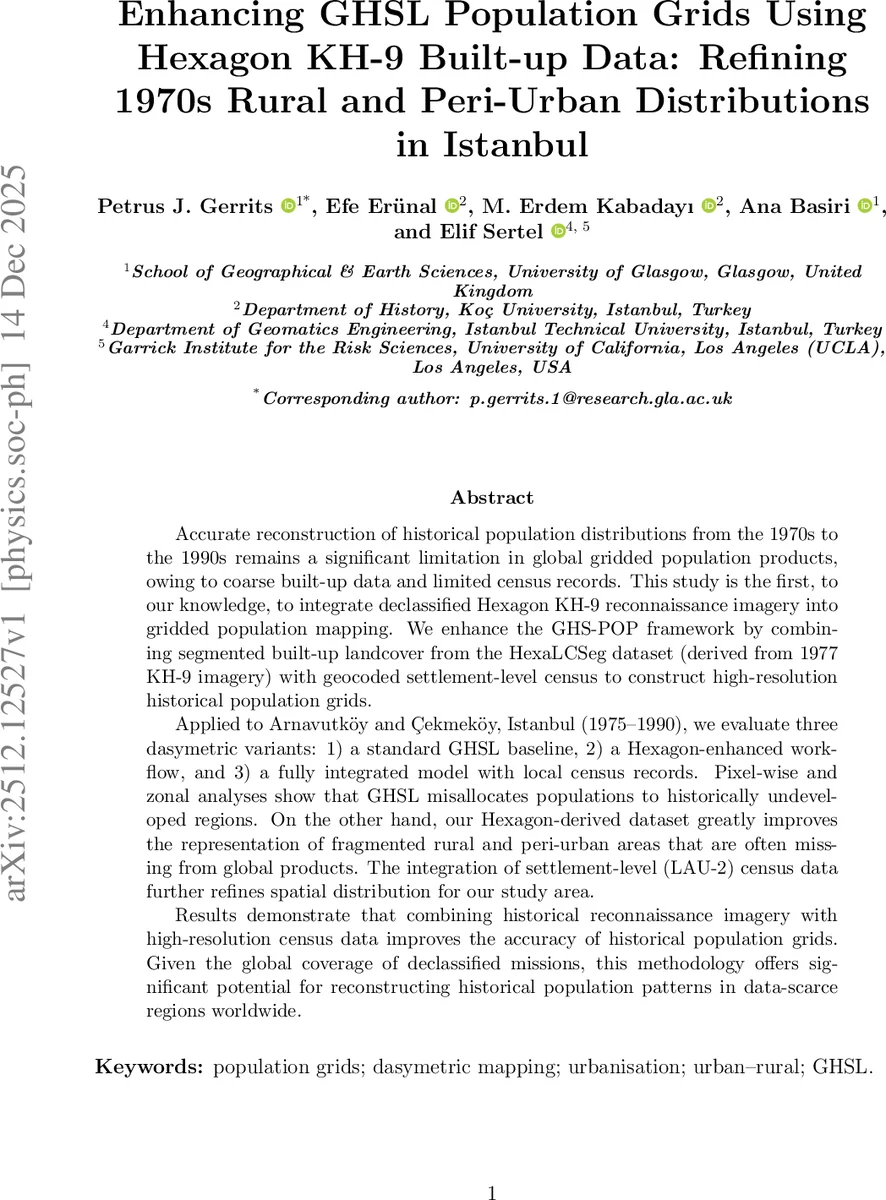
Accurate reconstruction of historical population distributions from the 1970s to the 1990s remains a significant limitation in global gridded population products due to coarse built-up data and limited census records. This study is, to our knowledge, the first to integrate declassified Hexagon KH-9 reconnaissance imagery into gridded population mapping. We enhance the GHS-POP framework by combining segmented built-up land cover from the HexaLCSeg dataset, derived from 1977 KH-9 imagery, with geocoded settlement-level census data to construct high-resolution historical population grids. Applied to Arnavutkoy and Cekmekoy in Istanbul for the period 1975-1990, we evaluate three dasymetric approaches, including a standard GHSL baseline, a Hexagon-enhanced workflow, and a fully integrated model incorporating local census records. Pixel-wise and zonal analyses show that GHSL misallocates populations to historically undeveloped regions, while the Hexagon-derived dataset substantially improves the representation of fragmented rural and peri-urban areas often missing from global products. Incorporating settlement-level LAU-2 census data further refines spatial population distribution. The results demonstrate that combining historical reconnaissance imagery with high-resolution census data improves the accuracy of historical population grids, and given the global coverage of declassified missions, this methodology offers significant potential for reconstructing historical population patterns in data-scarce regions worldwide.
💡 Research Summary
Reconstructing accurate historical population distributions from the 1970s to the 1990s presents a significant challenge in geospatial science due to the scarcity of high-resolution built-up data and fragmented census records. Existing global products, such as the Global Human Settlement Layer (GHSL), often suffer from population misallocation, where inhabitants are erroneously assigned to undeveloped or non-residential areas because of coarse land-cover datasets. This research introduces a groundbreaking methodology to overcome these limitations by utilizing declassified KH-9 Hexagon reconnaissance imagery.
The core innovation of this study lies in the integration of high-resolution built-up land cover data derived from 1977 KH-9 spy satellite imagery. The researchers developed the “HexaLCSeg” dataset, which segments built-up areas with much higher precision than conventional global datasets. By applying this to the Istanbul regions of Arnavutkoy and Cekmekoy for the period between 1975 and 1990, the study evaluated three distinct dasymetric mapping approaches: a standard GHSL baseline, a Hexagon-enhanced workflow, and a fully integrated model that incorporates geocoded settlement-level (LAU-2) census data.
The findings reveal that the standard GHSL approach significantly misallocates populations to historically undeveloped regions. However, the Hexagon-enhanced workflow substantially improves the representation of fragmented rural and peri-urban settlement patterns that are typically missed by lower-resolution global products. The most advanced model, which integrates both the high-resolution imagery and local census records, provided the most refined spatial distribution of the population.
The implications of this research extend far beyond the study area of Istanbul. Since the KH-9 mission provided global coverage, this methodology offers a scalable and powerful framework for reconstructing historical population patterns in data-scarce regions worldwide. By repurposing declassified military-grade imagery for civilian scientific purposes, this study opens new frontiers in historical demography and urban evolution studies, providing a much-needed tool for high-fidelity historical population mapping.
Comments & Academic Discussion
Loading comments...
Leave a Comment